
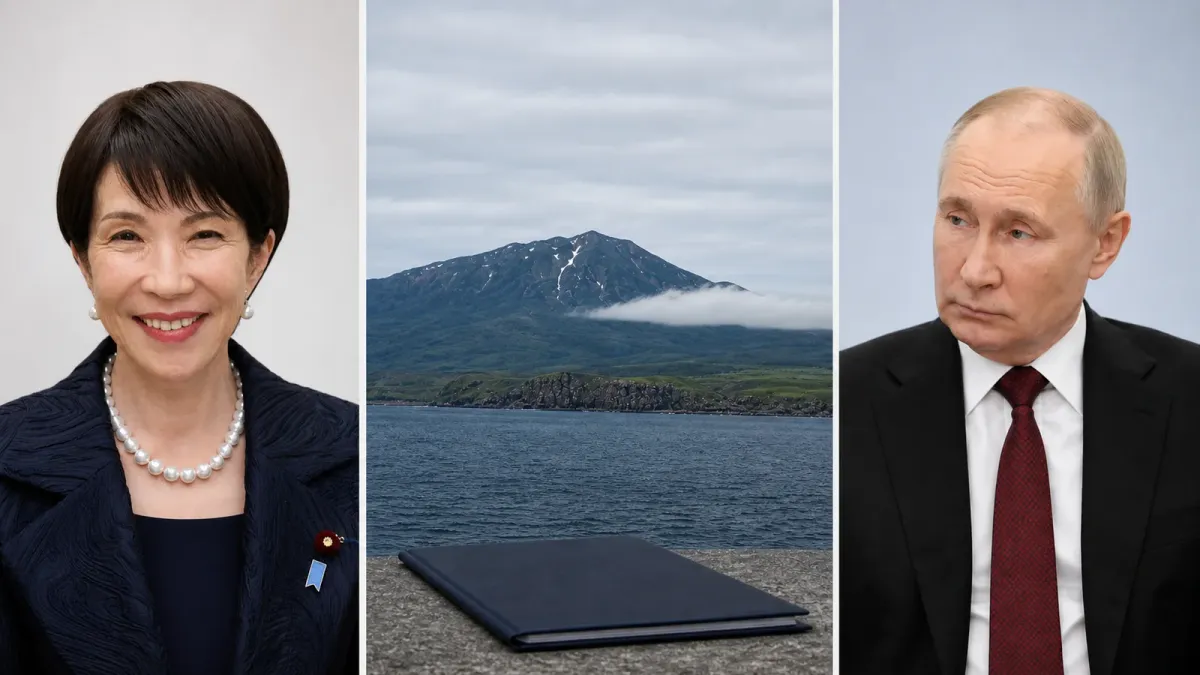
Japan summoned Russia's ambassador after President Vladimir Putin made his first visit to Iturup on August 13, turning a long-running territorial dispute into a fresh diplomatic confrontation. Iturup is one of four Russian-held islands that Japan claims as its Northern Territories.
Japanese Prime Minister Sanae Takaichi called the visit unacceptable and incompatible with Tokyo's position. Russia rejected the protest, saying the southern Kuril Islands are part of the Russian Federation and that its leaders can travel there without consulting another government.
The immediate result is a sharper public standoff, not a change in control. But the visit matters because the island dispute has prevented Japan and Russia from signing a formal peace treaty after World War II, and because both governments are presenting their claims as settled rather than negotiable.
What happened on Iturup
Putin traveled to Iturup, known in Japan as Etorofu, and visited a fish-processing plant, a hospital and a school, according to The Associated Press. He also met Valery Limarenko, governor of Russia's Sakhalin region.
Japan's foreign minister, Toshimitsu Motegi, summoned Russian Ambassador Nikolay Nozdrev in Tokyo and lodged a formal protest. Motegi asked the ambassador to relay Japan's position to Moscow. Takaichi later said the trip had damaged Japanese public sentiment toward Russia.
Russia's embassy in Japan answered that Moscow considers the islands an integral part of Russia. That response made clear that the dispute is not simply about the symbolism of a presidential visit; it is also a clash over which country's sovereignty should be treated as the starting point for any negotiation.
Why four islands still block a peace treaty
The dispute centers on Etorofu, Kunashiri, Shikotan and the Habomai islets. Japan's Ministry of Foreign Affairs says an 1855 treaty placed the boundary between Etorofu and Uruppu, leaving the four southern islands on the Japanese side.
Soviet forces occupied the islands in the final weeks of World War II. Russia has controlled them since, while Japan has continued to claim them. The two countries restored diplomatic relations in 1956, but the unresolved territorial question kept them from concluding a full peace treaty.
The names themselves signal the competing narratives. Russia groups the territory into the southern Kuril Islands. Japan calls the same four islands the Northern Territories and uses Japanese names including Etorofu and Kunashiri.
What the protest changes
A diplomatic summons formally records Japan's objection and raises the political cost of treating the visit as routine. It does not create a new negotiating process or alter who administers Iturup. El País also reported that Tokyo summoned the ambassador and that Putin described the Russian position as supported by postwar documents.
The next meaningful signal would be a formal diplomatic exchange that goes beyond restating sovereignty claims. For now, Putin's first visit and Japan's immediate protest show the gap has widened: each side is using the same trip to reinforce a version of the dispute that leaves little room for compromise.


