
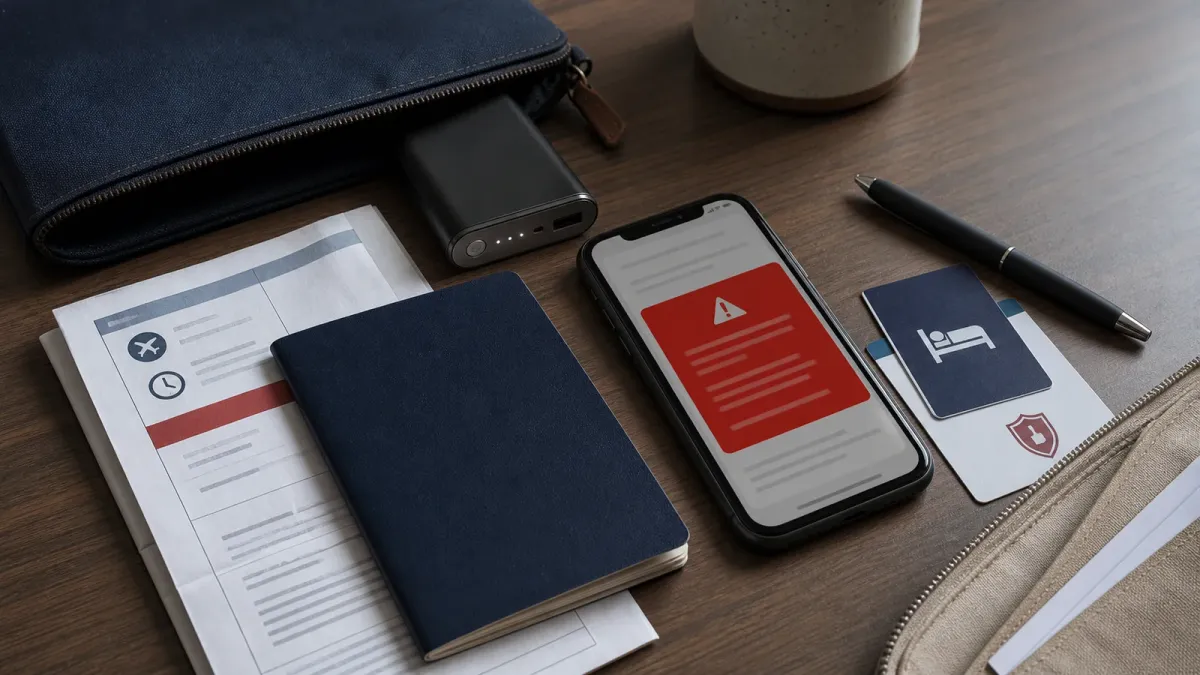
A July 19, 2026 security alert from U.S. Embassy Amman said Jordanian authorities evacuated the international airport and seaport in Aqaba because of a specific and credible threat. For travelers, the useful question is not only whether flights or ferries resume. It is what to do when official alerts change faster than an itinerary.
The broader travel picture was already tense. The U.S. Department of State lists Jordan at Level 3, meaning Americans should reconsider travel, and its July 18 worldwide caution said the security environment in the Middle East remains complex, with possible flight cancellations and airspace closures. The Associated Press and The Guardian also reported new regional escalation involving U.S. and Iranian forces after deadly attacks on U.S. troops in Jordan.
This checklist is general travel information, not a substitute for instructions from local authorities, airlines, tour operators, or the nearest U.S. embassy or consulate. In an immediate danger, follow local emergency directions first.
Do this first
- Do not go to an evacuated airport or port just to check. Wait for your airline, ferry operator, hotel, tour company, local authorities, or embassy alerts to confirm that travel to the site is allowed.
- Confirm your flight through more than one channel. Check the airline app, the airport website if available, and direct messages from the carrier. Regional airspace closures can make third-party flight trackers lag behind official changes.
- Keep your group in one reachable place. Share a hotel lobby, trusted address, or tour meeting point with your travel party and emergency contact. Avoid posting a precise live location publicly.
- Charge phones and save key documents offline. Keep passport photos, visa pages, insurance documents, prescriptions, hotel details, and airline record locators available without mobile data.
- Ask about rebooking before you move. A later confirmed route from a safe location is usually better than trying to reach a closed terminal during an active security response.
Check these details
If you are in Jordan or planning to go there soon, review the State Department's Jordan advisory, the latest embassy alerts, and your carrier's disruption policy before making a new reservation. The advisory also tells travelers to have an emergency departure plan that does not depend on U.S. government assistance, to monitor local media, and to enroll in the Smart Traveler Enrollment Program so the embassy can send security updates.
Travel insurance is worth reading line by line during a security disruption. Look for medical evacuation coverage, trip interruption rules, excluded war or terrorism clauses, and whether the insurer requires you to call before booking a replacement flight or hotel.
Common mistakes
Do not assume a reopened airport means every route is safe or operating. One runway, airspace corridor, border crossing, airline, or ferry route can remain restricted while another resumes. Also avoid relying on a single group chat for critical instructions; keep checking official alerts directly.
When to get help
If you are a U.S. citizen in Jordan and need emergency assistance, contact U.S. Embassy Amman or the State Department's emergency line. If you face immediate physical danger, call local emergency services first, then update your airline, hotel, family, and embassy contact as soon as it is safe to do so.


