
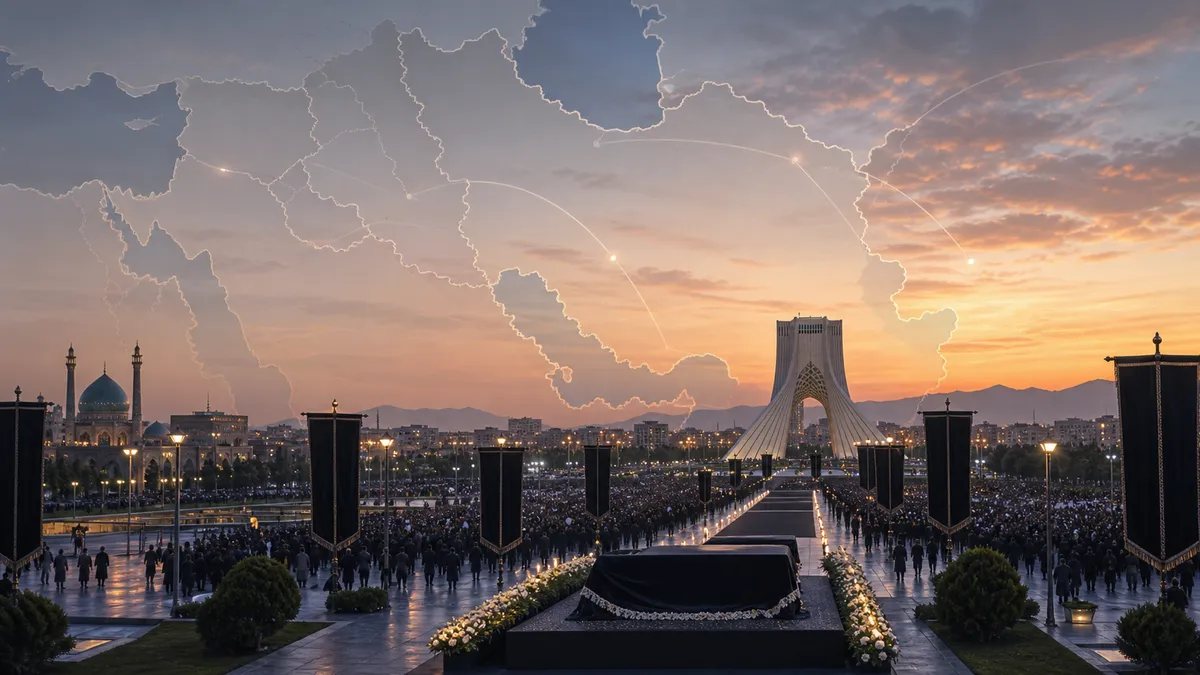
Iran's dayslong funeral for Ayatollah Ali Khamenei has become more than a state mourning event. The July 4-6 ceremonies in Tehran, Qom, Mashhad and Iraq are also a public measure of the Islamic Republic's internal discipline and its leverage in a tense regional standoff.
The Associated Press reported that crowds gathered again in Tehran on Sunday, July 5, after ceremonies began Saturday for the late supreme leader, who was killed in a U.S.-Israel strike on Feb. 28. AP photographs showed major disruption around Tehran, including closed streets, mourning processions and crowds around Imam Khomeini Mosalla Grand Mosque.
The political message is deliberate. The Guardian reported that organizers planned a six-day, multi-city funeral designed to project national resolve after months of war and uncertainty. Reuters Connect, carrying a dispatch from Latin America News Agency, said Iranian officials described requests from more than 30 countries to send high-level delegations to the farewell ceremonies.
Why the funeral matters
For Iran's leaders, the immediate goal is to show continuity. Khamenei ruled for more than three decades, and his death left the country's political, military and religious institutions under close scrutiny. A large, orderly funeral gives officials a chance to display unity at home while signaling that Iran's regional relationships remain intact.
The timing adds another layer. U.S.-Iran diplomacy has been fragile after the recent war and disputes over the Strait of Hormuz, nuclear limits and regional security. A funeral that draws foreign delegations can function as a diplomatic stage, even when formal talks are paused or moving slowly.
That makes the images from Tehran politically useful. They give Iran's authorities a way to frame the moment as national resilience, while giving foreign governments another signal to read before deciding how quickly to restart talks or harden their positions.
It is also a risk. AP reported inflammatory anti-U.S. and anti-Israel rhetoric at the funeral, including a direct threat against President Donald Trump from a performer. That kind of rhetoric may strengthen hard-line domestic messaging, but it can also narrow the space for negotiators who are trying to prevent another cycle of escalation.
What to watch next
The practical questions are whether the ceremonies end with a clearer line on succession, whether Tehran reopens diplomatic channels after the burial schedule concludes, and whether regional governments treat the funeral as a closing chapter or a new starting point.
Official Iranian pages have emphasized foreign condolences and attendance, while Iranian state-linked organizers have focused on crowd size and security. Those signals matter because they show how the government wants the week to be read: not just as mourning, but as proof that Iran can absorb a leadership shock and keep acting as a regional power.
For readers outside the region, the core takeaway is simple: funeral images can look ceremonial, but this one is also political infrastructure. The next move in U.S.-Iran diplomacy may be shaped as much by what Iranian officials believe the crowds demonstrated as by what diplomats say in the next negotiating room.


