
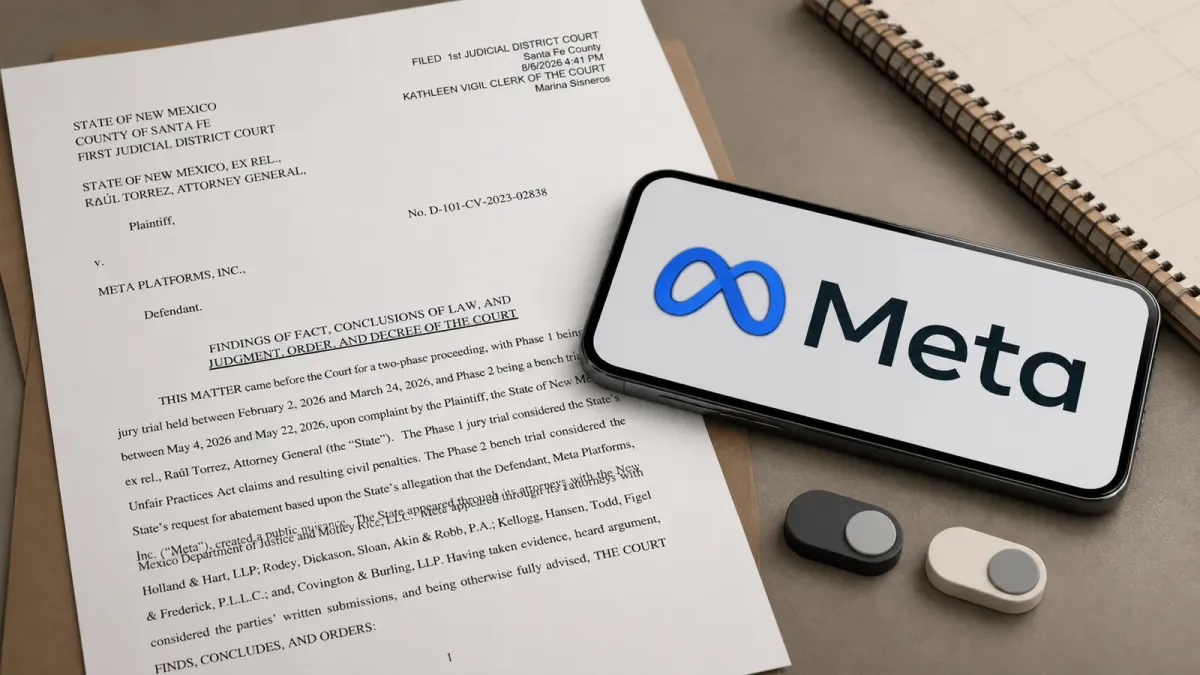
Meta has been ordered to pay $567 million into a New Mexico youth mental-health abatement fund and keep new protections in place for minors on Facebook and Instagram for five years, turning a state child-safety lawsuit into a test of how far courts can push social platforms to change their products.
The order, filed August 6, 2026, comes on top of a $375 million civil penalty from the first phase of the same case. Together, the rulings put Meta's New Mexico liability at $942 million, though the company has said it disagrees with the decision and plans to appeal.
The practical point for families is narrower than the headline number: the judge did not order a full redesign of Meta's algorithms, but did require age-assurance work, default teen protections, reporting duties, limits on some notifications and usage, and a state fund for treatment and prevention programs.
What the court ordered
The First Judicial District Court in Santa Fe ordered Meta to deposit $567 million into an abatement fund. The court allocated $420 million for treatment, $90 million for screening and assessment, $33 million for awareness and prevention, $15 million for referral and coordination, and $9 million for implementation, quality improvement, and evaluation.
Judge Bryan Biedscheid limited the abatement spending period to five years, writing that the shorter period was meant to address current harm and risk of future harm rather than create a 15-year program. Meta must report its compliance to the court and the state twice a year, by June 30 and December 31, during the abatement period.
The account changes parents should watch
The order requires Meta to continue improving age-assurance tools in New Mexico, including efforts to develop a dedicated model for predicting users under 13 within two years. Meta must request proof of age from accounts it predicts belong to users under 13 and mark accounts for deletion if the user does not verify within 30 days, subject to legal-hold obligations.
The court also told Meta to treat users as under 13 or under 18 when its systems believe they fall in those groups but cannot estimate a precise age, unless the user verifies otherwise. Schools or a child-safety organization must have a reporting portal for suspected under-13 accounts, and Meta must make it easier to report underage users.
For teen accounts in New Mexico, Instagram must remain private by default, and Facebook must limit friends by default to users under 18 for accounts belonging to minors. Meta also must prevent unconnected adults from messaging users under 18 and may not recommend minor accounts to adult users.
What the judge did not do
The ruling stops short of ordering direct changes to Meta's core recommendation algorithms. The court said broad restrictions on autoplay, infinite scroll, and algorithmic recommendations would raise First Amendment and Section 230 questions and could affect content presentation in ways better handled through broader regulation.
Instead, the court targeted features it viewed as less tied to content display. Meta must eliminate most push notifications for known or estimated under-18 users from 10 p.m. to 7 a.m. and from 8 a.m. to 3 p.m. during the academic year, with exceptions for messages from connected users and urgent targeted alerts. It also must hide like counts by default for minors unless a parent or guardian approves a change.
The order sets a monthly usage cap of 90 cumulative hours across Facebook and Instagram for accounts belonging to users under 18. It also requires Meta to block romantic or sexualized interactions between New Mexico minors and Meta AI chatbots, and to prevent adults from using chatbots to simulate or discuss sexualized or romantic interactions with a person under 18.
Why this matters beyond New Mexico
New Mexico's attorney general framed the decision as a roadmap for other states, and the case lands while social-media companies face lawsuits from states, school districts, and families over youth mental health, addictive design, and safety controls. The order may encourage more public-nuisance theories against platform design, even if appellate courts later narrow the ruling.
The case also shows the limits of state-by-state platform regulation. The judge noted that some age-verification options are constrained by the federal Children's Online Privacy Protection Act, and that certain industry-wide features may be better addressed by lawmakers or regulators than by one court order against one company.
For parents and schools, the next signal is not just whether Meta pays. It is whether the required reports show working age checks, faster underage-account reporting, stricter adult-minor contact controls, and practical changes that families can actually see inside Facebook and Instagram.
What happens next
Meta's expected appeal could delay or reshape the judgment, especially if the company posts a supersedeas bond and the five-year abatement period is tolled while appeals are pending. The court also anticipated separate orders on how the abatement fund will be administered and how money will be drawn down.
That means the ruling is a major legal development, but not an immediate national rule for every Instagram or Facebook account. For now, it is a New Mexico order with a large price tag, detailed product obligations, and a bigger question for the courts: when does a social platform's design become a public-health problem that a judge can force it to clean up?


