

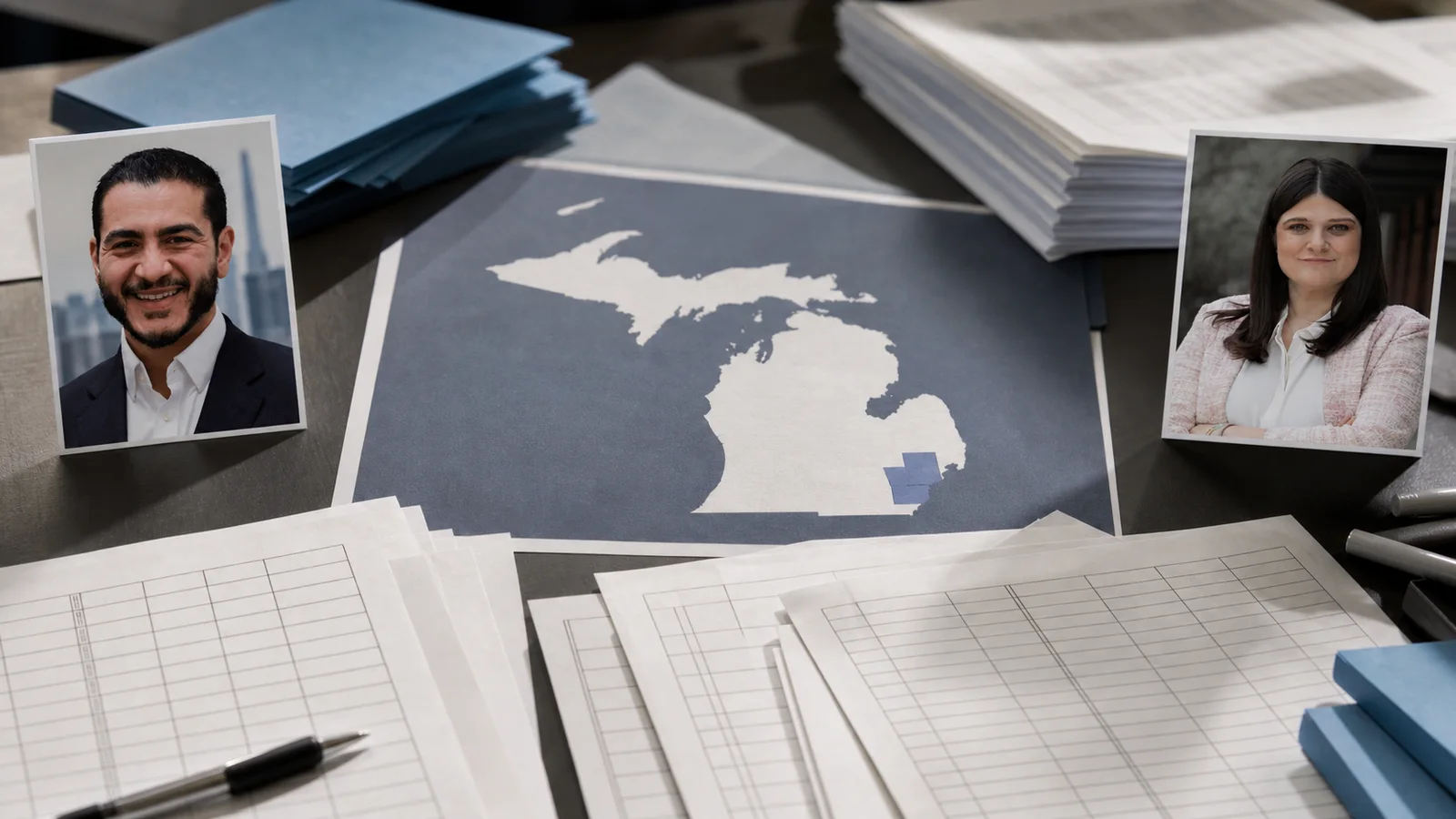
Michigan's Democratic U.S. Senate primary remained too close to call early Wednesday, August 5, with Abdul El-Sayed holding a narrow lead over Rep. Haley Stevens in partial returns and the state's largest county still central to the outcome.
The race matters beyond Michigan because it will decide which Democrat faces Republican Mike Rogers for an open Senate seat in November. It has also become a visible test of whether Democratic primary voters want a progressive insurgent or a more establishment-aligned nominee in one of the party's most important battleground states.
What changed overnight
Bridge Michigan reported that, as of 11 p.m. on August 4, El-Sayed was ahead in partial counts from Washtenaw, Kent, Ingham and Macomb counties, while Stevens was running strongly in early Wayne County returns. The outlet cautioned that much of the state had not yet been fully tallied.
The Associated Press also described the race as tightly contested, with El-Sayed ahead early and decisive Wayne County votes still being counted. The Guardian reported shortly after midnight Eastern time that the contest was still too close to call.
That is the key constraint for readers: the visible trend is real, but it is not a final result. A narrow lead can change when large counties, absentee ballots or late-reporting precincts are added to the count.
Why Wayne County matters
Wayne County includes Detroit and is Michigan's most populous county. In close statewide Democratic primaries, its late or partial returns can reshape the margin because it contributes a large share of the total vote.
Stevens' strength in early Wayne County ballots helped narrow El-Sayed's earlier advantage, according to Bridge Michigan. That makes the remaining Wayne County count one of the clearest things to watch before treating the race as decided.
It also explains why a simple statewide percentage can be misleading before the count is mature. A candidate can lead in a long list of counties while the other candidate has more room to gain in a large county that has not finished reporting. That is why election desks wait for the mix of counted and uncounted votes, not just the visible margin. In a race this close, sequence can look like momentum before it becomes math.
The larger fight
El-Sayed, a former public health official, has run as a progressive candidate with support from figures such as Bernie Sanders and Alexandria Ocasio-Cortez. Stevens, a sitting member of Congress, has emphasized experience, manufacturing policy and support from more establishment Democratic figures.
The race has also drawn national money and attention around foreign policy, party strategy and electability. AP reported that pro-Israel groups spent heavily in the contest, while progressive organizers treated the primary as a test of their movement's strength after several high-profile Democratic fights over Gaza, health care and economic policy.
For voters outside Michigan, the practical consequence is the Senate map. The nominee will move immediately into a general-election race against Rogers, a former congressman and Republican nominee. Democrats need competitive performances in states such as Michigan if they hope to expand their Senate position in November.
The unsettled count also gives both campaigns an immediate communications problem. Each side has to keep supporters engaged without overstating the result, while national allies decide whether to frame the night as a movement signal, an establishment stress test or simply an unfinished count in a close state.
That caution is especially important in a race already carrying national narratives. A premature winner call would not just mislead readers about the count; it could also distort the political meaning of the night by turning an unfinished process into a verdict on ideology, outside spending or general-election strength before the ballots support that conclusion.
What to watch next
The first thing to watch is whether election desks project a winner after more Wayne County results and other late precincts are counted. The second is the final margin: a narrow result can shape how quickly the party unites and how aggressively outside groups stay involved.
The third is the winner's first general-election message. An El-Sayed win would likely be framed as a major progressive breakthrough in a Senate battleground. A Stevens win would show that establishment-aligned Democrats still have durable strength in a state where electability arguments remain powerful.
Until more results are reported, the cleanest read is simple: El-Sayed had the early edge, Stevens still had a plausible path through late-counted votes, and Michigan Democrats had not yet settled which argument they want to carry into November.


