
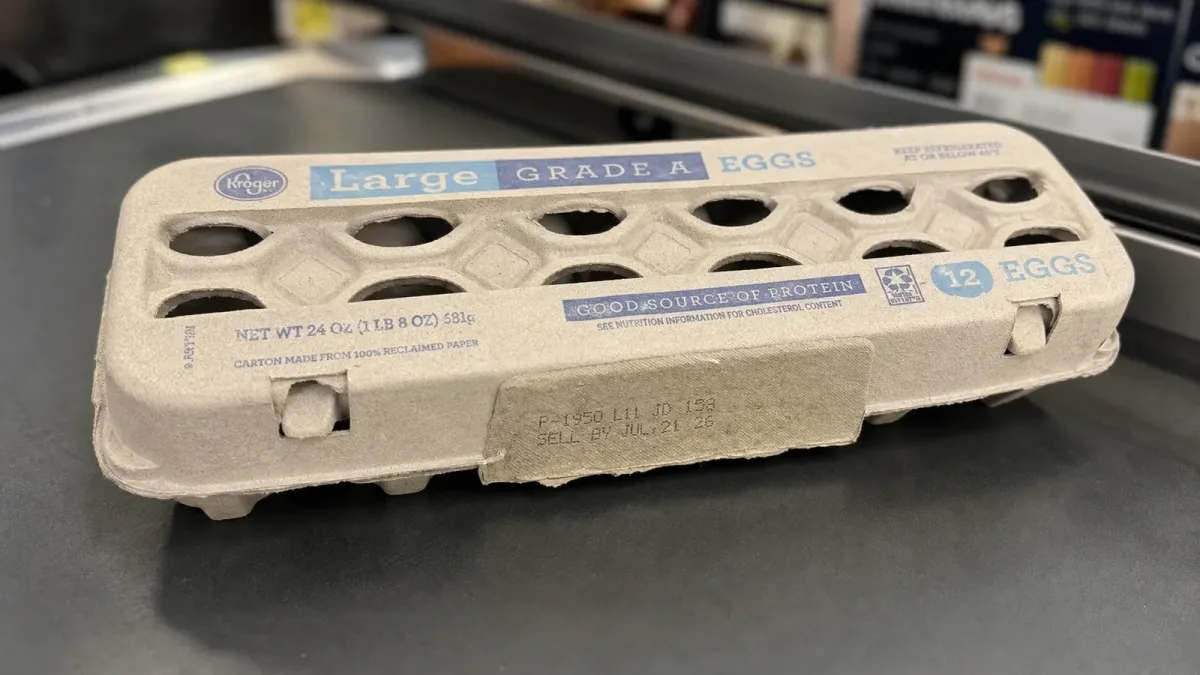
Midwest Poultry Services is recalling 1,589,577 dozen eggs—about 19.1 million individual eggs—because they may be contaminated with Salmonella Enteritidis, according to a company announcement posted by the Food and Drug Administration on July 22, 2026. The voluntary recall covers white shell eggs and brown cage-free eggs produced in Texas.
Consumers should first look on either side of the carton for plant code P-1950 or 0840962. The affected cartons also carry a Julian date from 157 through 184 and a sell-by or best-by date from July 20 through Aug. 17, 2026. All three details should be checked against the FDA notice.
The retail brands named in the notice include Kroger, Simple Truth, Brookshire’s, Country Morning and Sunups. The eggs were available at Kroger stores in Texas and Louisiana; Brookshire Grocery stores in Texas, Oklahoma, Arkansas, Louisiana, New Mexico and Mississippi; and some smaller retailers. Food-service customers in Texas, Oklahoma and Louisiana also received affected eggs.
Which cartons are included
The recall spans many package sizes, including 12-, 18-, 24-, 30-, 36- and 60-count cartons, plus several bulk food-service cases. Kroger cartons include large, extra-large, medium and jumbo eggs. Simple Truth products include cage-free brown medium and large eggs. Brookshire’s, Country Morning and Sunups products are also listed in multiple sizes.
The FDA’s complete product table gives the UPC for every affected carton. That matters because the brand name alone is not enough to identify a recalled product, and no other Midwest Poultry Services products are included, the company said.
What to do now
Do not eat eggs that match the recall details. The company says consumers should return them to the original place of purchase for a full refund. People with questions can call Midwest Poultry Services at 574-405-9531 from 8 a.m. to 4:30 p.m. Eastern time, Monday through Friday.
If recalled eggs or their contents touched refrigerator shelves, utensils or kitchen surfaces, wash and sanitize those areas and wash your hands. Restaurants and other food-service operators should not sell or serve affected eggs.
People who may have eaten the eggs should watch for diarrhea, fever and stomach cramps. The Centers for Disease Control and Prevention says symptoms usually begin six hours to six days after infection and generally last four to seven days. Children younger than 5, adults 65 and older, and people with weakened immune systems face a higher risk of severe illness.
Contact a health professional for severe symptoms, including bloody diarrhea, fever above 102 degrees Fahrenheit, vomiting that prevents keeping liquids down or signs of dehydration.
What the company says
Midwest Poultry Services said it identified the issue through environmental monitoring and root-cause work at two Texas farms. It has stopped distributing fresh eggs produced at those farms and said eggs were diverted to a breaking plant for pasteurization while the company investigated.
No specific illnesses had been linked to the recalled eggs as of the July 22 announcement. That status could change if regulators or the company release new findings, so consumers with matching cartons should follow the recall instructions even if no one in their household feels sick.


