
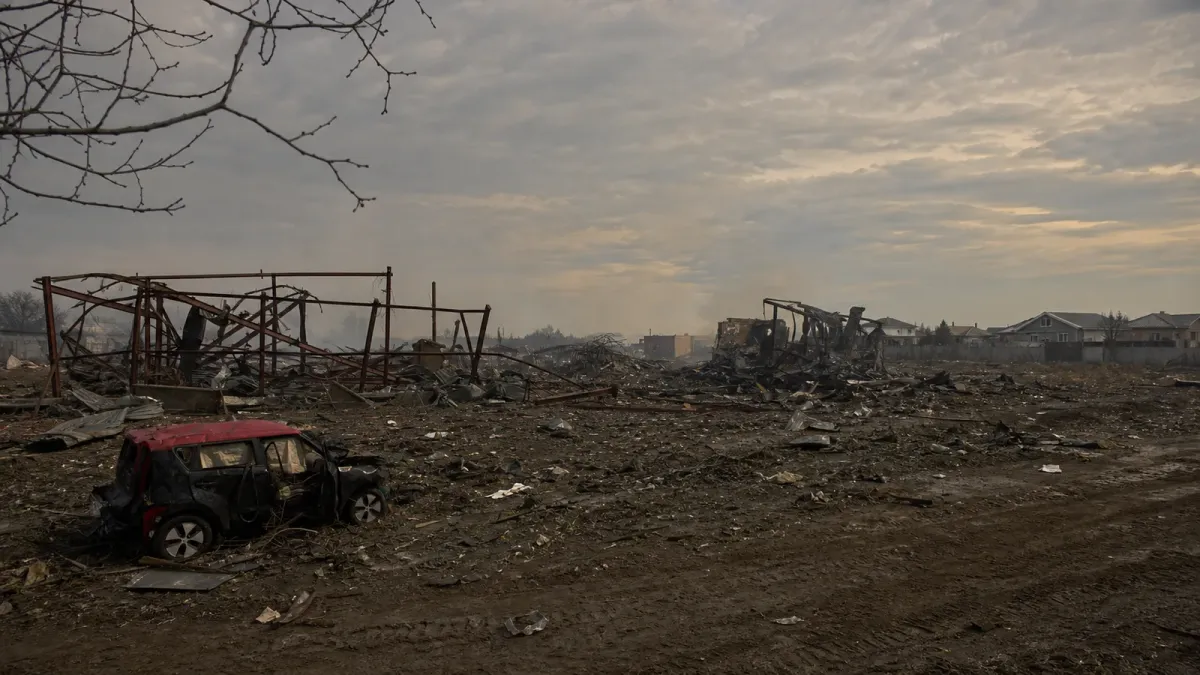
The death toll from a Russian strike and subsequent ammunition detonation in Myla, west of Kyiv, rose to 38 on Sunday, August 30, with four people still missing. Ukrainian officials described it as Russia’s deadliest attack in the Kyiv region this year and said rescue teams were still clearing explosives from the site.
The attack struck a warehouse that Ukrainian authorities said contained ammunition, drones and other explosives. The initial hit set off secondary blasts and fires that spread into surrounding homes and buildings. Kyiv regional chief Tymur Tkachenko said 52 people were injured, including five children, and roughly 300 structures were damaged in Myla and nearby communities.
What changed
President Volodymyr Zelenskyy said most fires had been extinguished but warned that the area remained heavily contaminated by unexploded ordnance. He also acknowledged that the military stockpile should not have been located beside residential buildings and said investigators were examining how it came to be stored there.
That creates two distinct lines of responsibility. Ukraine attributes the destruction to the Russian strike, while Ukrainian prosecutors are separately examining whether negligent storage multiplied the casualties and damage. The blast reportedly affected houses, apartment buildings and a care facility for older people and people with disabilities.
The updated toll also comes during a sustained Russian air campaign against Kyiv and other parts of Ukraine. Ukrainian officials said recent attacks have included large numbers of drones, aerial bombs and missiles, forcing air defenses to operate for long periods and keeping civilians under repeated alerts.
A new threat to the energy system
Russia’s Defense Ministry said Sunday that it was preparing large-scale strikes on Ukraine’s energy infrastructure. Moscow described the plan as retaliation for Ukrainian attacks on Russian oil, gas and commercial facilities that Kyiv says help finance or supply the war.
The threat has practical consequences beyond the battlefield. Russia has repeatedly targeted Ukraine’s power system during previous winters, causing outages and damaging generation and transmission equipment. A renewed campaign would test repair capacity, air defenses and emergency power plans before colder months arrive.
What remains unclear
Officials have not provided a complete public inventory of the Myla warehouse, a final accounting of the missing, or a timeline for making the surrounding area safe. Injury totals also changed during the day as regional authorities and the president reported updates from different points in the rescue operation.
It is also unclear when Russia might carry out the threatened energy strikes or how extensive they would be. Moscow has framed past attacks as responses to Ukrainian operations, while Ukraine says Russia is responsible for the escalation and is seeking international pressure to stop it.
What happens next
Emergency teams will continue searching for the missing and neutralizing explosive hazards. Prosecutors must determine whether storage decisions worsened the disaster, while residents face the immediate task of returning to damaged neighborhoods.
The broader test is whether the attack marks another step toward a winter campaign against civilian infrastructure. The Myla toll shows how a strike on a military site can become a mass-casualty disaster when explosive stockpiles and homes are placed within the same blast zone.


