
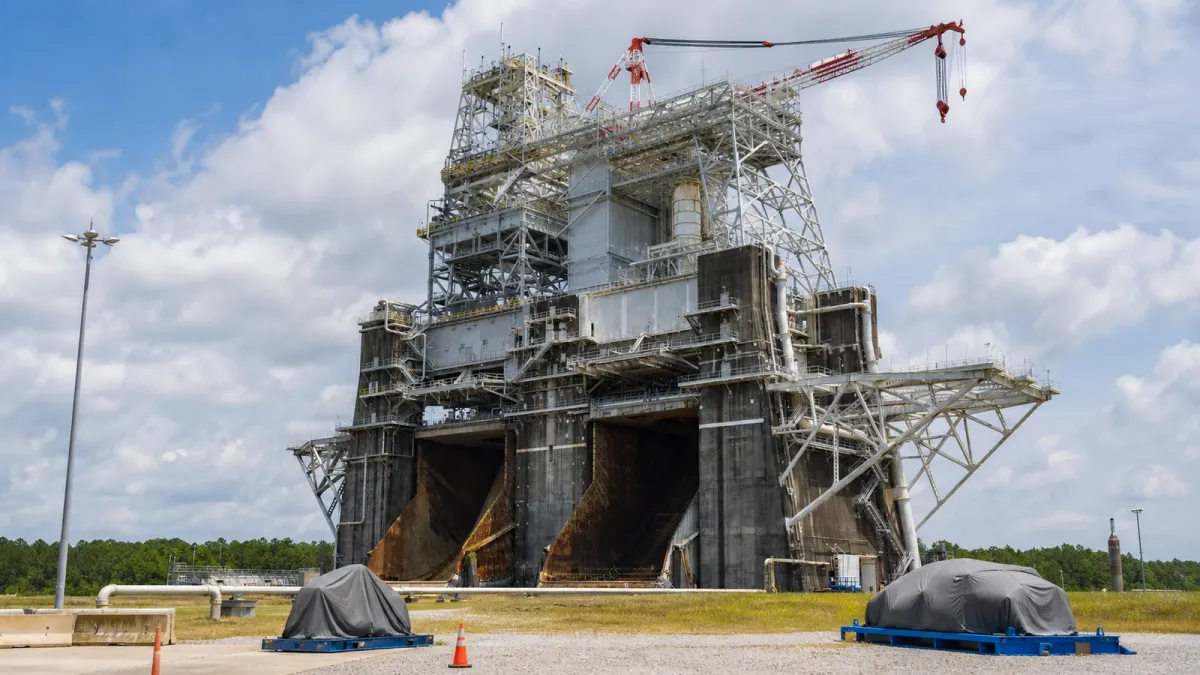
NASA and Blue Origin have agreed to use the B-2 test stand at NASA Stennis Space Center in Mississippi for New Glenn second-stage hot-fire testing, a July 24, 2026, move that ties a new commercial rocket program to hardware built for Apollo-era Moon missions.
The short version: this gives Blue Origin another place to validate New Glenn's upper stage before flight, while NASA gets commercial rocket work onto one of its most powerful propulsion test facilities as Artemis missions depend more heavily on private launch and lander systems.
What changed
NASA said the agreement is an annex to a reimbursable Space Act Agreement signed earlier in July. The agency said testing is targeted to begin this fall and will use the B-2 position at Stennis, near Bay St. Louis, Mississippi.
Blue Origin said the B-Test Complex will provide an additional testbed for New Glenn upper-stage hot-fire work. The company framed the site as part of a broader effort to add test capacity and reduce pressure on Launch Complex 36 operations in Florida.
The upper stage matters because it is the part of New Glenn that finishes the job after the booster has done its work. NASA said the second stage is powered by two BE-3 engines using liquid oxygen and liquid hydrogen, with each engine generating 200,000 pounds of thrust in vacuum.
Why Stennis matters
The B-2 stand is not a generic pad. NASA said the dual-position B-1/B-2 test complex was built in the 1960s to test Saturn V rocket stages that sent astronauts to the Moon. More recently, NASA used the stand for the Space Launch System core-stage Green Run before Artemis I.
That history is part of the point. New Glenn is one of the vehicles NASA expects to matter for future Moon work, and the agency said the testing supports efforts to land American astronauts on the lunar surface and build a Moon Base near the lunar South Pole.
NASA also said Artemis III is planned as a multi-launch campaign in which astronauts test rendezvous and docking between Orion and commercial human landing systems from Blue Origin and SpaceX in low Earth orbit. Blue Origin's New Glenn is also expected to launch missions that will land on the Moon.
The caveat
The Stennis agreement does not by itself clear New Glenn for every Artemis role. Associated Press reporting after New Glenn's April 19, 2026, flight said launches were grounded while Blue Origin and the Federal Aviation Administration investigated an upper-stage problem that left a satellite short of its intended orbit. Blue Origin also acknowledged a May 28 hot-fire anomaly in separate company updates.
That makes the Stennis work useful but not automatic. It adds a second-stage test path and NASA technical support, but the program still has to prove reliability through hardware tests, investigation work, and future flight milestones.
What to watch next
The next concrete marker is whether Blue Origin begins Stennis testing this fall, as NASA described. After that, watch for FAA investigation updates, New Glenn return-to-flight timing, and any change to NASA's Artemis III or Artemis IV planning assumptions.
For readers following the Moon program, the practical takeaway is simple: NASA is not only buying commercial lunar services. It is putting legacy federal test infrastructure behind the companies it needs to make those services credible.


