
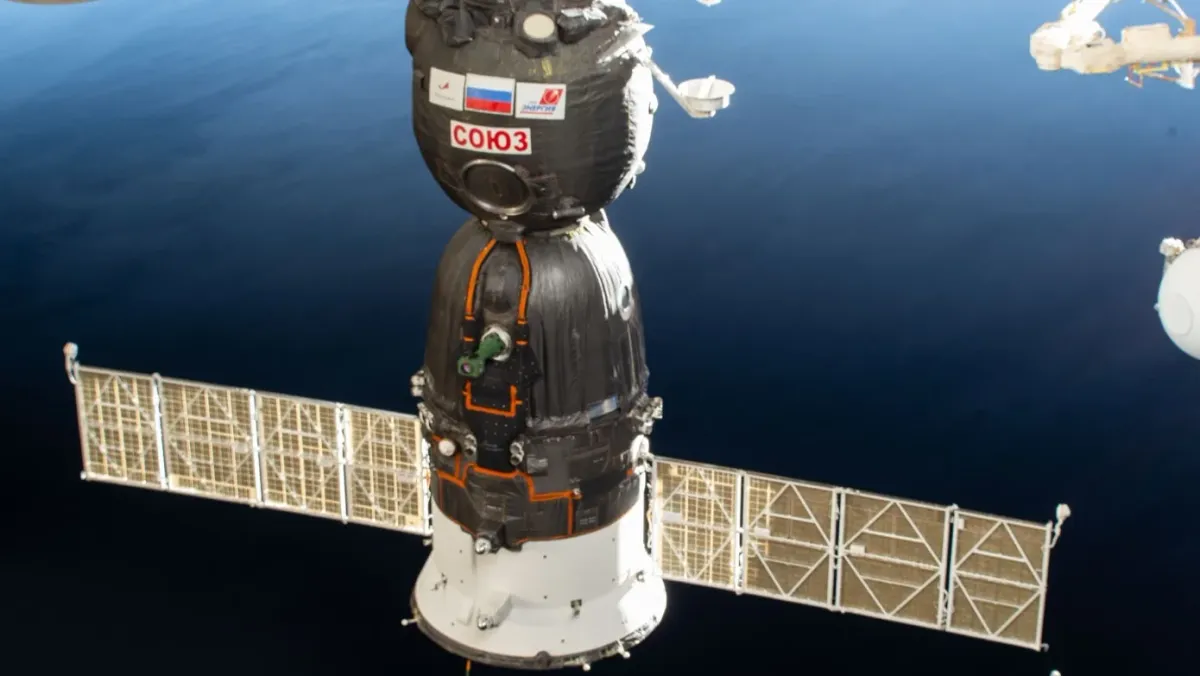
NASA astronaut Chris Williams is set to begin the trip home Sunday morning, July 26, after 241 days aboard the International Space Station, closing out his first mission in orbit.
Williams and Roscosmos cosmonauts Sergey Kud-Sverchkov and Sergei Mikaev are scheduled to undock their Soyuz MS-28 spacecraft from the station's Rassvet module at 3:03 a.m. EDT, then land by parachute at 6:25 a.m. EDT southeast of Dzhezkazgan, Kazakhstan, according to NASA's latest return advisory.
The short answer for viewers: the key moments are undocking, a deorbit burn at 5:31 a.m. EDT and landing less than an hour later. NASA says the times can shift with real-time operations, so the agency's live stream is the place to check if you are following the return as it happens.
What comes home with the crew
The landing ends an eight-month stay that NASA says covered 3,856 orbits and more than 102 million miles. Williams will return to NASA's Johnson Space Center in Houston after recovery crews bring the Soyuz crew to Karaganda, Kazakhstan. Kud-Sverchkov and Mikaev will return to their training base in Star City, Russia.
The mission was not only a ride-along in orbit. NASA's research closeout says Williams worked on DNA-inspired materials being studied for targeted cancer therapies, semiconductor crystal growth in microgravity, frozen biological sample handling, biofilm prevention, cargo operations and station maintenance.
He also completed two spacewalks. NASA says one helped repair Canadarm2, the station's robotic arm, and another prepared the station for additional roll-out solar arrays that are expected to increase the lab's power generation when the final set is installed.
Why this return matters
A crew return is a routine part of station operations, but it is still a practical test of the chain that makes long-duration spaceflight work: crew handover, hatch closure, undocking, deorbit, landing, recovery and medical readjustment on Earth.
For NASA, Williams' mission also ties everyday station research to the larger Moon and Mars pipeline. The agency describes the station as a proving ground for human health, materials science, robotic operations and commercial activity in low Earth orbit. Those are not abstract goals when a crew member brings home samples, operational lessons and a body that must readapt to gravity after eight months in space.
What to watch next
After Soyuz MS-28 undocks, Expedition 75 formally begins aboard the station. The immediate public focus will be whether the landing sequence stays on schedule and whether recovery teams report a normal extraction from the capsule.
The longer-term question is what researchers learn from the samples and work completed during the mission. That part will take longer than the landing broadcast, but it is the reason a scheduled crew return is more than a calendar item: it is the moment months of work in orbit starts moving back into Earth labs.


