
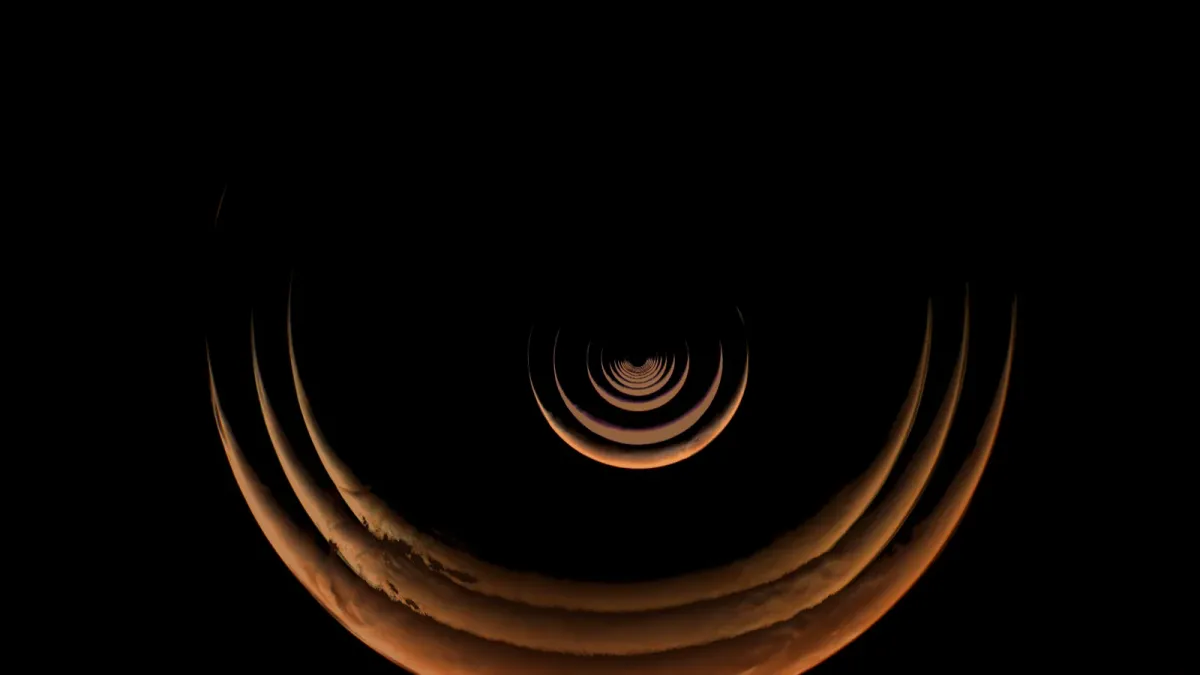
NASA's Psyche mission has turned a May 15, 2026 Mars flyby into more than a navigation milestone: the spacecraft delivered new instrument data and a time-lapse view that shows Mars growing from a thin crescent as Psyche swept past the planet.
The short answer is that the spacecraft did what it needed to do. NASA's Jet Propulsion Laboratory said the flyby used Mars' gravity to add speed, slightly tilt Psyche's trajectory, and keep the mission on course for the metal-rich asteroid Psyche in summer 2029.
What changed
NASA released the mission's Mars flyby data and time-lapse package on July 17, 2026. The video covers the approach, close approach, and departure sequence, using images from Psyche's multispectral imager.
The flyby brought Psyche within 2,864 miles, or 4,609 kilometers, of Mars. JPL said the spacecraft's instruments operated as designed, giving mission teams a rehearsal for the science work they plan to do at the asteroid.
That distinction is important. A gravity assist is usually described as a route correction, but this pass also let engineers test instruments against a planet whose surface, magnetic environment, and atmosphere are already well studied. If a sensor returned something unexpected at Mars, the team would have a known comparison point before relying on it at a far less familiar asteroid.
What the instruments showed
The gamma-ray and neutron spectrometer could not measure Mars gamma rays from that distance, but it did detect an expected neutron count-rate increase near closest approach. That matters because the instrument is intended to help identify chemical elements on asteroid Psyche's surface.
The magnetometer also recorded its first magnetic field signature from a celestial body, according to JPL. The instrument saw the bow shock region where solar wind interacts with Mars' magnetic environment, giving the team a real-world calibration check before the asteroid encounter.
The imager produced the most public-facing result: rare views of Mars from Psyche's high-phase approach angle. The sequence shows the planet first as a bright crescent, then in more detailed surface views that include windblown craters, the south polar ice cap, and Huygens crater.
Why it matters
Psyche is not going to Mars. Mars was the slingshot. The target is asteroid 16 Psyche, a metal-rich body in the main asteroid belt that scientists want to study because it may reveal clues about the building blocks of rocky planets.
The key reader takeaway is not that the flyby discovered a new Mars mystery. It is that NASA used a familiar planet as a full-system rehearsal: navigation, imaging, magnetic-field measurement, and particle detection all had to work before the spacecraft spends years crossing the solar system.
What happens next
JPL said Psyche is now headed toward its target and remains on schedule to resume sustained thrusting with its solar-electric propulsion system later in 2026. If the current plan holds, the spacecraft will arrive at asteroid Psyche in summer 2029.


