
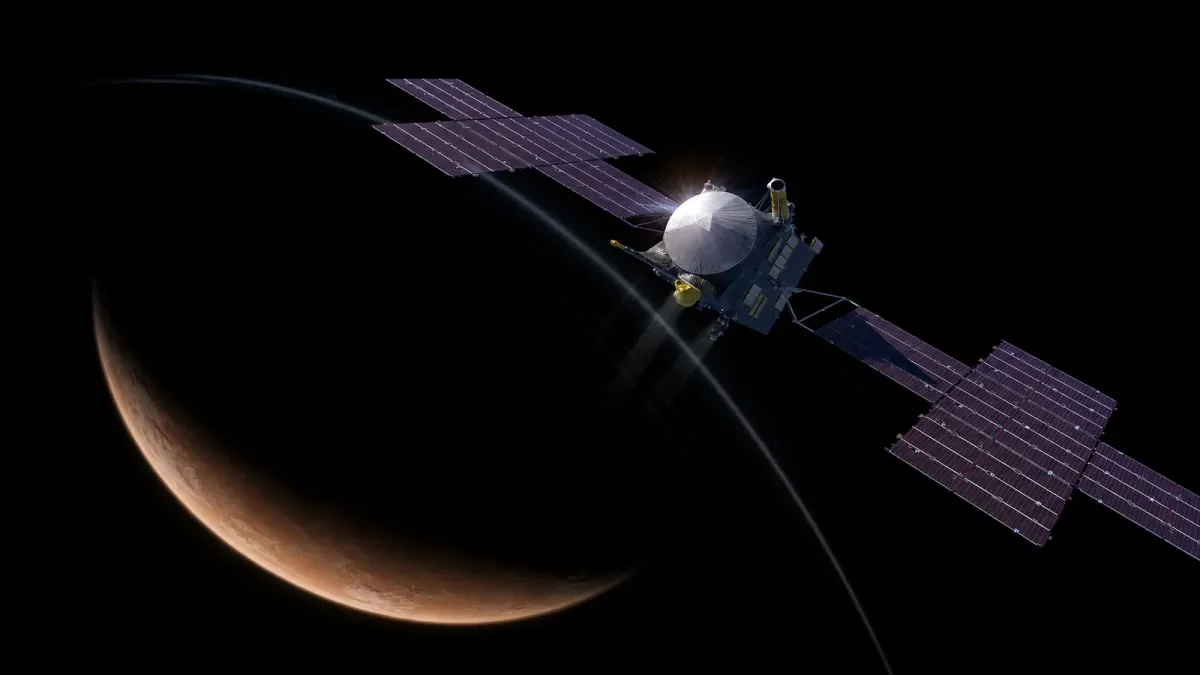
NASA's Psyche mission gave the public a new look at Mars on July 17, but the images are more than a space-video moment. The spacecraft used Mars on May 15, 2026, as a gravity assist on its way to the metal-rich asteroid Psyche, and the newly released data show that the flyby also worked as a live rehearsal for the mission's science instruments.
Psyche passed within 2,864 miles, or 4,609 kilometers, of the Martian surface, according to NASA. The maneuver gave the spacecraft about a 1,000 mph boost and shifted its orbital plane by about 1 degree, keeping it on course for a planned arrival at asteroid Psyche in summer 2029.
The short answer
The Mars detour mattered for two reasons: it changed Psyche's path without using onboard propellant, and it let mission teams test instruments against a planet scientists already know well. That makes Mars a calibration target before the spacecraft reaches a much less familiar object in the asteroid belt.
What the new data showed
NASA's Jet Propulsion Laboratory said the mission teams studied flyby data in the weeks after the encounter and found that the spacecraft's imager, magnetometer, and gamma-ray and neutron spectrometer operated as designed.
The multispectral imager captured the approach, close pass, and departure in a monthlong sequence. Early in the approach, Mars appeared as a thin crescent because of the viewing angle. Near close approach, the images showed surface details including windblown craters, the south polar ice cap, and Huygens crater.
The neutron spectrometer also detected an expected count-rate increase near closest approach, while the magnetometer saw Mars' bow shock region, where the solar wind meets the planet's magnetic environment. NASA said the gamma-ray signal from Mars was not expected at the flyby distance.
Why it matters for the asteroid mission
Psyche's final target is not Mars. It is asteroid Psyche, a metal-rich object in the main asteroid belt between Mars and Jupiter. Scientists want to study it because it may preserve clues about the metallic cores and early building blocks of rocky planets.
The flyby gave engineers and scientists a rare chance to check navigation, camera calibration, magnetic measurements, and composition-sensing hardware during a real planetary encounter. NASA said the spacecraft is in good shape and is expected to resume sustained solar-electric thrusting later this fall.
What to watch next
The mission is now in the long cruise phase toward asteroid Psyche. The key milestones are whether the spacecraft stays on its post-flyby trajectory, how the instrument teams finish comparing the Mars data with other Mars missions, and whether sustained thrusting resumes as planned before the 2029 arrival window.


