
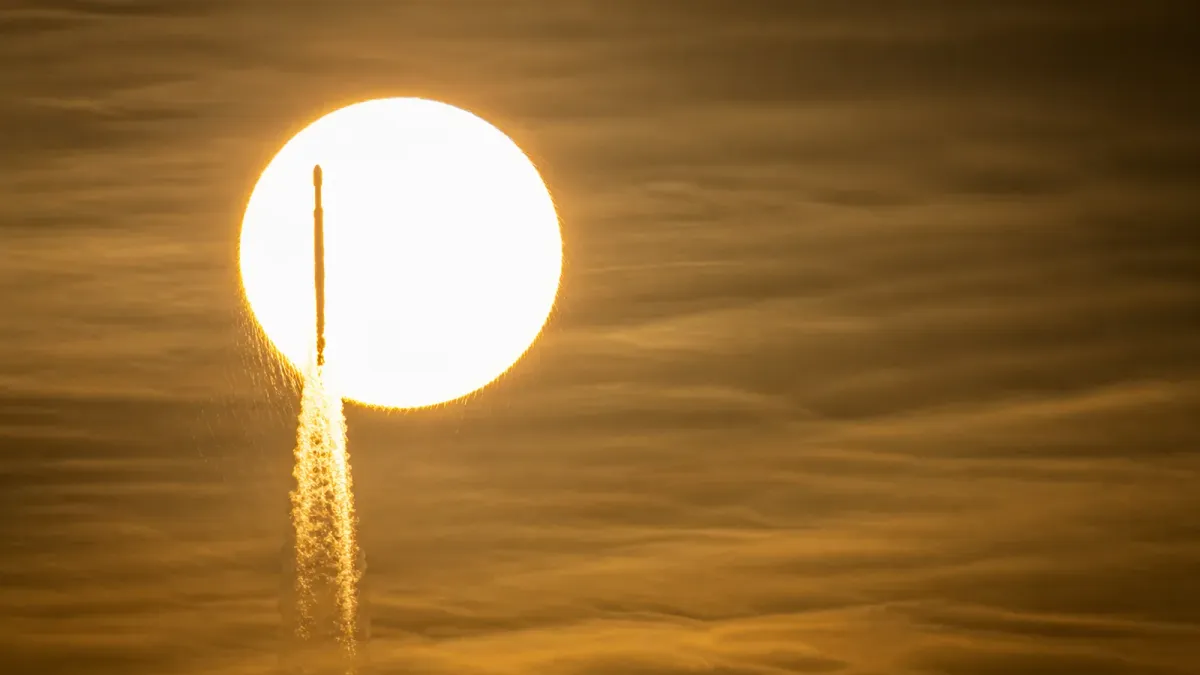
NASA’s Nancy Grace Roman Space Telescope launched from Kennedy Space Center on Sunday, August 30, aboard a SpaceX Falcon Heavy rocket. The successful liftoff begins a journey of roughly three months and 1 million miles to the telescope’s operating region near the second Sun-Earth Lagrange point, known as L2.
The $4.3 billion observatory is not designed to replace Hubble or the James Webb Space Telescope. Its advantage is scale: NASA says Roman will see a field of view at least 100 times larger than Hubble’s, allowing it to survey enormous areas of sky much faster.
That wide view is meant to turn individual discoveries into population studies. Roman is expected to measure light from as many as a billion galaxies, find thousands of supernovae and build a statistical census of planets across the Milky Way.
The short answer
Roman will combine space-based image quality with a survey strategy. Hubble is exceptionally sharp but observes a relatively narrow patch at once. Roman can repeatedly map broad regions, making it useful for tracking how galaxies cluster, how the universe expands and how frequently different kinds of planetary systems occur.
The telescope carries a wide-field instrument for its main surveys. It also includes a coronagraph technology demonstration designed to block a star’s glare so much fainter objects near it can be studied. That work could help prepare future missions that aim to image Earth-like planets more directly.
Why L2 matters
The Sun-Earth L2 region sits far beyond the Moon in the direction away from the Sun. A spacecraft there can maintain a relatively stable relationship with Earth and the Sun, helping engineers manage power, communications and thermal conditions while keeping the observatory’s view of space clear.
Roman will share the broader L2 neighborhood with the Webb telescope, but the two missions have different strengths. Webb looks deeply at selected targets across infrared wavelengths; Roman’s defining job is to cover far more sky and reveal large samples for closer study.
What scientists hope to learn
One goal is to test competing explanations for dark energy, the name given to whatever is driving the universe’s accelerating expansion. Roman will measure the distribution of galaxies and observe distant supernovae, giving scientists multiple ways to check whether the expansion rate has changed over cosmic time.
Another goal is a broad census of exoplanets. By monitoring dense star fields and measuring subtle changes in light, Roman can detect planets that are difficult to find with methods optimized for worlds orbiting close to their stars. The result should be a more complete picture of how common different planetary systems are.
What happens next
Launch is only the beginning. Flight controllers must guide Roman toward L2, deploy and check its systems, cool and calibrate the instruments, and confirm that the telescope can point with the required precision. That commissioning work must succeed before routine science observations begin.
The mission’s value will not be one immediate image. It will be a repeatedly observed, wide-area record of the universe that other telescopes can use to choose targets. Roman’s launch opens that possibility; the next test is whether the observatory arrives, deploys and performs as designed.


