
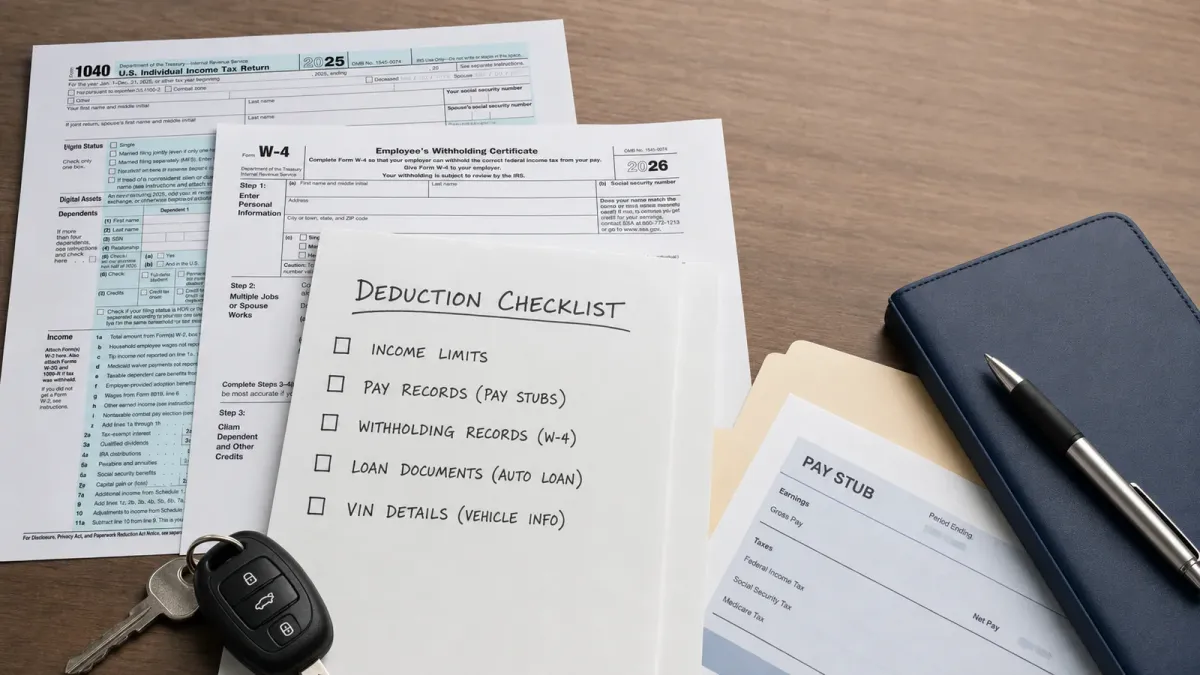
The short answer: do not treat the new IRS deductions as automatic tax-free income. The Internal Revenue Service says several breaks now apply to tips, overtime, seniors and some car-loan interest, but each one has limits that can change whether you qualify or how much you can actually deduct.
That matters in July 2026 because midyear is still early enough to check pay records, loan documents and withholding before the next filing season. The IRS updated its Working Families Tax Cuts guidance on July 1, 2026, and its 2026 withholding publication points taxpayers to the same practical issue: a bigger deduction is useful only if the facts on your return support it.
Use this as a pre-filing checklist, not tax advice. If your income, filing status, self-employment income or vehicle purchase is complicated, a qualified tax professional can help you apply the rules to your return.
Do this first
1. Separate a deduction from a refund. A deduction lowers taxable income. It is not the same as a dollar-for-dollar credit, and it does not mean every dollar of tips, overtime or interest disappears from your tax bill. The actual savings depend on your tax bracket and whether the income or expense meets the IRS definition.
2. Check the income phaseouts. IRS Publication 505 says the overtime deduction starts phasing out above modified adjusted gross income of $150,000, or $300,000 for married couples filing jointly. The car-loan interest deduction starts phasing out above $100,000, or $200,000 for joint filers. The enhanced senior deduction phases out above $75,000, or $150,000 for joint filers.
3. Keep the right documents. For tips and overtime, look for how the income is reported on a Form W-2, Form 1099 or other statement. For a vehicle loan, the IRS says the loan generally must be for a personal-use vehicle, originated after Dec. 31, 2024, and secured by a lien. You also need the vehicle identification number when claiming the car-loan interest deduction.
Check these details
The senior deduction can be worth up to $6,000 per eligible person, or $12,000 when both spouses qualify, but the IRS says the taxpayer must be 65 by the end of the tax year and include a Social Security number on the return.
The tip deduction can be as much as $25,000, but the tips must be qualified tips in occupations identified by the IRS as customarily and regularly receiving tips before Dec. 31, 2024. For self-employed workers, the deduction cannot exceed net income from the business where the tips were earned.
The overtime deduction can reach $12,500, or $25,000 for joint filers, but the IRS describes it as the qualified overtime pay above the regular rate, such as the half portion in time-and-a-half pay. That distinction can matter if a worker assumes the full overtime paycheck is deductible.
The car-loan interest deduction can be up to $10,000, but lease payments do not qualify. The IRS says the vehicle must be a car, minivan, van, SUV, pickup truck or motorcycle under 14,000 pounds that had final assembly in the United States. The agency points taxpayers to the vehicle label, VIN or the NHTSA VIN Decoder to verify assembly location.
Bottom line
Before changing withholding or counting on a larger refund, match the deduction to its documents: pay statements for tips and overtime, age and income for the senior deduction, and loan and VIN details for car interest. The mistake to avoid is budgeting around the headline before checking the rule that limits it.
Sources: IRS Working Families Tax Cuts guidance, IRS Publication 505, IRS get-ready guidance and the CFPB tax filing guide.


