
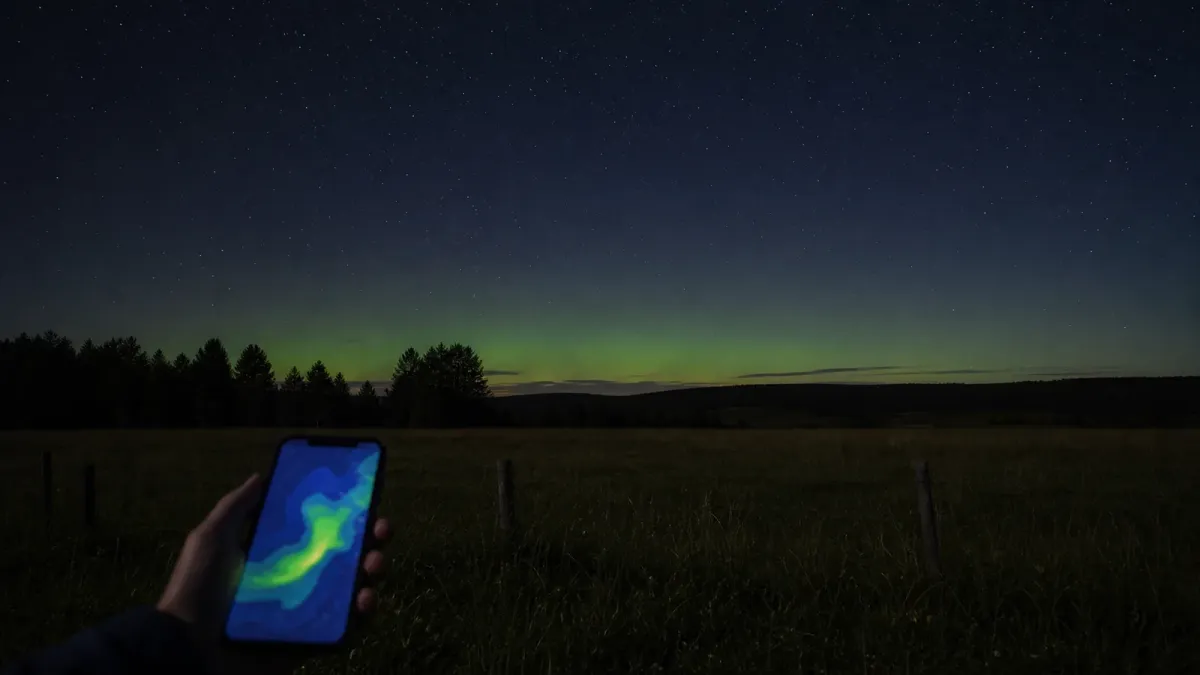
Search interest for a July 21-22 northern lights forecast is rising, but the practical answer is more cautious than the phrase aurora alert can make it sound: check NOAA's live Space Weather Prediction Center tools before driving away from city lights tonight.
The latest reader question is timely because a fast solar-wind stream from a coronal hole was expected to raise geomagnetic activity late Tuesday, July 21, into Wednesday, July 22. People reported Tuesday afternoon that a minor G1 geomagnetic storm could make aurora visible near the U.S.-Canada border, especially in northern states with dark skies.
NOAA's own tools are the better last-mile check. Its aurora dashboard shows the tonight-and-tomorrow viewline forecast, the 30-minute aurora forecast and the Kp scale that helps translate space-weather activity into viewing odds. A G1 storm is minor; it can be enough for a faint northern-horizon display, but it is not the kind of event that reliably pushes bright aurora deep into the United States.
The short answer
If you are in Washington, Idaho, Montana, North Dakota, Minnesota, Wisconsin, Michigan, northern New England or another location close to the Canadian border, tonight may be worth monitoring. If you are farther south, treat viral maps and screenshots as a prompt to check the live NOAA viewline rather than as a promise.
What to check first
Start with NOAA's aurora dashboard, then compare it with the 30-minute aurora forecast close to your planned viewing time. The 30-minute product is useful because aurora visibility can change quickly as solar-wind speed and magnetic orientation shift between the L1 observation point and Earth.
Then check ordinary weather. Clear skies, a dark northern horizon and low local light pollution matter as much as the space-weather forecast during a weak event. Summer twilight also narrows the window, so the best chance is usually late night rather than soon after sunset.
How to decide whether to go
Make the trip only if three things line up: the NOAA viewline is close to you, cloud cover is low and you have a safe dark-sky spot with a clear view north. Bring patience and use a phone's night mode or a stable long exposure if the glow is too faint for the naked eye.
The bottom line: July 22 is a watch-and-check night, not a guaranteed show. NOAA's live forecast should decide the trip, not a static social post or yesterday's aurora map.


