
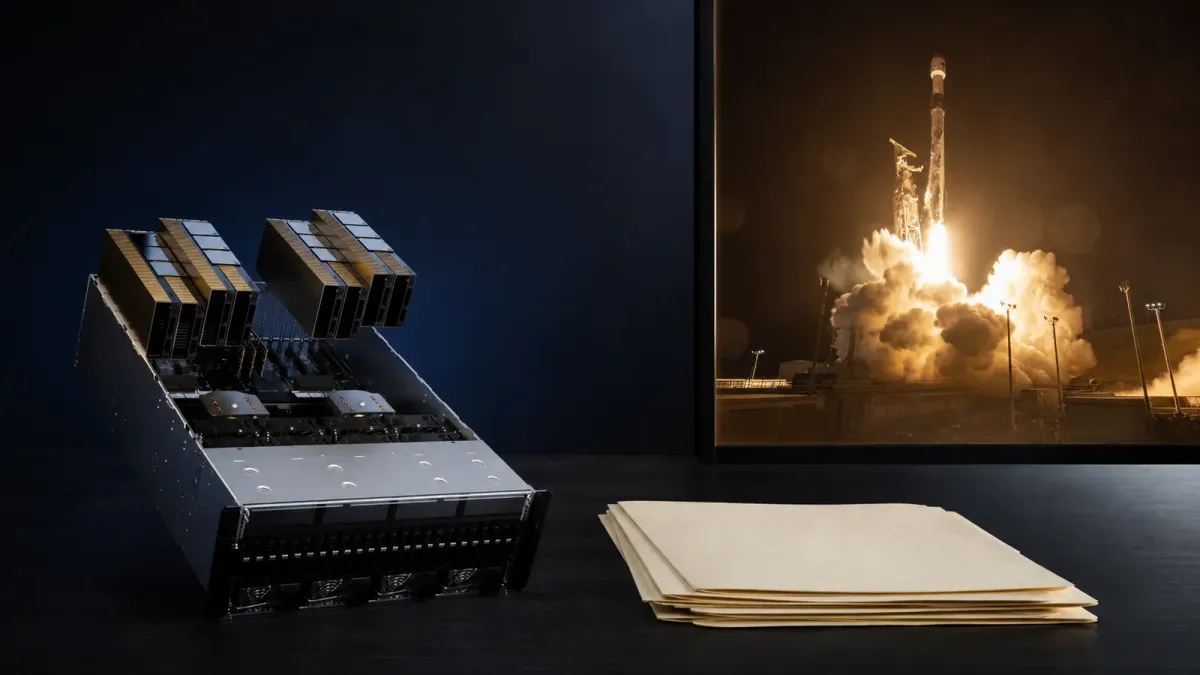
Nvidia's newest securities filing confirms a huge SpaceX position, but the headline number needs a date attached. The chipmaker reported 122,764,805 Class A shares valued at $20,975,594,582 as of June 30, 2026. That is a historical quarter-end snapshot—not evidence that Nvidia spent $21 billion on SpaceX on August 14.
The distinction matters because SpaceX closed at $140 on August 14, according to CNBC. At that price, the same share count would be worth about $17.19 billion, roughly $3.79 billion below the value printed in the filing. That difference is a change in market value, not proof of a sale or a realized loss.
What the filing actually says
Nvidia submitted its Form 13F on August 14, the deadline for reports covering the quarter ended June 30. The filing lists eight reportable positions with a combined quarter-end value of $63.44 billion.
SpaceX was Nvidia's second-largest reported position. It represented about 33.1% of the filing's total value, behind a $29.99 billion Intel position that represented about 47.3%. Together, those two lines accounted for about 80.3% of Nvidia's reported 13F holdings.
The primary SEC filing is precise about the number of shares and their June 30 fair value. That precision can create false confidence if a reader treats the document like a live brokerage statement.
What Form 13F does not tell you
- It does not reveal the purchase date. A filing submitted August 14 reports holdings from June 30. CNBC reported that the SpaceX shares came through Nvidia's earlier investment in xAI, citing a person familiar with the matter, but the 13F itself does not show that transaction history.
- It does not provide cost basis. The $20.98 billion is the position's market value at quarter-end, not necessarily the amount Nvidia paid or the profit it had earned.
- It is not Nvidia's complete balance sheet. The SEC requires Form 13F to cover securities on its official 13(f) list. The form excludes short positions and does not capture every private investment, foreign security, derivative or operating asset.
- It is not current. The SEC allows the report to arrive up to 45 days after quarter-end. A manager can add to, trim or exit a position before the public sees the filing.
Read the $21 billion number in three steps
First, freeze the date. Divide the reported $20.98 billion value by 122.76 million shares and the filing implies a June 30 SpaceX price of about $170.86. That calculation explains the disclosed value without making any assumption about Nvidia's purchase price.
Second, separate ownership from price. If the share count remained unchanged, the August 14 closing price would reduce the mark to about $17.19 billion. The filing cannot confirm that the share count remained unchanged after June 30, so even that updated figure is an estimate, not a new disclosure.
Third, examine concentration and strategic ties separately. CNBC reported that SpaceX plans to use Nvidia chips in its AI data centers and that Elon Musk expects a significant allocation of Nvidia's next-generation Vera Rubin processors in 2027. Nvidia can be both an investor and a supplier, but the 13F alone does not prove that either relationship is profitable, improper or risk-free.
Why the filing still matters
The report makes the scale visible. A single SpaceX line represented one-third of Nvidia's disclosed 13F value at quarter-end, and its price move since June 30 was large enough to change the position's estimated value by billions of dollars.
For investors, the useful response is not to copy the position blindly or dismiss it as old news. Check four things: the report date, the share count, the current price and what the form excludes. Then read the company's earnings disclosures for any discussion of valuation changes, strategic commitments or concentration risk.
The SEC's Form 13F guidance says the filing reports fair market value at the end of the calendar quarter and does not include short positions. Those limits are why a dramatic filing can be important without being a live trading signal.
Bottom line: Nvidia disclosed a very large SpaceX holding, but the defensible conclusion is narrower than the headline. The filing proves the position existed on June 30 and shows its value that day. It does not prove a new August purchase, reveal Nvidia's cost basis or tell investors exactly what the stake is worth now.


