
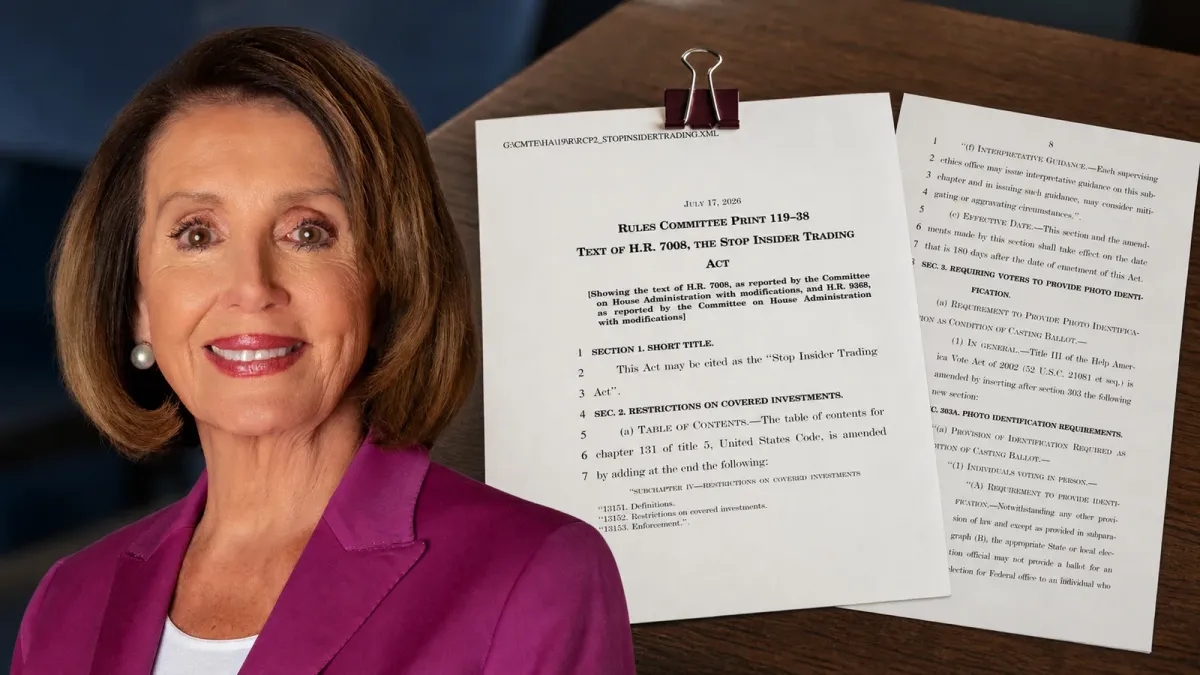
Opinion: The viral claim is numerically true: Nancy Pelosi and 197 other House Democrats voted against the Stop Insider Trading Act on July 22, 2026. But presenting that fact as proof that Democrats simply voted to protect congressional insider trading is political sleight of hand. Congress took a popular ethics reform, weakened it, bolted on a national voter-identification mandate and then dared the opposition to vote no.
The official House roll call leaves no dispute about the arithmetic. H.R. 7008 passed 232-198. All 198 no votes came from Democrats, including Pelosi; 13 Democrats joined 218 Republicans and one independent in voting yes. Anyone denying that result is denying the public record.
The record also shows why a screenshot of the tally is not the whole story. The measure barred lawmakers, spouses and dependent children from buying new publicly traded individual stocks. Yet it allowed them to keep stocks already owned and sell those holdings after advance notice. It did not impose the same restriction on the sitting president or vice president. Then House leaders combined that partial ban with an unrelated federal voter-ID proposal.
The case: Congress engineered a campaign ad, not a clean reform
A clean congressional stock-trading ban should be one of the easiest bipartisan votes in Washington. Public officials receive briefings, write tax rules, award contracts, regulate industries and move markets with their words. Even when no crime can be proved, owning individual companies that rise or fall on those decisions creates an obvious conflict of interest. The proper standard is not merely avoiding prosecution. It is removing the temptation and the appearance of self-dealing.
Republican leaders instead brought H.R. 7008 to the floor under a closed rule. The Rules Committee rejected proposals to let the House consider stronger bipartisan substitutes, including plans built around divestment or qualified blind trusts. It also rejected an amendment that would have extended the restrictions to the president, vice president, Cabinet officials, political appointees and federal judges. The final package then absorbed voter-ID language from a separate bill.
That was not legislative housekeeping. It created a predictable trap: vote yes and accept an election-law change that had nothing to do with stock ownership; vote no and appear in a social-media post claiming you support insider trading. Republican Rep. Thomas Massie, who ultimately voted for the bill, described the strategy bluntly in comments reported by The Associated Press: the voter-ID language was added so Democrats would vote against the stock measure and Republicans could use that vote in the November campaign.
The bill’s name promised more than its text delivered
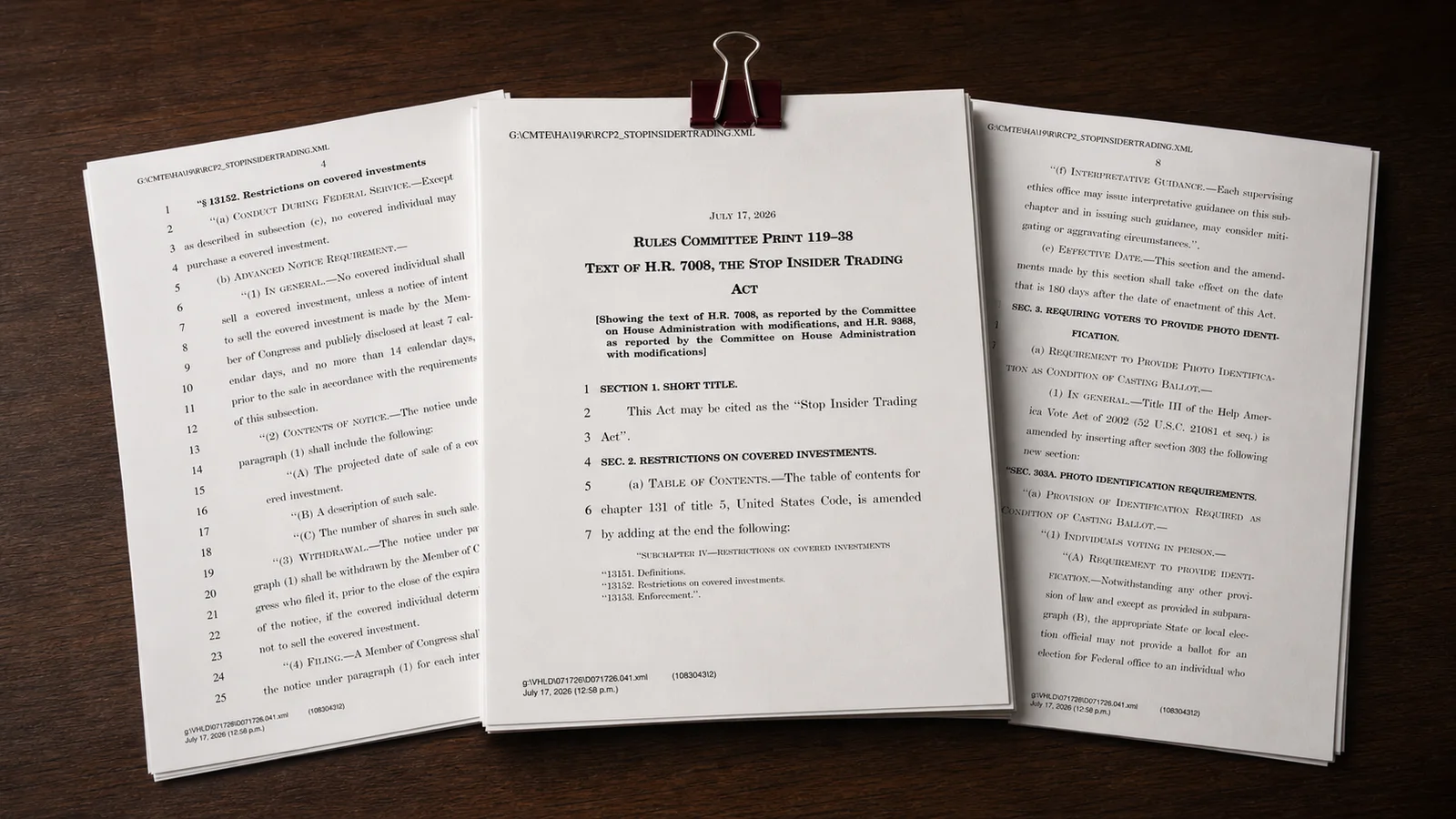
Calling H.R. 7008 the Stop Insider Trading Act does not make it a complete stock-trading ban. Preventing new purchases is meaningful, but permitting officials to retain existing individual stocks leaves them financially exposed to the companies they oversee. Permitting sales after advance notice does not eliminate the possibility that an official could avoid a loss after receiving nonpublic information. Excluding other powerful federal officials makes the ethics principle look partisan rather than universal.
A coalition of nonpartisan ethics organizations, including the Campaign Legal Center and Citizens for Responsibility and Ethics in Washington, urged lawmakers to oppose H.R. 7008 months before the floor vote. Their objection was not that members deserve freedom to trade. It was that the proposal allowed continued ownership, sales, private investments and other routes for conflicts to survive. That criticism matters because it comes from groups that have spent years demanding a real ban.
The counterpoint: imperfect progress can still be progress
Supporters have a fair argument. Congress has repeatedly failed to enact any meaningful restriction, and H.R. 7008 would close off new purchases of many individual public stocks by lawmakers and their immediate families. Thirteen Democrats voted for it. Republican Rep. Chip Roy, a supporter of a stronger divestment approach, called the bill a major step forward. In a legislature built on compromise, rejecting every incomplete bill can preserve the status quo indefinitely.
That argument would be stronger if the House had allowed a vote on the cleaner alternatives and kept election law out of the package. A first step should move directly toward the destination. This bill left the largest existing portfolios in place, preserved sales and excluded other powerful officeholders, while adding a provision designed to inflame a separate partisan fight. That is not merely imperfection; it is compromised design.
Democrats do not deserve a free pass, either. Pelosi’s family stock activity has made her the enduring symbol of the problem, even though public suspicion is not proof of criminal insider trading. She initially resisted a congressional trading ban in 2021 before later supporting one, and House Democrats failed to enact a durable ban when they controlled the chamber. Voting against a flawed Republican bill does not erase that record. If Democrats want the benefit of the doubt, they should forcefully champion a clean measure and put every member on the record.
What to do with this
Voters should reject both slogans: “Democrats voted for insider trading” and “Republicans passed a real ban.” Ask four concrete questions of any proposal. Does it require divestment or a genuinely blind trust? Does it cover spouses, dependent children, presidents, vice presidents and senior officials? Does it prohibit individual stocks, options, sector funds, private securities and other conflict-prone assets? Does it have simple, public and enforceable penalties?
Congress should bring up a stand-alone bill that answers yes to all four. No voter-ID rider. No partisan carveout. No grandfathered portfolio that lets an official keep voting on companies whose shares remain in the family account. Diversified mutual funds, broad index funds, Treasury securities and other genuinely nonconflicted investments can remain available. Public service does not require financial asceticism; it requires rules that put public duty ahead of private advantage.
Bottom line
The screenshot is true in the narrowest sense and misleading in the way that matters. Pelosi and 197 other Democrats voted no. Republicans also designed a weak, rider-loaded bill that made the no votes easy to weaponize. Americans should refuse the manufactured choice between pretending that vote meant nothing and pretending H.R. 7008 solved the problem. The right answer is a clean ban, a clean vote and no excuses from either party.


