
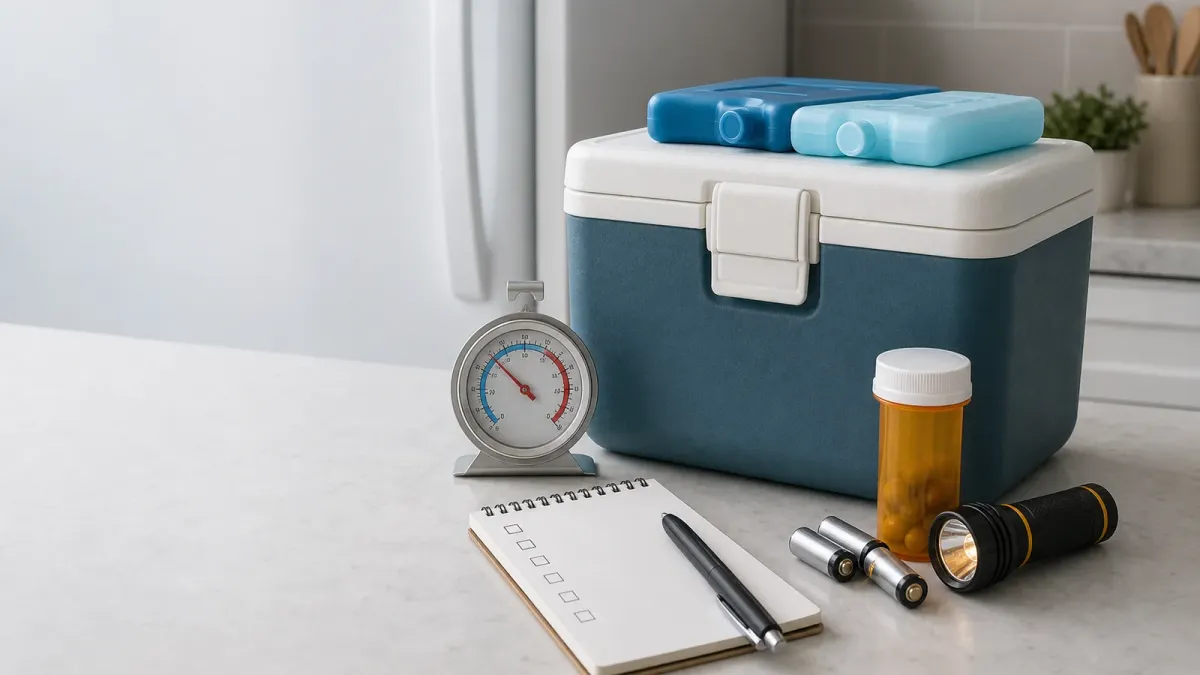
A power outage becomes a food and health problem faster than many households expect. The first useful clock starts when electricity stops: keep cold doors closed, protect anything that depends on refrigeration, and do not wait until food smells bad to decide whether it is safe.
The official advice is simple enough to tape inside a cabinet. The CDC, FDA and FoodSafety.gov all point to the same basic timing: a closed refrigerator can keep food safe for about 4 hours, a full freezer for about 48 hours, and a half-full freezer for about 24 hours.
Do this first
- Keep refrigerator and freezer doors closed as much as possible.
- Move perishable refrigerated food to a cooler with ice or frozen gel packs if power has been out for 4 hours and you can keep the cooler at 40 degrees F or below.
- Check appliance thermometers before deciding what to keep. A refrigerator should be at or below 40 degrees F; a freezer should be at or below 0 degrees F.
- Throw out meat, poultry, seafood, milk, eggs, soft cheeses, cut fruit and leftovers if they have been above 40 degrees F for too long.
- Never taste food to test whether it is safe.
Check medicine and devices
Food is not the only refrigerator issue. Ready.gov advises people who use electricity-powered medical devices or refrigerated medicines to make a plan with a medical provider before an outage. Ask how long a specific medicine can be stored at warmer temperatures and what backup power or replacement supply is appropriate.
If someone in the home relies on oxygen equipment, a powered mobility device, a home dialysis machine, an electric bed, a CPAP machine, or another essential device, keep the battery plan separate from the general phone-charging plan. Label charging cords, keep backup batteries where they can be reached in the dark, and sign up for local emergency alerts.
Before the next outage
Put one appliance thermometer in the refrigerator and one in the freezer before storm season or the next heat wave. Freeze containers of water if there is room, keep a manual can opener with shelf-stable food, and write down the local utility outage number. If your household has refrigerated medicine, infant formula, or medical equipment, keep those instructions with the outage kit rather than buried in a pharmacy bag or device manual.
Common mistakes
Do not put food outside to keep it cold; outdoor temperatures can shift, and food can be exposed to animals or contamination. Do not run a generator indoors, in a garage, or near windows. Carbon monoxide can build up quickly, and generator guidance should come from local officials, the manufacturer, or emergency management agencies.
When power returns, check temperatures before restocking. Frozen food that still has ice crystals or stayed at 40 degrees F or below may be safe to refreeze, but perishable refrigerated food that crossed unsafe temperatures should be discarded. The practical rule is still the safest one: when in doubt, throw it out.


