
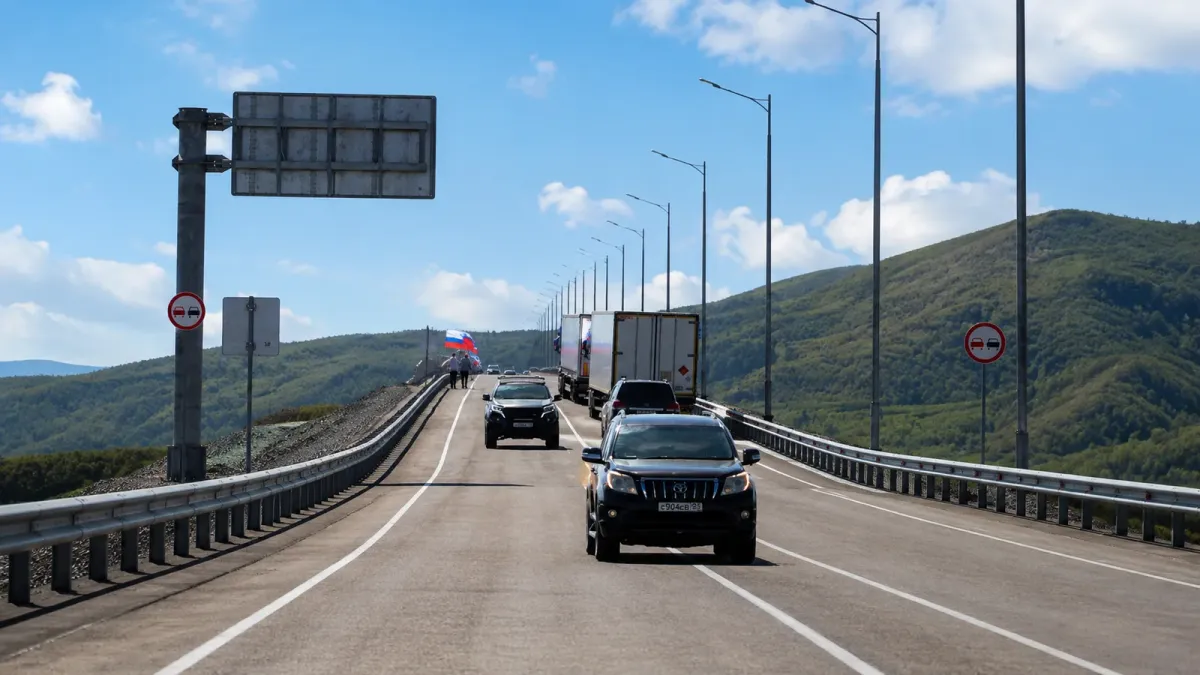
Russia and North Korea opened the first road bridge across their shared border on Monday, September 7, turning a long-discussed infrastructure project into a new physical link between two increasingly close partners.
The two-lane bridge spans roughly one kilometer, or 0.6 mile, across the Tumen River. A new border checkpoint is designed to handle as many as 300 vehicles and more than 2,300 people a day once it reaches full capacity, according to the Russian government.
Russian Prime Minister Mikhail Mishustin and North Korean Premier Pak Thae Song joined the opening ceremony by video. The first flag-decorated trucks crossed after officials launched traffic, state media and independent news organizations reported.
What the new crossing changes
Until now, the two countries’ direct overland connection depended on a rail bridge built in the Soviet era. The new road link creates a more flexible route for cargo, buses and passenger vehicles, and it is intended to operate year-round.
That does not automatically reveal what goods will move across the border or how quickly traffic will grow. It does, however, remove a practical bottleneck. Trucks can now cross directly rather than relying only on rail schedules and cargo handling, while the checkpoint creates room for customs and passenger processing at a larger scale.
Construction began in April 2025 after the project was agreed during Russian President Vladimir Putin’s 2024 visit to North Korea. Russian officials have promoted the bridge as a way to expand trade, tourism, technology exchanges and regional development in the Far East.
Why the timing matters
The opening comes as Russia and North Korea deepen political and military cooperation under a comprehensive strategic partnership treaty. North Korea has supplied Russia with ammunition and troops for the war in Ukraine, while Moscow has expanded diplomatic and economic ties with Pyongyang despite international sanctions.
A road bridge is civilian infrastructure, and officials on both sides emphasized jobs, tourism and commercial traffic. But the same capacity can make bilateral trade and logistics more resilient. That is why governments monitoring sanctions enforcement will pay attention not only to the bridge’s opening ceremony but to what crosses it over time.
The geography also matters. The crossing links Russia’s Primorye region with North Korea near the coast, in a narrow border area close to China. It gives Moscow and Pyongyang another route that does not depend on a third country.
What remains unclear
Neither government published a detailed traffic schedule or a public breakdown of expected cargo on opening day. The Russian-side checkpoint was still reported as incomplete in late August, so its initial operating capacity may be lower than the full design.
Watch for customs rules, passenger eligibility, freight volumes and any sanctions-related scrutiny. Those details will show whether the bridge begins mainly as a political symbol or quickly becomes a meaningful trade corridor. Initial operations may reveal that balance quickly.
The immediate fact is straightforward: Russia and North Korea now have their first direct road connection. Its wider significance will be measured by the flow of people and goods that follows.


