
Back-to-school sales tax holidays are underway or about to start in several states, but the useful move is not simply waiting for a tax-free weekend. The better move is checking your state's exact dates, price caps and exclusions before you load a cart.
The reason matters this year: the National Retail Federation said on July 14 that K-12 families expect to spend an average of $863.86 on back-to-school items in 2026, with total K-12 spending projected at a record $43.3 billion. A sales tax holiday can help, but only if the purchase fits the state's rulebook.
The Short Answer
Shop the official state list first, then the sale. Most holidays cover clothing, school supplies, backpacks or computers only up to a stated price. Some states include online orders, some apply local taxes differently, and purchases made outside the holiday usually do not qualify later for a refund.
Check the Dates First
Florida's back-to-school holiday runs from July 20 through August 20, 2026, according to the Florida Department of Revenue. Tennessee runs July 31 through August 2. Texas runs August 7 through August 9. Illinois runs August 7 through August 16, but it reduces the state portion of the tax instead of making every qualifying purchase fully tax-free.
The Federation of Tax Administrators' 2026 list shows why the calendar check is necessary. Some holidays have already passed, while others begin in early August or later. A state without a holiday may still have no statewide sales tax, and a state with a holiday may limit the benefit to narrow categories.
Check the Price Caps
The cap is usually per item, not per shopping trip. Florida lists school supplies at $50 or less, clothing and footwear at $100 or less, learning aids at $30 or less, and personal computers or certain accessories at $1,500 or less for noncommercial home or personal use.
Tennessee's traditional holiday generally covers clothing and school supplies priced at $100 or less and computers priced at $1,500 or less. Texas says qualifying clothing, footwear, school supplies and backpacks must be under $100. Illinois uses a $125 threshold for qualifying clothing and school supplies while lowering the state tax rate by 5 percentage points.
Do This Before Checkout
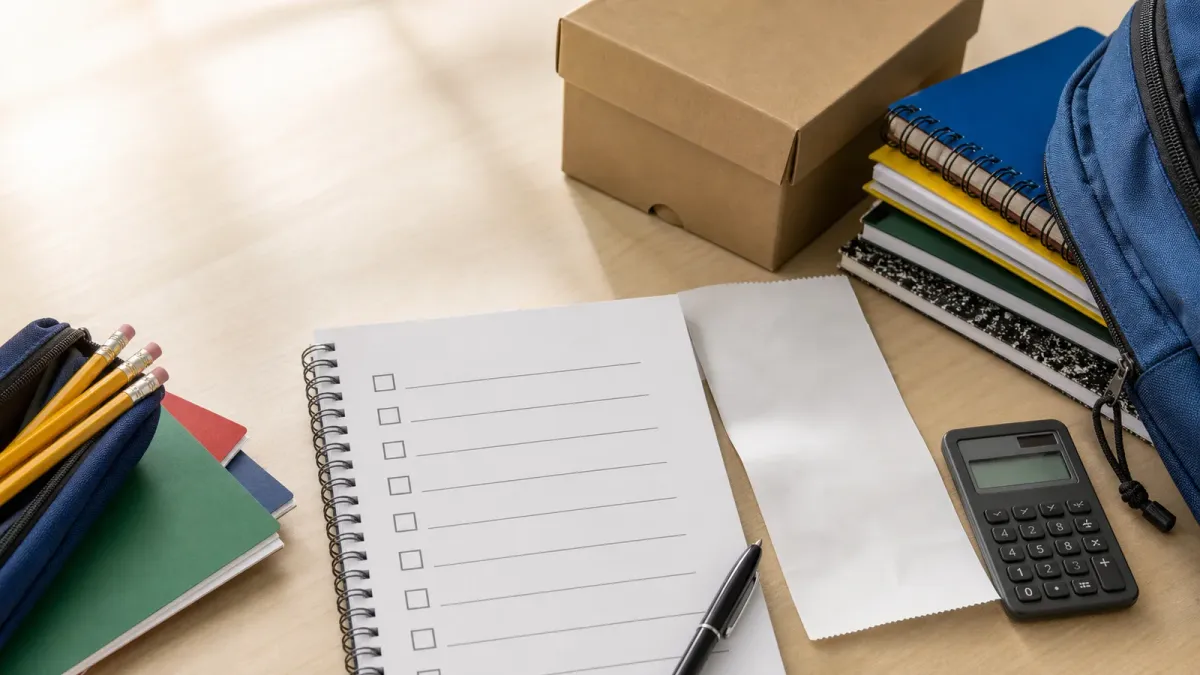
First, make a short list of the expensive items you actually need: shoes, uniforms, backpacks, calculators, tablets or laptops. Second, check whether the item category and price fit your state. Third, compare the tax savings with normal discounts; a non-holiday sale can still be cheaper.
For online orders, read the state guidance before assuming the exemption applies. Timing, shipping destination, payment processing and retailer participation can matter. Texas also warns that items bought before or after the holiday do not qualify for the exemption, and there is no later refund just because the item would have qualified during the window.
Common Mistakes
Do not assume every school-related product counts. Jewelry, watches, sports gear, luggage, printer paper, video game systems or non-school electronics may be excluded depending on the state. Also watch bundles: if a laptop, accessory pack or clothing set crosses a price cap, the tax result may change.
The best use of a tax holiday is a planned purchase you would make anyway. If the holiday pushes you into a bigger basket, a store card balance or a rushed upgrade, the tax break can disappear quickly.


