
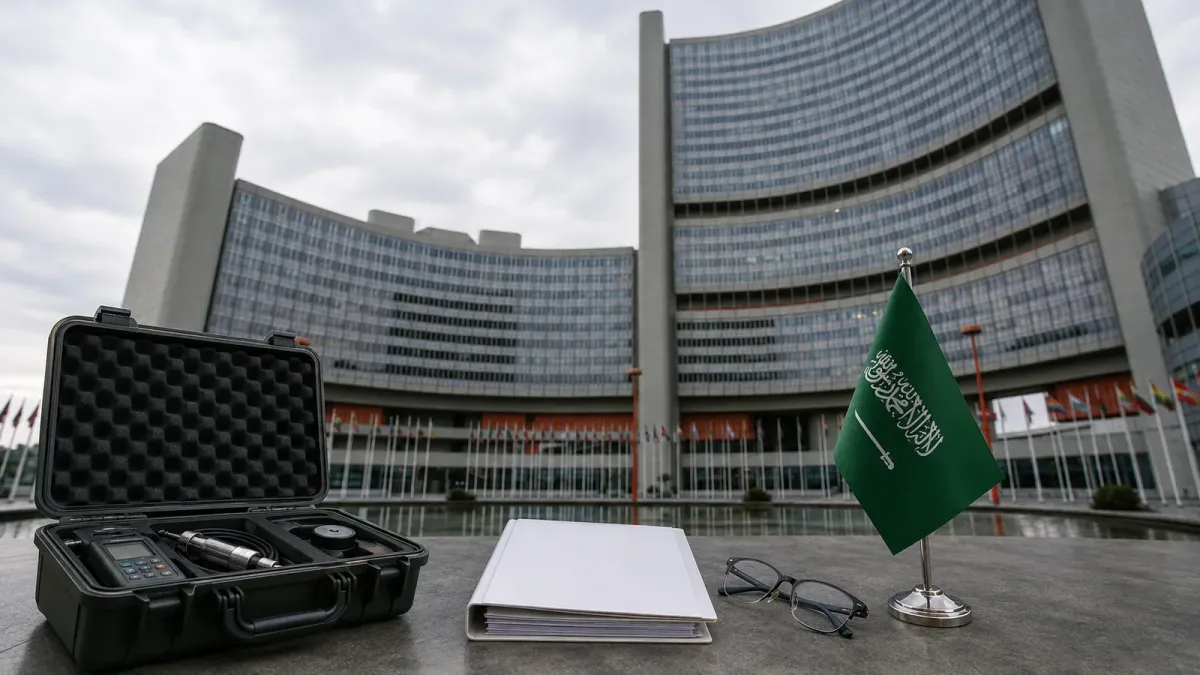
Saudi Arabia is preparing an arrangement that would give the International Atomic Energy Agency broader access to its nuclear program, IAEA Director General Rafael Grossi said on Monday, September 7. The plan is tied to a U.S.-Saudi civil nuclear agreement and could narrow one of the deal’s most important verification gaps.
The short answer is that Riyadh is not expected to sign the IAEA’s full Additional Protocol. Instead, Grossi said Saudi Arabia and the agency are working on something close to it in some areas. The exact language and legal powers have not been made public.
That distinction matters because Saudi Arabia’s agreement with Washington could support nuclear reactors and, after further study, uranium enrichment on Saudi soil. Enrichment can produce fuel for civilian reactors, but the same technology can create weapons-grade material at much higher concentrations.
What ordinary safeguards cover
Saudi Arabia is a party to the Nuclear Non-Proliferation Treaty as a non-nuclear-weapon state. That requires an IAEA safeguards agreement designed to verify that declared nuclear material is not diverted to weapons.
The kingdom previously operated under a Small Quantities Protocol, a lighter arrangement for countries with little or no nuclear material. It moved toward a full comprehensive safeguards system as its civilian nuclear ambitions expanded. Under that system, inspectors can monitor declared facilities and material, review records and verify inventories.
The limitation is the word declared. Traditional safeguards are strongest at sites and with materials a country has formally identified. They can be less effective when inspectors need information about possible undeclared activity.
What the Additional Protocol adds
The Additional Protocol gives the IAEA wider information rights and access. It can allow inspectors to visit locations beyond declared nuclear facilities, seek data about the broader nuclear fuel cycle and conduct short-notice inspections when questions arise.
It was developed after the discovery of undeclared nuclear programs exposed gaps in the older safeguards system. Nonproliferation specialists often treat it as the strongest widely used verification standard, especially for countries planning sensitive technologies such as enrichment or reprocessing.
The U.S.-Saudi agreement announced in July did not require Riyadh to adopt the full protocol. The U.S. Energy Department said the pact includes a separate bilateral safeguards agreement and upholds high nonproliferation standards, but most of the operational details have not been released publicly.
What a bespoke arrangement could do
A tailored agreement could give the IAEA additional information, inspection rights or monitoring tools at the most sensitive Saudi facilities. It could also be written to match the specific technologies supplied under the U.S. deal.
But “close to” the Additional Protocol is not the same as adopting the standardized agreement. The strength of the arrangement will depend on whether inspectors can reach undeclared locations, how quickly access must be granted, what data Saudi Arabia must provide and how disputes are resolved.
Those details are central for Congress, nuclear suppliers and regional governments assessing the deal. The United States has said the agreement will support American industry and Saudi energy diversification; critics argue that enrichment without the full Additional Protocol creates avoidable proliferation risk.
What to watch next
The next useful evidence will be a published safeguards text or a detailed IAEA description of its authority. Watch for whether the arrangement is legally binding, whether it includes short-notice access, and whether it applies to every part of a future Saudi fuel cycle.
For now, Grossi’s announcement is a meaningful signal of added oversight, but not a final answer. The verification standard can be judged only when the promised access is defined in enforceable terms.


