
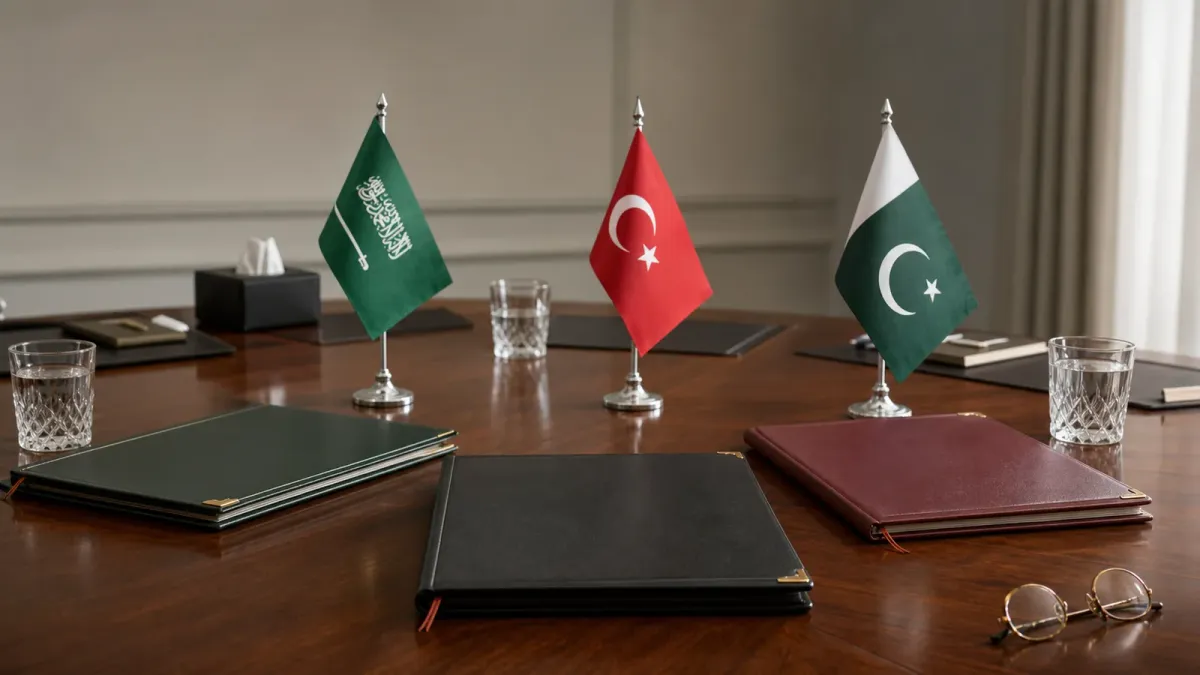
Saudi Arabia, Turkey and Pakistan signed a joint defense agreement in Makkah on Friday, August 7, 2026, creating a collective-defense pledge among three major Muslim-majority powers.
The public statement from Pakistan's Ministry of Foreign Affairs says the Makkah Joint Defence Agreement is meant to strengthen deterrence and states that any armed attack against one of the three countries will be regarded as an attack against all three.
That is the new fact that matters: a security relationship that was already close is now being framed as a formal attack-on-one commitment, even though the public statement does not spell out what each government would be required to do in a crisis.
What changed
The agreement was signed after Saudi Crown Prince and Prime Minister Mohammed bin Salman received Turkish President Recep Tayyip Erdogan and Pakistani Prime Minister Shehbaz Sharif at Al-Safa Palace in Makkah, according to the official statement.
The three governments said they were building on historical ties, shared strategic interests and existing defense cooperation. The statement also says the pact provides for enhancing all aspects of defense cooperation among the three states.
AP separately reported that officials from all three countries confirmed the pact and described it as a move to solidify cooperation at a time of growing security concerns. Al Jazeera also reported the agreement as a joint defense pact signed in Makkah.
Why it matters
For readers outside the region, the immediate consequence is not a new war plan. It is a signal that Saudi Arabia, Turkey and Pakistan want a more explicit security umbrella at a time when regional conflict, maritime risk and doubts about old security assumptions are reshaping Middle East diplomacy.
The agreement links Saudi Arabia's Gulf influence, Turkey's NATO-member military and defense industry, and Pakistan's large armed forces in a way that other governments will study closely. It could affect how Iran, Israel, India, the United States and Gulf states read deterrence signals, crisis messages and future arms cooperation.
The most important caveat is that the public statement leaves operational details unresolved. It does not publish the treaty text, define the threshold for an armed attack, describe automatic troop deployments, or explain how the three governments would coordinate command decisions during a fast-moving crisis.
What happens next
Watch for implementing steps rather than slogans. The practical tests will be whether the three countries announce joint exercises, defense-industrial projects, intelligence coordination, air or maritime deployments, or a formal consultation mechanism.
Regional reaction will also matter. If rivals treat the pact as a defensive signal, it may add deterrence without immediate escalation. If they treat it as a new bloc, the agreement could become another pressure point in a region already balancing wars, shipping routes and energy security.


