
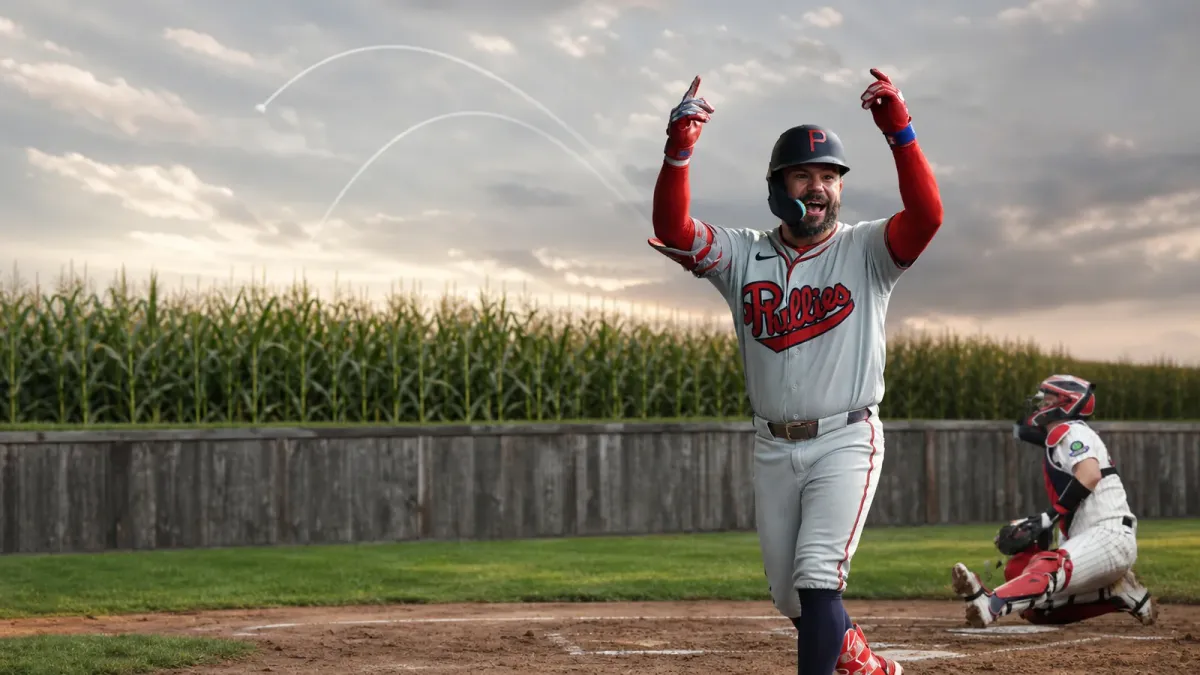
Kyle Schwarber turned Major League Baseball's return to the Field of Dreams into a Philadelphia power show. He homered on the first plate appearance of the game, hit a second home run in the fourth inning and finished with three RBIs as the Philadelphia Phillies beat the Minnesota Twins 7-1 on August 13, 2026, in Dyersville, Iowa.
The final score was clear, but the sequence mattered. Schwarber's leadoff shot immediately shifted the special-event game from ceremony to competition. His two-run homer in the fourth stretched a one-run contest into a 4-1 Philadelphia lead, and Bryce Harper followed with an RBI single before the inning ended. By then, the Twins were chasing the game rather than shaping it.
Aaron Nola supplied the other half of Philadelphia's formula. The right-hander allowed one earned run over five innings, struck out nine and worked around five hits and three walks. Four Phillies relievers then combined for four scoreless innings, while Brandon Marsh's two-run homer in the seventh completed the scoring.
How Philadelphia took control
The Phillies scored twice in the first inning. Schwarber's solo home run, his 36th of the season, was followed later by Bryson Stott's RBI single that brought Harper home. Minnesota answered in the second when Luke Keaschall hit a solo homer, but that was the Twins' only run.
Schwarber came up again in the fourth with Marsh aboard and sent another ball over the right-field wall for home run No. 37. Harper's single later in the inning scored Trea Turner and made it 5-1. The Phillies finished with 12 hits, did not commit an error and left eight runners on base. Minnesota had eight hits but stranded nine runners.
The official MLB game feed lists Schwarber at 2-for-5 with two runs, two home runs and three RBIs. Nola earned the win, improving to 4-9, while Twins starter Taj Bradley took the loss after allowing five runs over four innings. Philadelphia improved to 65-58; Minnesota fell to 60-63.
Why this Field of Dreams game felt different
This was the third major-league game staged at the Iowa site associated with the 1989 film and the first since 2022. MLB's official event page says the 2026 edition followed the Yankees-White Sox game in 2021 and the Cubs-Reds game in 2022. The Phillies and Twins played before an announced crowd of 7,163, and the game lasted two hours and 52 minutes.
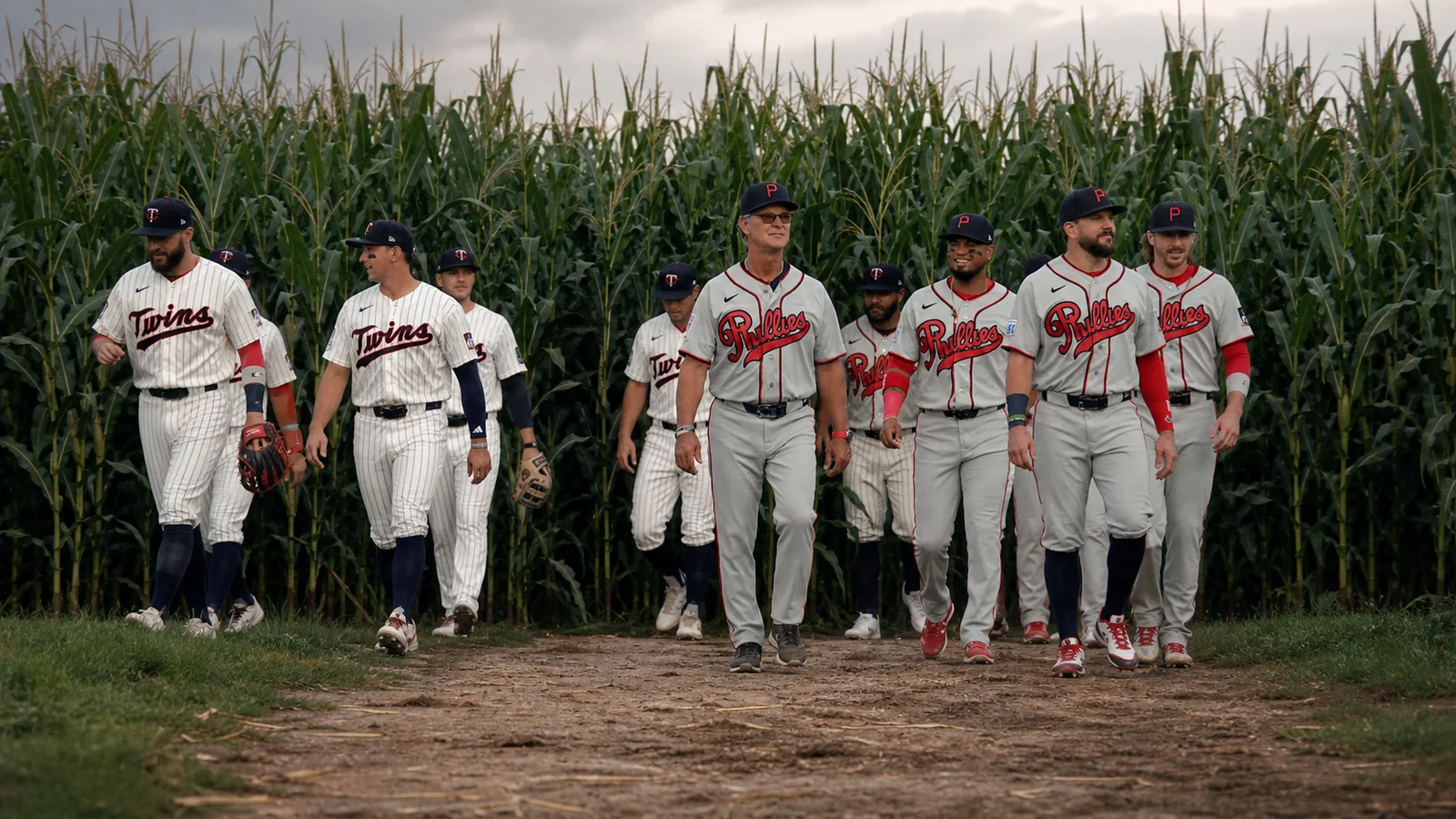
The visual presentation leaned into baseball history. Philadelphia wore gray uniforms inspired by the club's 1939-41 look, while Minnesota used white pinstripes based on its original 1960s uniforms. Players entered through the cornstalks, and Hall of Fame members were part of the pregame presentation. Those details created the setting, but Schwarber's performance supplied the sporting memory the event needed.
That distinction matters for a showcase game. The Field of Dreams setting is designed to sell memory and atmosphere, yet the format works best when the baseball produces a moment that stands on its own. A leadoff homer from one of the sport's most recognizable power hitters created that moment before the novelty could become the whole story. His second homer turned it from a single highlight into the defining performance of the night.
The quieter reason Philadelphia won
Schwarber's two swings will own the replay package, but Philadelphia's pitching kept the game from becoming a late-inning spectacle. Nola threw 97 pitches and recorded 58 strikes. The Twins put runners on base in several innings, but their only extra-base scoring came on Keaschall's homer.
The bullpen protected the margin without giving Minnesota a comeback opening. Brooks Raley, Alec Bowlan, Orion Kerkering and Jhoan Duran covered the final four innings. Duran, pitching against his former team, finished the ninth with a double play. The Phillies' defense played a clean game behind them.
For Minnesota, the missed opportunity was not a lack of baserunners. The Twins collected eight hits and three walks against Nola, yet scored only once and went quiet after the second inning. That gap between traffic and production is what turned a potentially competitive showcase into a six-run loss.
What comes next
The result counts like any other regular-season game. Philadelphia and Minnesota continue their series at Target Field on Saturday, August 15, with another game scheduled for Sunday, August 16. The Phillies carry a winning record out of Iowa; the Twins return home needing to convert more of their baserunners into runs.
The enduring image will be Schwarber in Philadelphia's retro uniform driving two balls toward the corn. The more useful baseball takeaway is broader: the Phillies paired immediate power with enough pitching depth to remove nearly every path back into the game. On a night built around nostalgia, that was a thoroughly current formula for winning.


