
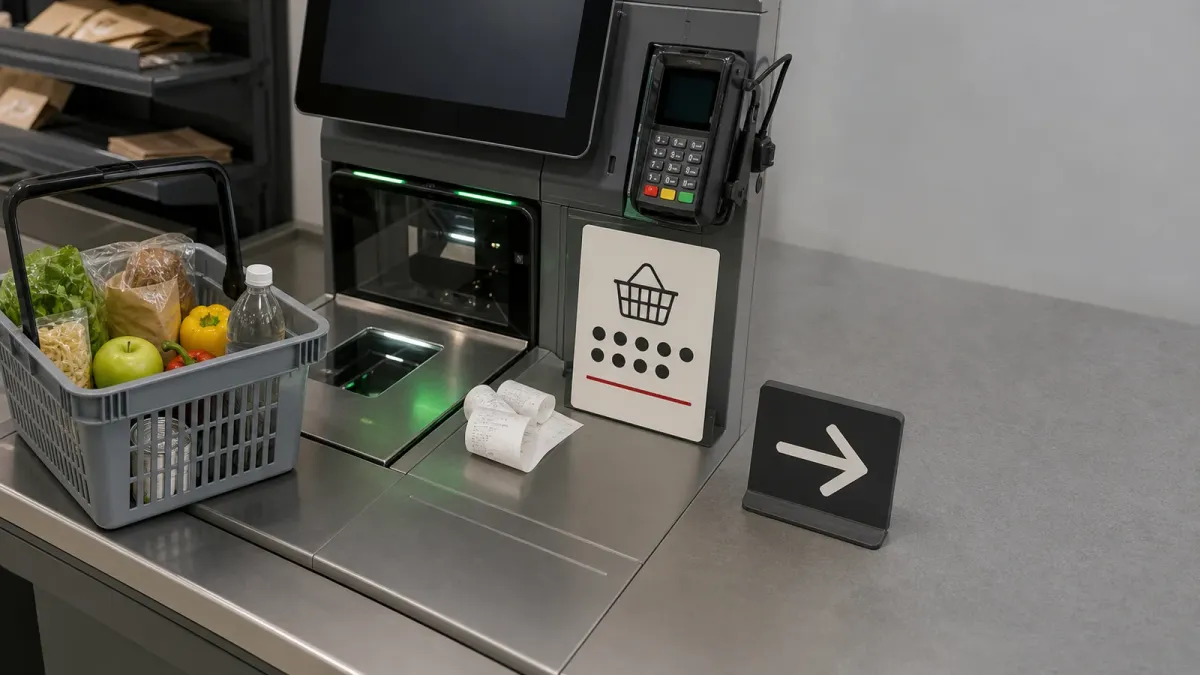
Self-checkout is back in the spotlight. Google Trends listed “self-checkout” as an active U.S. search trend on July 19, 2026, with more than 20,000 searches in the past day and a sharp rise from normal interest.
The reason is bigger than one store. Some shoppers are seeing more item caps, staff monitoring, closed kiosks or receipt checks, while lawmakers in several places are testing whether self-service lanes need clearer rules. The practical takeaway is simple: before you start scanning, check what that lane actually allows.
Do this first
- Look for an item limit. Long Beach, California, says covered food and drug retailers with self-service checkout must limit purchases at those stations to no more than 15 items.
- Check whether a staffed lane must be open. Rhode Island legislation would require grocery stores operating self-checkout stations to have at least one manual checkout station for every three self-service stations in operation.
- Move restricted items to a cashier. Long Beach guidance says covered stores must keep self-checkout from being used for items requiring ID, such as alcohol or tobacco, and for merchandise locked up or carrying special theft-deterrent devices.
- Do not assume a discount exists. A New York Assembly bill introduced May 28, 2026, would require food retailers to take 10% off goods bought through a self-service checkout kiosk, but the bill was still in Assembly committee as of the official bill page reviewed July 19.
Why stores are changing the lane
Self-checkout sits between convenience, labor, theft prevention and accessibility. Stores like the speed and staffing flexibility. Shoppers like skipping a line when they have a small basket. Problems start when a kiosk becomes the only practical option, when one employee is expected to monitor too many stations, or when a purchase includes items the machine cannot finish cleanly.
That is why the current rules focus less on banning self-checkout and more on guardrails. Rhode Island’s bill text defines self-service checkout as scanning, bagging and paying without human assistance, then ties it to a staffing ratio. Long Beach’s ordinance guidance pairs item limits with supervision, public signage and restrictions on ID-check and locked-up items.
What to check at the store
Start with the sign at the lane. If it lists an item cap, do not treat the kiosk as a shortcut for a full cart. If your basket includes alcohol, tobacco, medicine behind a counter, a locked-case item, a security-tagged product or anything that needs employee approval, a staffed lane may be faster.
Keep the receipt until you are outside the store. Even where receipt checks are routine, the simplest way to avoid a delay is to have the transaction record ready. If a kiosk freezes, double-scans or misses a coupon, ask for help before paying rather than trying to fix the problem after the receipt prints.
The bottom line
Self-checkout is not disappearing, but it is becoming less uniform. The same chain may run kiosks differently by city, state, store size or theft-prevention policy. Treat the lane like a local rule set: check the sign, scan only what the kiosk is built to handle, and switch to a staffed lane when the basket is complicated.


