
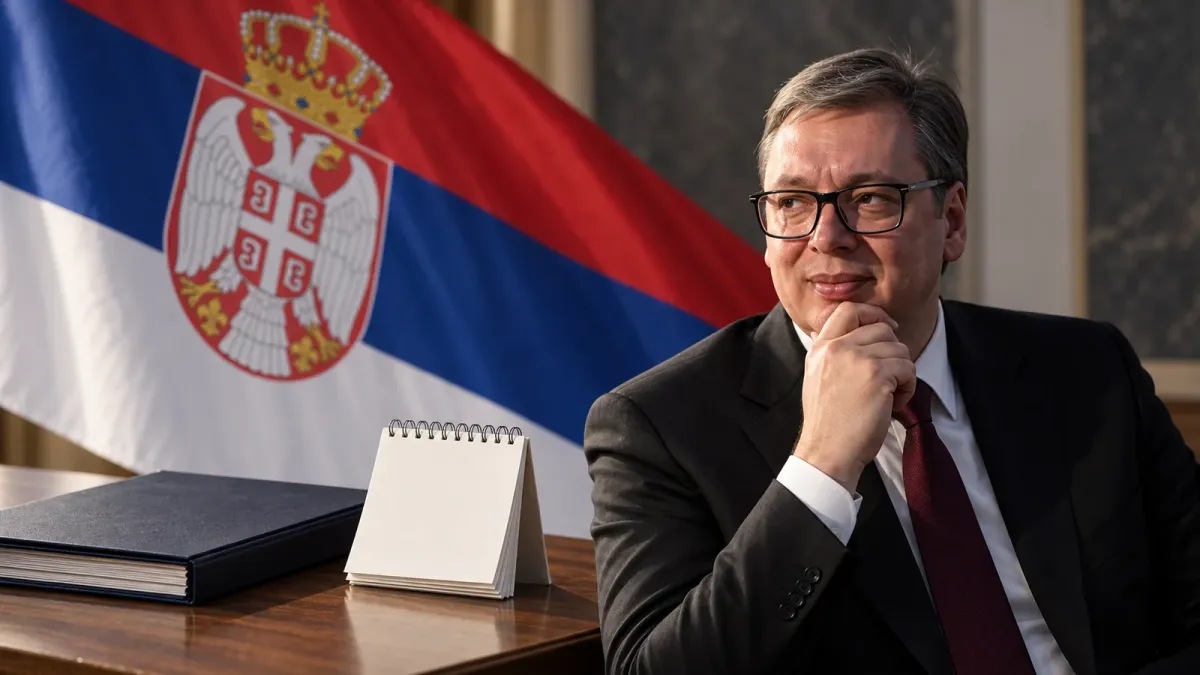
Serbia will hold an early parliamentary election on October 25 after President Aleksandar Vučić dissolved the country's 250-seat National Assembly on Wednesday, September 9. The decree starts a compressed campaign after nearly two years of student-led protests that have posed the most sustained challenge to Vučić's rule.
The immediate consequence is that political conflict moves from the streets toward a national ballot, but the election will not automatically settle the questions driving the protests. Opposition groups and international observers will be watching access to media, pressure on public employees, campaign conditions and the administration of the vote.
Vučić said an early election was needed after what he called major turbulence and deep divisions. The Serbian government said the decree dissolves the parliament elected in December 2023 and that election deadlines begin once the decision takes effect through publication in the Official Gazette.
Why the election was called now
The protest movement began after a concrete canopy collapsed at the renovated railway station in Novi Sad on November 1, 2024, killing 16 people. Demonstrators demanded accountability for the disaster and broader action against corruption they blamed for unsafe public works.
The movement grew into near-daily demonstrations that sometimes drew hundreds of thousands of people. Students had demanded an early parliamentary election for more than a year. Vučić, who has dominated Serbian politics since 2012, had resisted setting a date until now.
The timing gives governing parties just over six weeks to defend their majority. It also forces a student-backed movement that developed outside traditional party structures to translate street support into candidates, local organization and votes.
What voters will choose
The October 25 ballot is for parliament, not the presidency. Vučić cannot seek another presidential term after two nearly full terms. He has said he plans to resign the presidency and run for prime minister, although the formal candidate lists and campaign arrangements will determine the choices voters actually see.
A student-backed list is expected to include university professors and experts, while several center-left and right-wing opposition parties also plan to compete. The opposition's central challenge is coordination: multiple lists can broaden representation, but they can also divide voters seeking change.
Why international observers matter
The OSCE's Office for Democratic Institutions and Human Rights had already begun preparing for a possible observation mission before the date was announced. Its July needs-assessment work and advance recruitment indicate that outside monitors expect election administration and campaign conditions to receive close scrutiny.
That scrutiny follows long-running concerns about media pluralism, pressure on public-sector workers and public resources in Serbian elections. It does not predetermine the outcome, and Serbia's authorities deny accusations that democratic freedoms have been curtailed.
Vučić has also accused unnamed foreign powers of contributing to unrest, without offering evidence in Wednesday's announcement. Such claims are likely to be a campaign theme as the government casts the election as a choice between stability and disruption, while opponents frame it as a test of accountability.
What happens next
Election authorities must publish the calendar for candidate registration, campaigning, voter lists and election-day procedures. An official invitation would allow the OSCE to confirm and deploy its monitoring mission.
The decisive questions are whether the student-backed list can stay unified, whether established opposition parties cooperate or compete, and whether the campaign is broadly trusted. The October 25 result will shape not only Serbia's government but its stalled path toward European Union membership and its balance between ties with Europe, Russia and China.


