
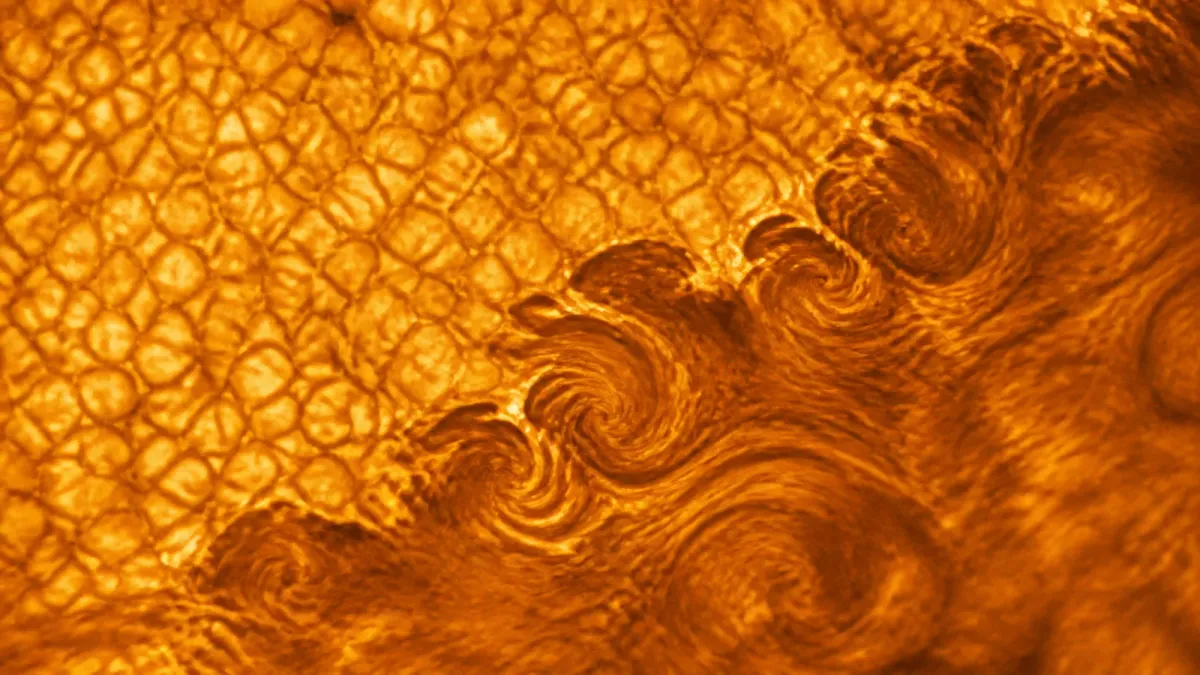
The sharpest visible-light image yet of the Sun is more than a spectacular close-up. It shows tiny whirlpool-like patterns that scientists say may help explain how the Sun stores and releases magnetic energy.
The U.S. National Science Foundation National Solar Observatory announced the discovery on August 5, 2026, after researchers used the Daniel K. Inouye Solar Telescope on Maui to identify Kelvin-Helmholtz instability in the Sun's photosphere, the visible surface layer. NASA featured the image on August 6 as its Astronomy Picture of the Day.
The short version: scientists have long expected this kind of instability on the Sun, but the new images gave them the resolution needed to see it directly at the edges of magnetic structures. That matters because small motions at the surface may help feed the larger solar activity that can affect satellites, GPS, radio communications and power grids on Earth.
What the image shows
The image was captured at 416 nanometers by the Inouye Solar Telescope, the world's largest solar telescope. NASA's APOD description says the false-yellow view was actually taken in deep blue light and spans roughly the radius of Earth, while still revealing city-sized details.
At first glance, the Sun's surface looks like a field of bright, flower-like cells. The important detail is at the edges. There, the new observations show fine stripes and deformed boundaries where magnetized plasma is moving in different directions or at different speeds.
That is where Kelvin-Helmholtz instability can appear. The same broad physics can show up when wind pushes over water and creates waves. On the Sun, the medium is not ocean water but hot, electrically conducting plasma threaded by magnetic fields.
Why scientists care
Solar physicists are trying to understand how energy moves from the Sun's visible surface into its outer atmosphere, the corona. The corona is far hotter than the photosphere, and scientists have spent decades studying how magnetic fields, waves and small-scale turbulence may help drive that mismatch.
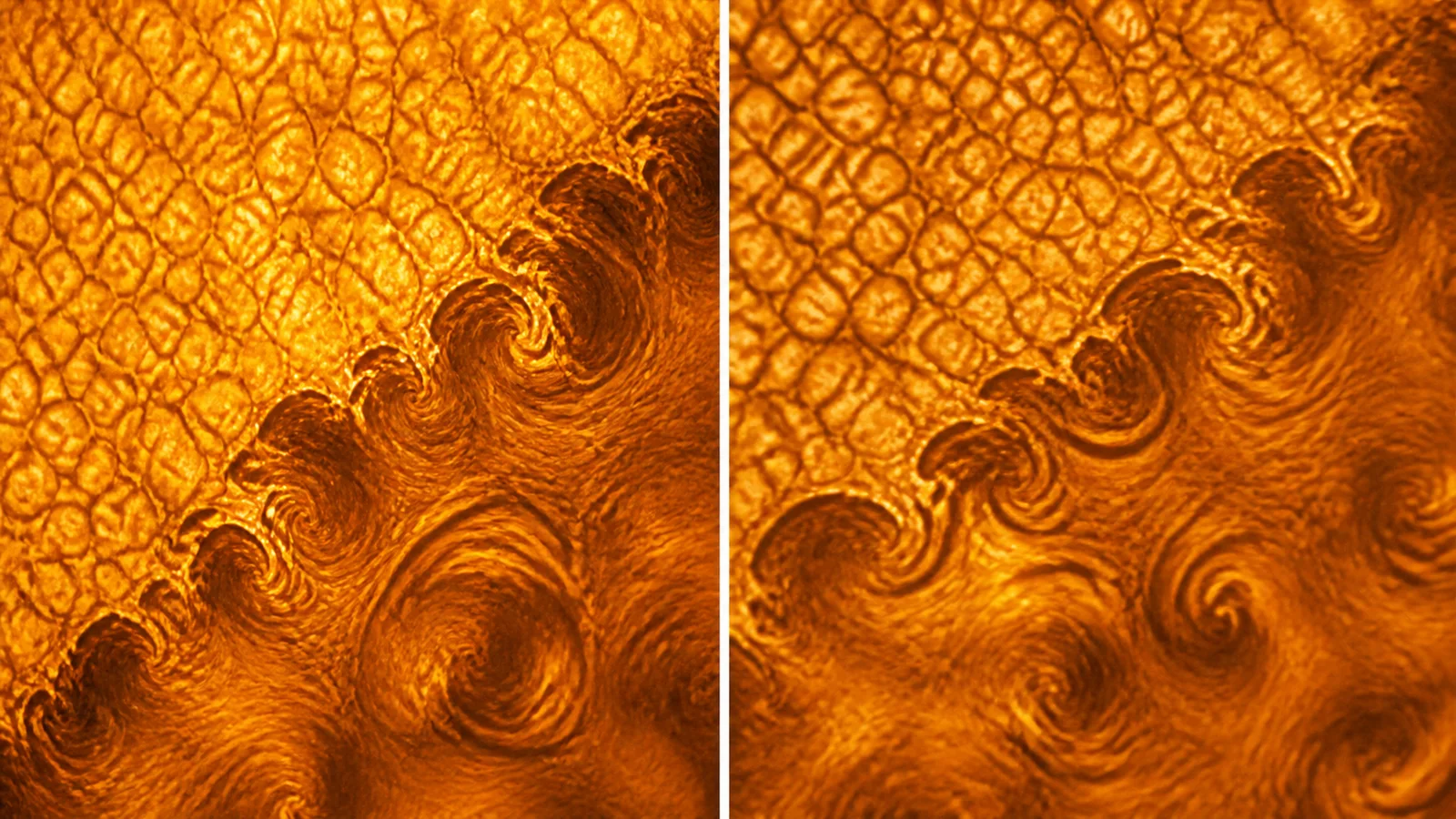
The NSO release says researchers compared the telescope observations with computer simulations and found dozens of vortex-like structures with similar behavior in both. One measured detail was especially useful: the average spacing between vortices, described as the instability wavelength, ranged between 50 and 65 kilometers in the observations and simulations.
That agreement gives the team stronger evidence that the patterns are not just a visual curiosity. They are signatures of a physical process that may help mix magnetized and non-magnetized plasma and bend the boundaries of magnetic structures.
The space-weather connection
The discovery does not mean a specific solar storm is coming. It is not a forecast, and readers should not treat it as an alert. The value is more basic: better physics can improve the models scientists use to understand solar flares, coronal mass ejections and the broader space-weather environment.
Coronal mass ejections can send charged material and magnetic fields into space. When strong events interact with Earth, they can disturb satellites, navigation signals, communications and some power-grid systems. Better knowledge of the small processes that twist and move magnetic fields can help researchers understand how larger eruptions become possible.
The Sun's surface is constantly bubbling with granulation, and magnetic structures do not sit still. The new images suggest that tiny swirls along magnetic boundaries may be part of the everyday machinery that twists magnetic fields and transfers energy upward.
What happens next
The research is published in Nature under the title Ubiquitous Kelvin-Helmholtz Instabilities Driving Plasma Mixing on the Sun. The next phase is less about a single image and more about scale: scientists want automated methods that can find and study many of these swirling patterns across high-resolution solar data.
That could help answer two practical questions. First, how much energy do these small instabilities carry into the Sun's upper atmosphere? Second, how much do they affect the diffusion and rearrangement of magnetic fields in the lower solar atmosphere?
For non-scientists, the takeaway is simple: the Sun's biggest events may depend partly on motions that are small enough to have been hidden until now. A sharper image did not just make the Sun look more detailed. It gave researchers a new way to see the mechanics behind the star that modern technology depends on understanding.


