
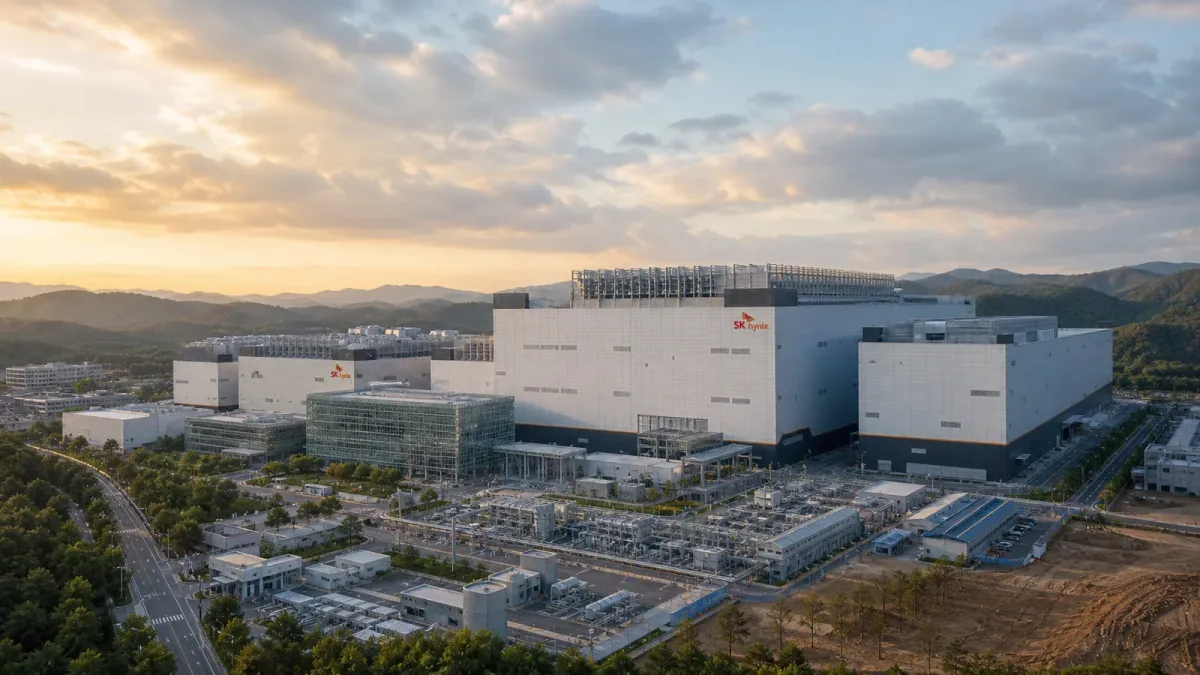
SK hynix approved about 54.3 trillion won, or roughly $38 billion, for two new memory-chip fabrication projects in South Korea on Friday, August 7, putting a fresh date and price tag on the AI infrastructure race.
The plan matters because it does not promise quick relief. The company said the Cheongju M17 cleanroom is targeted for December 2028 and the Yongin Y2 cleanroom for June 2029, meaning today’s shortage-driven memory market could stay tight while builders of AI data centers keep ordering high-bandwidth memory, DRAM and enterprise storage.
The numbers
SK hynix said its board approved 35.2 trillion won for the Yongin Y2 fab and 19.1 trillion won for the Cheongju M17 fab. Yongin Y2 is planned as a DRAM base for high-bandwidth memory and other next-generation products, while Cheongju M17 is aimed at NAND flash used in enterprise SSDs.
The company said construction on Y2 is scheduled to begin in July 2027 and run through October 2031. M17 is scheduled to break ground in February 2027, with investment running through April 2031.
The Wall Street Journal separately reported the same board approval and site split on Friday, describing the move as an expansion of semiconductor production capacity in South Korea as AI demand grows.
Why AI buyers care
High-bandwidth memory has become one of the scarce inputs behind advanced AI chips. Training and running large models depends not only on processors, but also on fast memory close enough to feed those processors without slowing the whole system.
SK hynix framed the decision as a supply-timing bet. Its release cited Omdia research projecting both DRAM and NAND demand to grow at a 19% compound annual rate from 2025 through 2030, and said memory is becoming core infrastructure for AI performance rather than a background component.
That is the reader consequence: more factories are coming, but not on the schedule of a consumer waiting for cheaper laptops, phones, consoles or PC parts. Big cloud and AI customers can absorb more near-term supply, while new cleanrooms require land, utilities, construction and equipment before they change market balance.
The caveat
This is still a forward-looking capital plan, not guaranteed production. SK hynix said cleanroom expansion and equipment installation will be sequenced with customer demand, a reminder that the final supply impact depends on orders, financing, tools, power and the broader AI cycle.
The announcement also fits a wider South Korean strategy. The Associated Press reported in June that Samsung Electronics and SK hynix planned a combined 800 trillion won, or about $518 billion, chipmaking hub tied to AI demand, with officials pointing to power, water and skilled labor as central constraints.
What to watch next
The first practical checkpoint is whether M17 breaks ground in February 2027 and whether Yongin Y2 follows in July 2027. After that, investors and customers will watch equipment orders, cleanroom openings, and whether AI demand remains strong enough to justify the pace through 2031.
For consumers, the useful takeaway is narrower: a $38 billion memory buildout is a sign that suppliers believe AI demand has staying power, but it is not an immediate price cut. The relief, if it comes, is measured in years.


