
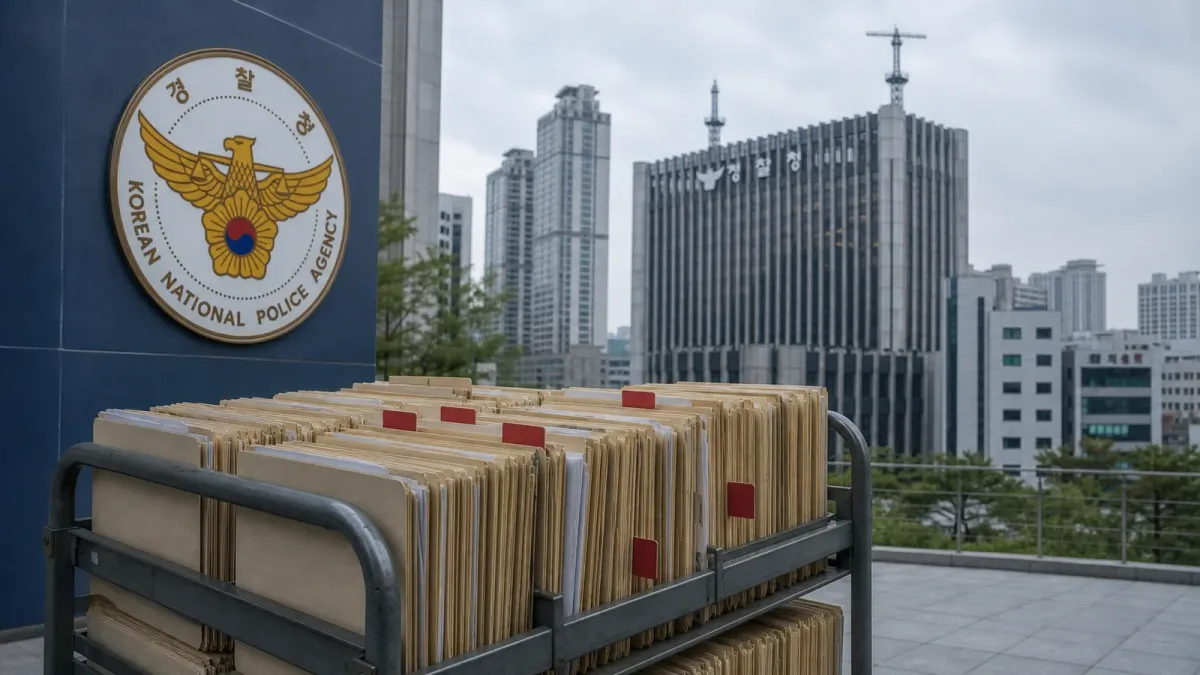
South Korea’s National Police Agency plans to re-examine about 310,000 missing-person cases closed over the past three years, an extraordinary nationwide review prompted by allegations that a Jeju police officer falsely marked two missing adults as safe before their bodies were found.
The agency expects to complete the review by November, according to Yonhap News Agency. Files showing signs of improper or inadequate handling are to be reopened, with metropolitan and provincial agencies conducting continuing checks of cases closed by local stations. The scale turns what began as a local scandal into a test of national police oversight.
The review does not mean that 310,000 people remain missing or that every closure was wrong. Most missing-person reports end when the person is located or returns. The central question is whether officers verified safety and followed required procedures before closing each file.
What triggered the review
The controversy centers on a 37-year-old woman, Jang Mi-ran, who disappeared on Jeju Island in May. Authorities allege that an officer closed the report within hours and told her boyfriend that he had contacted her and that she did not want her location disclosed. Police later said they found no record of that contact. Jang’s body was discovered this week near where she had been staying.
The same officer is accused of using a similar false statement to close the case of a man in his 60s, whose body was also found. The officer has been investigated on suspicion of dereliction of duty and falsifying official electronic records. Yonhap reported Friday that he partially admitted falsely telling Jang’s boyfriend that she had been contacted. Other allegations remain under investigation and should not be treated as proven.
Police initially began reviewing the 298 missing-person reports handled by that officer. The response then widened dramatically. Acting National Police Agency Commissioner Yoo Jae-seong apologized for the handling of the Jeju cases and promised a systemwide examination and institutional changes.
Why adult cases can fall through gaps
The scandal has exposed a distinction in South Korean law between people who fall within protected missing-person categories and other missing adults. Children, people with dementia, autistic people and some people with disabilities receive formal protections that can make investigative tools such as location requests, emergency alerts and family-DNA comparisons more readily available.
Other adults may be classified differently, in part because adults generally have a right to leave without disclosing their location. That privacy principle is important, but it can create a dangerous gap when an officer closes a report without direct, reliable confirmation that the person is safe.

The problem is therefore not solved by treating every missing adult as a crime victim. Police need a process that respects autonomy while requiring verifiable contact, documented supervisory review and rapid escalation when circumstances suggest coercion, injury or foul play.
What police say will change
The nationwide review is designed to identify cases most vulnerable to improper closure, verify whether the missing people are safe and determine whether officers followed procedure. Cases that cannot withstand that check are expected to be reopened and referred to the appropriate regional authority.
Officials have also discussed ending non-face-to-face closure in sensitive circumstances, strengthening managerial approval and requiring regular reviews by higher-level police agencies. South Korea’s Interior Ministry ordered a broader examination of the missing-person system and emphasized that reforms should prevent cases from being buried or colleagues from shielding one another.
Those safeguards matter because the police are preparing to receive greater investigative authority as South Korea restructures its prosecution system. Expanding police power without stronger auditing, documentation and accountability would deepen the public-trust problem exposed by Jeju.
What remains unknown
Authorities have not said how many of the 310,000 files are likely to be reopened, how many people remain unlocated or what resources will be assigned to renewed investigations. The causes and circumstances of the deaths that triggered the scandal also remain subjects of active investigation.
The review’s credibility will depend on transparent standards: what evidence counts as confirmation of safety, who checks an officer’s decision, how families are notified and how police report newly identified failures. A large number alone is not reform. The meaningful measure will be whether questionable closures are found, corrected and prevented from recurring.


