
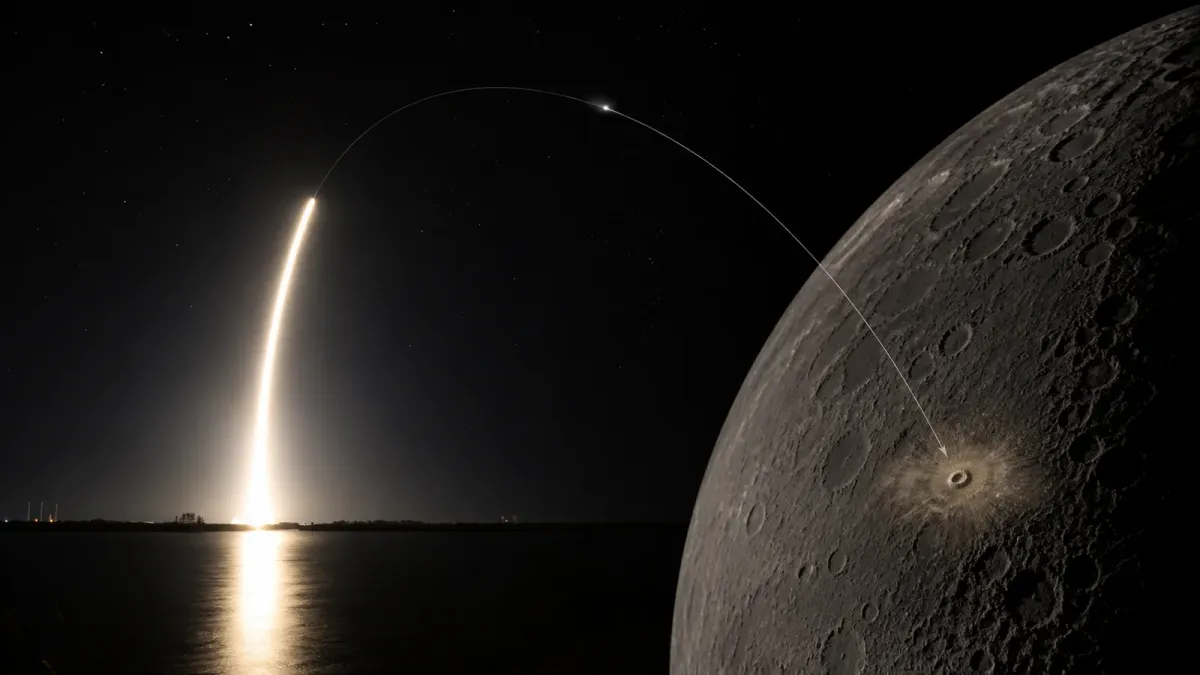
A spent SpaceX Falcon 9 upper stage appears to have slammed into the moon on Wednesday, August 5, 2026, turning a predicted crash into a practical warning about the next phase of lunar exploration.
The impact was not directly photographed at the moment it happened, but astronomers told The Associated Press they were confident the rocket body hit near Einstein Crater after a telescope in Chile detected sodium and lithium consistent with a debris plume. The upper stage had been drifting since a January 15, 2025 launch that sent Firefly Aerospace's Blue Ghost and ispace's Resilience landers toward the moon.
The immediate risk to people on Earth was zero. The larger issue is that a moon increasingly used by governments and private companies will need better traffic rules for abandoned hardware, failed spacecraft and mission parts that do not simply burn up in Earth's atmosphere.
What changed
The object was a Falcon 9 upper stage more than 40 feet long and roughly 4 tons, according to AP's account of tracking estimates. Scientists expected it to strike at about 5,400 mph, near the moon's western limb, where Earth-based observers have a difficult viewing angle.
Project Pluto's Bill Gray had predicted the August 5 impact after tracking the object's orbit. A recent arXiv physical-characterization paper also linked the object to the 2025 lunar launch and described it as a useful benchmark for identifying future cislunar objects.
Visual confirmation may take longer. NASA's Lunar Reconnaissance Orbiter is expected to image the site after a later pass, which could show the new crater and help scientists compare predictions with the actual scar left on the surface.
Why it matters
Lunar impacts are not new. NASA intentionally crashed spent rocket stages during the Apollo era, and other spacecraft have hit the moon accidentally. What is changing is the amount of planned activity around the moon, from robotic cargo deliveries to NASA's Artemis program and commercial landers from companies including SpaceX and Blue Origin.
That makes the crash less a freak accident than an early stress test. If a dead upper stage can be tracked for months and still become a lunar impactor, future mission planners will need clearer disposal plans, better object catalogs and shared expectations about who is responsible when hardware is left in cislunar space.
What to watch next
The next useful update should come from orbital imagery. If LRO or another spacecraft confirms the crater, scientists can compare the location, size and ejecta pattern with pre-impact models. That would improve tracking methods for later debris and help mission teams judge how far future landers, instruments and astronaut sites should be from possible impact zones.
The policy question will last longer than the crater photos. As the moon becomes a destination for repeated commercial and national missions, space junk is no longer only an Earth-orbit problem.


