
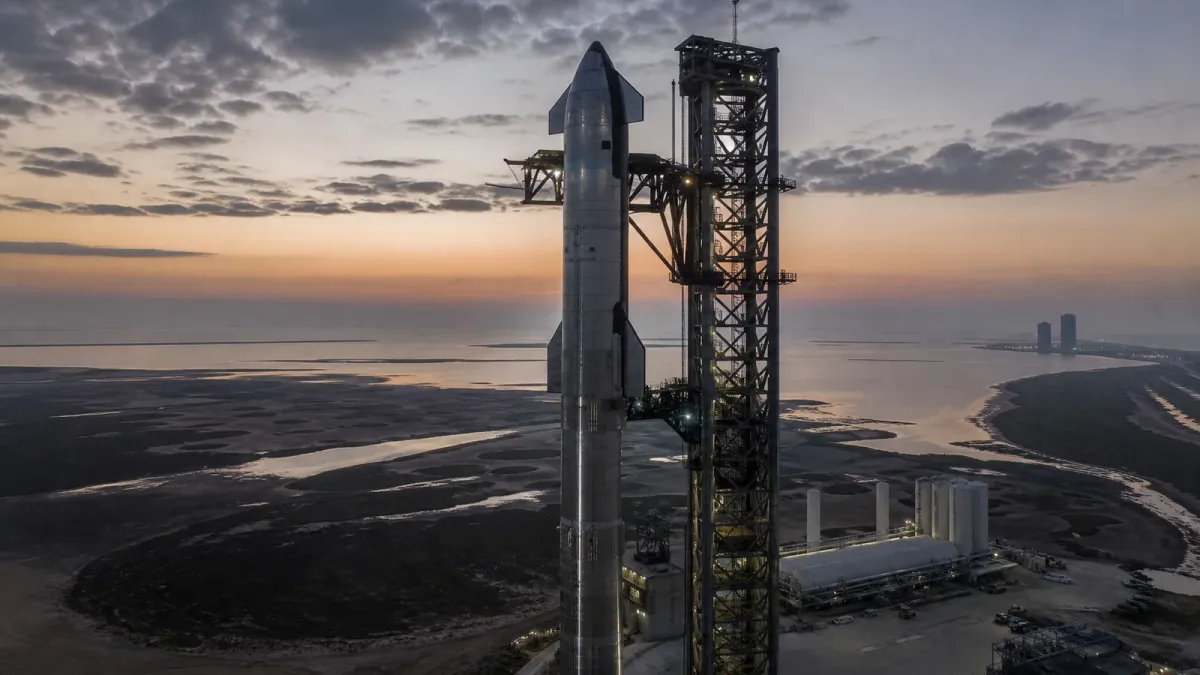
SpaceX is preparing to try again with Starship Flight 13 on Thursday, July 23, after a last-second abort stopped the previous attempt before the rocket left the pad in South Texas.
The company says the 90-minute window opens at 5:45 p.m. CT, with a webcast expected about 30 minutes before liftoff. The schedule can still move because Starship remains a developmental test program, not a routine launch service.
The retry matters because Flight 13 is supposed to show whether SpaceX has tightened several weak points from the prior Starship test and from the July 16 abort: booster engine startup, engine relight, Starlink satellite deployment and heat-shield inspection during flight.
What SpaceX wants to test
The Super Heavy booster’s main assignment is straightforward but demanding: launch, climb, separate from Starship, perform a boostback burn and complete a landing burn toward an offshore splashdown point in the Gulf of America.
SpaceX says hardware and software changes were made after Flight 12, when the booster’s post-separation flip was off target and five of its 33 engines had trouble relighting. For Flight 13, the company says it adjusted startup sequencing, engine alarms and abort logic to better match the conditions seen during multi-engine flight.
The Starship upper stage has its own checklist. SpaceX plans to deploy 20 Starlink V3 satellites, relight one Raptor engine in space and guide the vehicle through another controlled entry, descent and splashdown in the Indian Ocean.
Why the satellites are part of the test
The Starlink payload is not only about internet capacity. SpaceX says the V3 satellites are expected to extend their solar arrays and antennas, attempt laser links with the larger Starlink constellation and then reenter on the same suborbital path as Starship.
Six of the satellites are also carrying cameras intended to scan Starship’s heat shield. SpaceX says several tiles on Starship were painted white to simulate missing tiles and give the cameras clear inspection targets.
That makes Flight 13 a heat-shield data mission as much as a rocket test. SpaceX is also flying modified tiles, new attachment mechanisms and load-sensing tiles to measure stress as the vehicle faces higher dynamic pressure on ascent.
The safety context
The Federal Aviation Administration closed its investigation into the Flight 12 mishap on July 13 and said Flight 13 could proceed if SpaceX met all safety and licensing requirements. The FAA said it accepted SpaceX’s findings and corrective actions after the booster was lost during the earlier test, with no reported public injuries or public property damage.
Associated Press reported that the July 16 attempt was stopped when some Super Heavy engines failed to start, triggering an automatic abort seconds before liftoff. That outcome left the rocket on the pad, but it also put more attention on whether the next count can pass cleanly through engine startup.
What to watch next
The first sign to watch is whether SpaceX keeps the July 23 target as inspections continue. If the countdown proceeds, engine startup at the final seconds will be the first major hurdle.
After liftoff, the key moments come at stage separation, booster relight, Starlink deployment and the upper stage’s reentry data. A fully clean flight is not required for SpaceX to learn from the test, but the closer Flight 13 gets to its planned sequence, the more useful it becomes for Starship’s next steps.


