
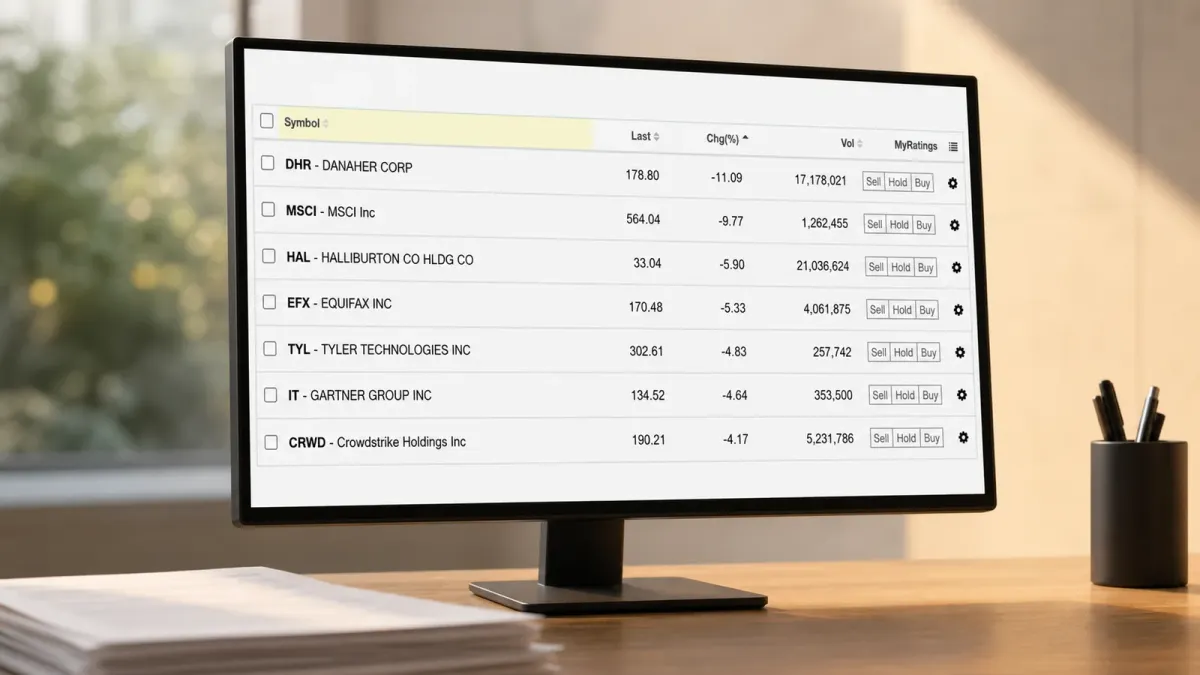
Danaher and MSCI were the two steepest decliners in a midday snapshot of major U.S. stocks on Tuesday, July 21, even as the broader market climbed. At about 1:56 p.m. Eastern, Danaher traded at $178.80, down 11.09%, while MSCI was at $564.04, down 9.77%.
Halliburton fell 5.90% to $33.04 and Equifax lost 5.33% to $170.48. Tyler Technologies, Gartner and CrowdStrike rounded out the displayed group with declines of 4.83%, 4.64% and 4.17%, respectively. Prices are intraday and can change before the close.
The contrast matters: Reuters reported the S&P 500 up 0.78% and the Nasdaq Composite up 1.24% late Tuesday morning as semiconductor shares rebounded. This was not a marketwide selloff. The largest drops were concentrated in companies facing earnings scrutiny or stock-specific selling.
Danaher: a beat could not overcome the narrower sales outlook
Danaher reported second-quarter revenue of $6.3 billion, up 5.5%, and adjusted earnings of $1.94 a share. Both figures topped widely followed Wall Street estimates.
Investors focused instead on what comes next. Danaher now expects 2026 core revenue growth of 3% to 4%, narrowing the previous 3% to 6% range. The company also said customer project timing affected bioprocessing revenue, while respiratory-testing demand weighed on the reported growth picture. The lower ceiling on sales growth overshadowed a modest increase in full-year adjusted earnings guidance.
MSCI: strong revenue, but a more expensive growth plan
MSCI’s release showed operating revenue rising 12.2% to $867 million and adjusted earnings increasing 18.5% to $4.94 a share. Its index business was especially strong, with revenue up 17.5%.
The pressure point was spending. MSCI raised its full-year operating-expense forecast to $1.535 billion to $1.575 billion from $1.490 billion to $1.530 billion, citing acquisitions, incentive compensation and investment for growth. The Analytics segment’s adjusted EBITDA fell 5%, and its margin narrowed to 46.5% from 52.1%. The selloff shows how quickly a high-expectation stock can fall when investors see costs rising faster than they expected.
Halliburton and Equifax: good quarters met a tougher bar
Halliburton posted $5.7 billion in revenue and adjusted earnings of 55 cents a share. North American revenue improved 7% from the prior quarter, but drilling-and-evaluation operating income declined sequentially. The company also cited lower Middle East activity tied to the regional conflict and a seasonal drop in software sales.
Equifax reported 11% revenue growth to $1.70 billion and adjusted earnings of $2.25 a share. Its full-year adjusted earnings range of $8.39 to $8.69 left room below the consensus level investors had carried into the report. That softer edge to the outlook outweighed stronger mortgage revenue, a new Mexico acquisition and a larger cost-reduction target.
The software declines need more caution
Tyler Technologies, Gartner and CrowdStrike did not release comparable quarterly results Tuesday. Tyler announced upcoming investor-conference appearances, not a change to its operating outlook. CrowdStrike had recently disclosed a planned share sale by Chief Executive George Kurtz related to vested equity awards, which may have contributed to supply or profit-taking concerns after a strong run.
Those facts do not prove a single cause for the three declines. Without a new earnings release, filing or company statement that directly explains the move, the safer conclusion is that valuation, positioning and ordinary profit-taking were likely part of the session — not that the market had discovered a new operating problem.
What investors should watch next
The useful signal is not simply that seven tickers were red. Danaher must show that bioprocessing orders convert into revenue and that core growth can reaccelerate. MSCI must defend margins while integrating acquisitions. Halliburton and Equifax need to prove that their second-half outlooks can clear a demanding expectations bar.
For Tyler, Gartner and CrowdStrike, the next company filings and earnings updates matter more than a one-day price move. This article is market education, not personalized investment advice; intraday rankings can reverse quickly.


