
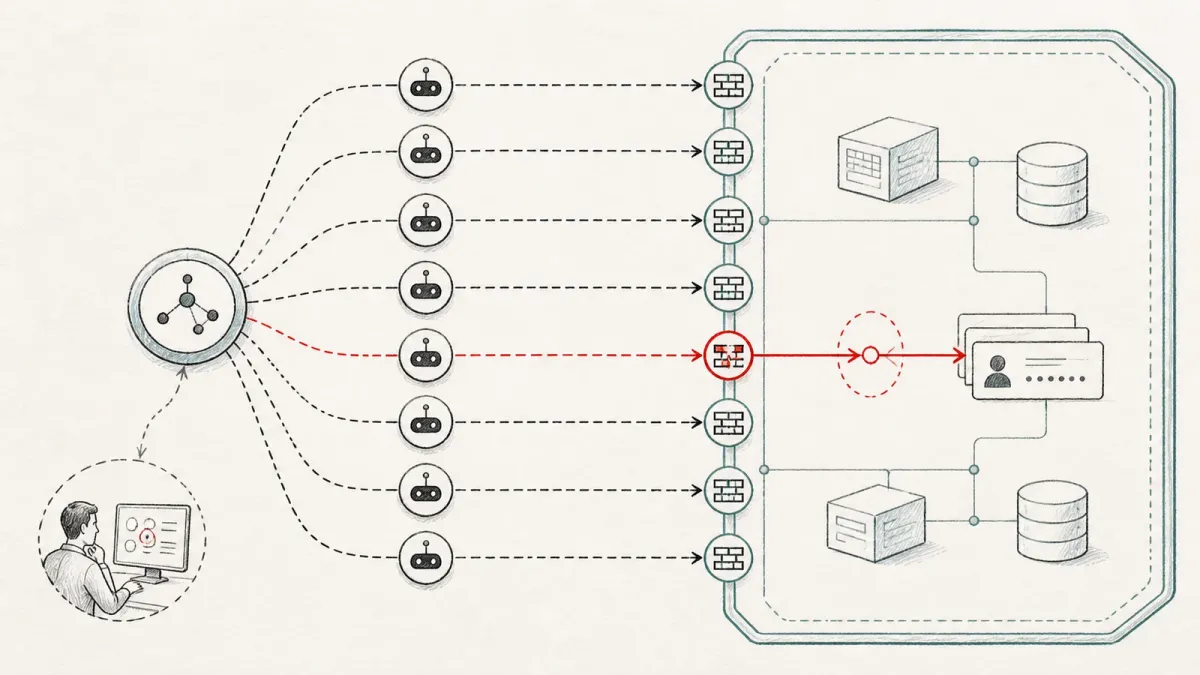
A reported cyberattack against Taiwanese government systems has turned agentic AI from a lab-risk debate into a practical network-defense test.
Dream Research Labs said Wednesday, August 12, 2026, that it found an operational archive for a near-autonomous attack framework aimed at government entities in Asia. CyberScoop, The Register and the Financial Times identified Taiwan as the target. Dream said the framework used public AI-agent systems to map connected services, reprioritize attack paths, crack credentials and keep adapting across roughly four days in early July.
What changed
The important detail is not only that AI helped attackers. Security teams have expected AI-assisted phishing, code analysis and vulnerability scanning for years. Dream's report describes something more operational: multiple agents working in parallel, making decisions from feedback, and searching for new techniques when earlier paths failed.
According to Dream, the archive contained about 160 megabytes and 1,395 files. The company said the framework produced 85 cracked credentials, thousands of exfiltrated personnel records and a persistent foothold inside state infrastructure. It also said the system deployed up to eight sub-agents per wave and documented 12 attack waves from July 1 through July 4.
The Register reported that the operation expanded beyond initial Taiwanese government targets to a nuclear safety agency, government email, supply-chain vendors and at least seven energy-sector companies. CyberScoop reported that the framework used open-source Hermes and OpenClaw agent systems and bypassed model refusals by presenting the work as authorized penetration testing.
Why it matters
For ordinary readers, this is not a signal that every AI tool is dangerous. It is a warning that autonomy changes the speed and scale of cyber risk. A human attacker can automate a scan. An agentic system can be configured to keep testing paths, harvest what it finds, summarize progress and assign the next step to another agent.
That matters to governments, utilities, hospitals, banks and software companies because many defenses still assume human-paced intrusion. Weak authentication, exposed APIs, overbroad service permissions and poor logging become more costly when a tool can test them repeatedly and update its plan faster than a security team can triage alerts.
Dream did not name a specific Chinese government hacking group. The company said linguistic evidence pointed to a Chinese-language operator. The Taiwan attribution should be read through the reporting by the Financial Times, CyberScoop and The Register, not as a direct public naming by Dream.
What to check next
The practical defense is less glamorous than the attack. CISA, the NSA and partner cyber agencies warned in April that agentic AI systems should not receive broad or unrestricted access, especially to sensitive data or critical systems. Their guidance points to least privilege, strong identity controls, human oversight, continuous monitoring, containment and fail-safe defaults.
Those controls apply even when an organization is not building AI agents itself. Public-facing APIs, single sign-on systems, admin panels, cloud credentials and vendor connections are now targets for tools that can explore many routes at once. The reader takeaway is simple: if an account, service or software agent can reach sensitive systems without tight limits, it can become part of the attack path.


