
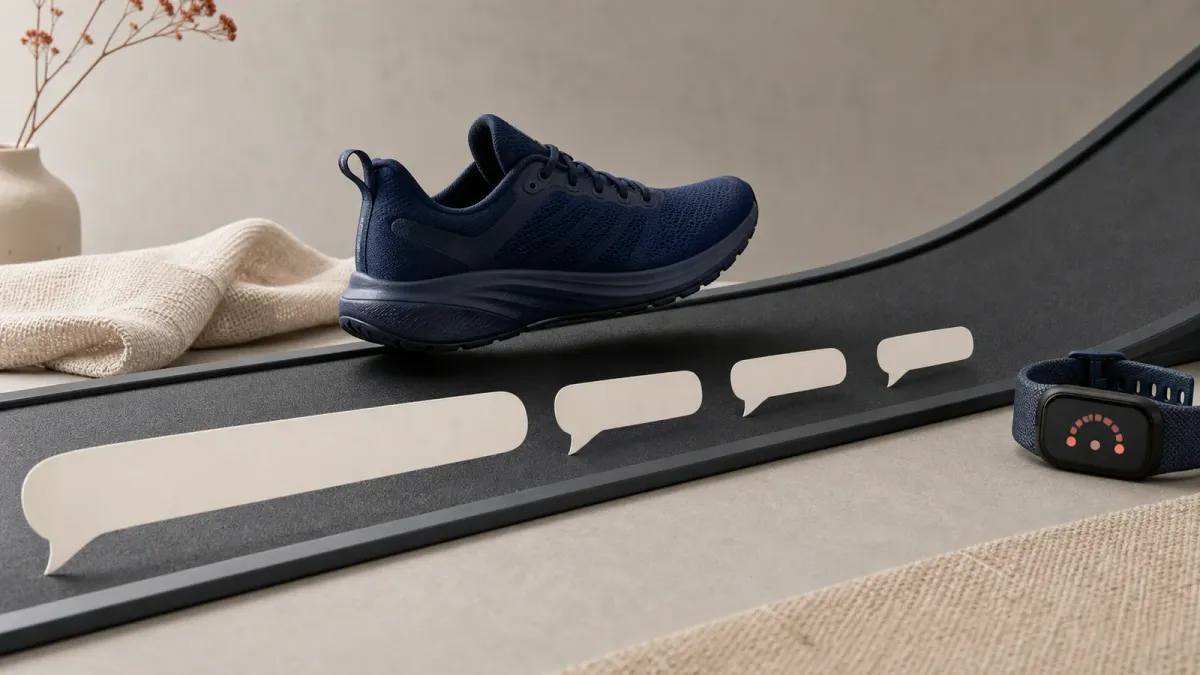
Fitness watches can divide a workout into neat color-coded heart-rate zones, but the numbers may feel less tidy once you start moving. A hill, hot weather, fatigue, medication or the sensor itself can change the reading. One useful cross-check requires no device at all: notice how easily you can speak.
The Centers for Disease Control and Prevention describes moderate-intensity aerobic activity as effort that lets you talk but not sing. During vigorous activity, you generally cannot say more than a few words without pausing for breath. That simple distinction is known as the talk test.
The test will not measure fitness with laboratory precision, and it cannot diagnose a heart or lung problem. It can, however, help many adults choose a sustainable pace for walking, cycling, jogging or another continuous aerobic activity—and spot when a wearable target does not match perceived effort.
The short answer
After warming up, settle into a steady pace and say a full sentence aloud. If you can speak comfortably but would struggle to sing, you are probably working at a moderate intensity. If you can manage only a few words before taking a breath, the effort is likely vigorous. If singing would be easy, the activity is probably light for you.
The key phrase is for you. A brisk walk may be moderate for one person, vigorous for another and light for someone with more training. Federal guidance uses relative intensity for exactly that reason: the same speed does not create the same demand in every body.
How the talk test works
As exercise intensity rises, working muscles require more oxygen and produce more carbon dioxide. Breathing becomes faster and deeper, and speech eventually becomes harder to sustain. A review of talk-test research found that comfortable speech generally remains possible below important ventilatory or lactate thresholds and becomes difficult above them. In plain language, the point at which conversation starts breaking up offers a practical clue that effort has moved beyond an easy-to-moderate range.
You do not need a special phrase. A natural sentence of roughly 20 to 30 words is enough to reveal whether you can speak normally, although repeating the same sentence can make comparisons more consistent. Do not hold your breath or slow down just before testing.
- Warm up first. Spend five to 10 minutes moving easily so your breathing and heart rate rise gradually.
- Choose a steady effort. Hold the same pace for a few minutes instead of testing during a sprint or sudden hill.
- Say a full sentence. Use your normal speaking voice, not a rushed whisper.
- Judge the result. Comfortable speech with no urge to sing points toward moderate effort; only a few words points toward vigorous effort.
- Check again when conditions change. Heat, humidity, hills, fatigue and altitude can make the same speed feel harder.
How it compares with heart-rate zones
Heart rate is still useful. The American Heart Association places moderate activity at roughly 50% to 70% of estimated maximum heart rate and vigorous activity at roughly 70% to 85%. But those percentages are general guides, and the familiar maximum-heart-rate calculation based on age is an estimate rather than a personal test result.
A watch adds another layer of uncertainty. Consumer wearables can be helpful for following trends, yet a review of systematic reviews found that accuracy varies by measurement and can worsen during exercise or motion. A loose fit, arm movement, cold skin and the activity itself may affect an optical wrist sensor.
That does not make the watch useless. Treat the device, your breathing and your perceived effort as three pieces of the same picture. If a watch says you are in an easy zone but you can barely finish a sentence, ease back and check the fit and settings. If conversation is comfortable and the reading is unexpectedly high or low, compare it with later workouts and discuss persistent or symptomatic changes with a health professional.
Some medications, including beta blockers, can alter heart-rate response. The AHA advises people with a heart condition or medications that affect heart rate to ask a health professional about an appropriate target. In that situation, a clinician may recommend the talk test, a perceived-exertion scale or another individualized method.
Turn the result into a weekly plan

The current Physical Activity Guidelines for Americans recommend that adults accumulate 150 to 300 minutes of moderate aerobic activity each week, or 75 to 150 minutes of vigorous activity, or an equivalent combination. Adults should also do muscle-strengthening activity involving major muscle groups on at least two days each week.
You do not have to complete the aerobic work in one long session. A beginner might start with 10 minutes at a conversational pace on several days, then add five minutes to one or two sessions as the routine becomes comfortable. Someone who already exercises could use the talk test to keep easy days genuinely easy and reserve breathless work for planned vigorous sessions.
A simple moderate-intensity week could include five 30-minute brisk walks. Another option is three 20-minute rides and three 15-minute walks, with daily movement filling the remaining time. The exact activity matters less than choosing something repeatable and keeping the effort appropriate.
When to slow down or get help
Normal exercise makes breathing faster, but new or unusual symptoms are not a cue to push through. Stop exercising if you develop chest pressure or pain, dizziness, confusion, an unusually fast or uneven heartbeat, or extreme shortness of breath. The American Heart Association advises contacting a health professional about warning signs during or after activity. Call 911 for chest pain that is sudden or severe, lasts more than a few minutes, or occurs with symptoms such as shortness of breath, nausea, sweating or lightheadedness.
People returning after a long period of inactivity can begin with light activity and build gradually. Anyone with a chronic condition, a recent procedure, pregnancy-related restrictions or symptoms triggered by exercise should ask a qualified health professional how to adapt intensity and volume.
Bottom line
The talk test is deliberately low-tech: moderate effort leaves room for conversation, while vigorous effort breaks speech into a few words at a time. Use it alongside—not in competition with—heart-rate data. The best cardio pace is not the number that looks most impressive on a screen; it is the level that fits the day’s goal, your health and a routine you can sustain.


