
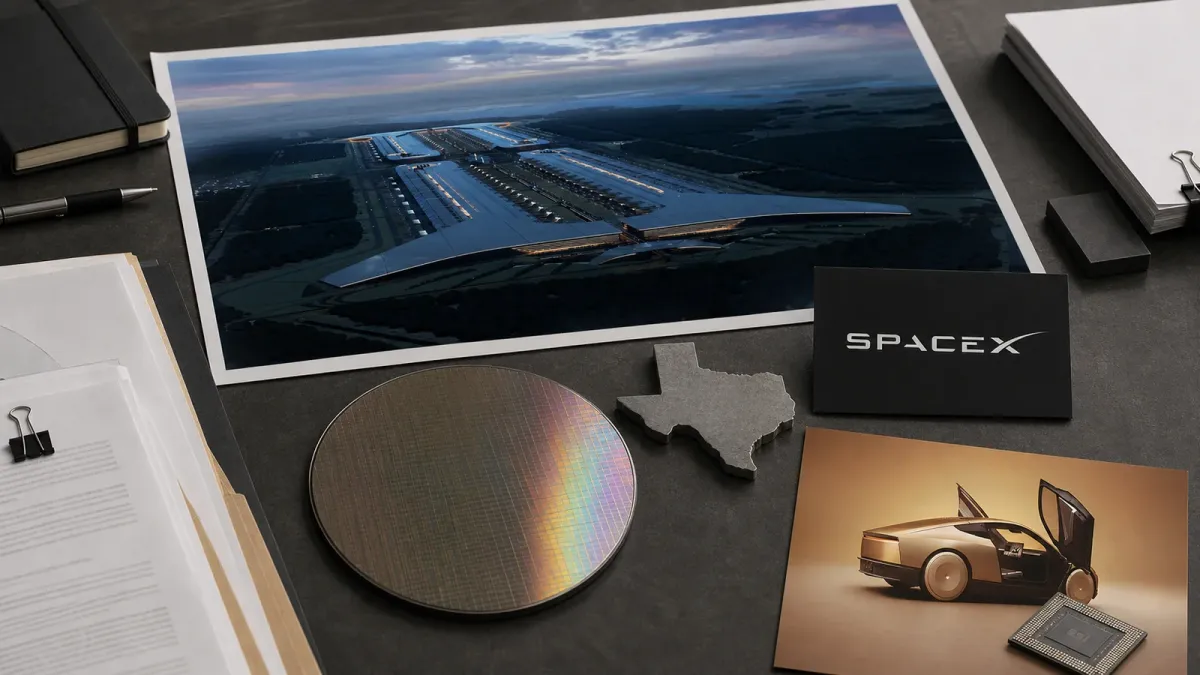
SpaceX has picked Grimes County, Texas, for Terafab, a planned semiconductor complex that would put chip manufacturing, advanced packaging and testing under one roof for Tesla and SpaceX projects.
The announcement matters beyond the local jobs number. The first phase carries more than $16.8 billion in planned capital investment, 3,000 projected jobs and a $30 million Texas Enterprise Fund grant, according to the Texas governor's office. It is also a public test of whether Elon Musk's companies can bring more of the AI hardware supply chain inside their own walls.
Texas officials said on August 6 that SpaceX will construct a vertically integrated semiconductor fabrication plant in Grimes County and that the facility is qualified under the state's Jobs, Energy, Technology, and Innovation program. The governor's office described the planned site as a 100-million-square-foot facility meant to consolidate production steps that are usually spread across suppliers and locations.
What SpaceX says it needs
Fox Business, citing SpaceX's announcement, reported that Terafab is intended to produce advanced logic and memory devices for Tesla Optimus robots, self-driving Cybercabs and SpaceX space-based data centers. The company also framed the project as a response to a future chip demand gap that existing suppliers may not be able to fill quickly enough.
That is the central reader question. This is not just another factory-incentive story. If Tesla and SpaceX are right about their compute needs, the bottleneck is not only whether they can buy enough chips. It is whether the current chip ecosystem can deliver the type, volume and packaging of chips they want on a schedule that fits autonomous vehicles, humanoid robots and orbital data infrastructure.
The numbers are unusually large
The official first-phase figures are already large: more than $16.8 billion in capital investment and 3,000 jobs. The scale claim is larger still. Texas officials and business reports describe the planned Terafab as 100 million square feet, far beyond ordinary industrial projects and bigger than many existing landmark buildings by floor area.
Those figures should be read as project targets, not completed output. A semiconductor megaproject can change as permitting, power, water, equipment, financing, workforce and supplier decisions move from announcement to execution. The useful signal now is that Texas has put public incentives and program status behind the site, while SpaceX and Tesla have made the location part of their AI-hardware strategy.
Why one roof is the point
Most semiconductor supply chains are specialized and distributed. Design, fabrication, memory, packaging and testing often involve different companies and locations. Terafab's pitch is that bringing more of those steps together could shorten feedback loops and give the companies tighter control over chips built for specific uses.
For Tesla, that could mean hardware tuned for robotaxis and Optimus robots. For SpaceX, it could mean chips built for space-based data systems and other compute-heavy projects. For investors and customers, the practical issue is whether vertical integration lowers risk or simply moves more technical and capital risk onto the companies' own balance sheets.
The local test comes next
The project is also a Grimes County story. Local and business reports have pointed to questions about public incentives, rural infrastructure, water, power and community oversight. Those questions do not erase the economic-development case, but they do mean the announcement is only the first checkpoint.
Readers should watch three things next: whether local agreements disclose enforceable infrastructure commitments, whether construction and equipment timelines stay aligned with the chip-demand story, and whether Tesla or SpaceX provide clearer milestones for what Terafab will make first.
The bottom line: Terafab is being sold as an answer to an AI chip shortage that Musk's companies believe they will feel directly. The jobs and grant numbers are immediate. The bigger test is whether the biggest building claim turns into a working chip supply chain, not just a bigger industrial footprint.


