
Tesla has put a $10.1 billion solar manufacturing plan on paper in Texas, but the filing reads less like a done deal than a public test of whether state and local incentives can make the site work.
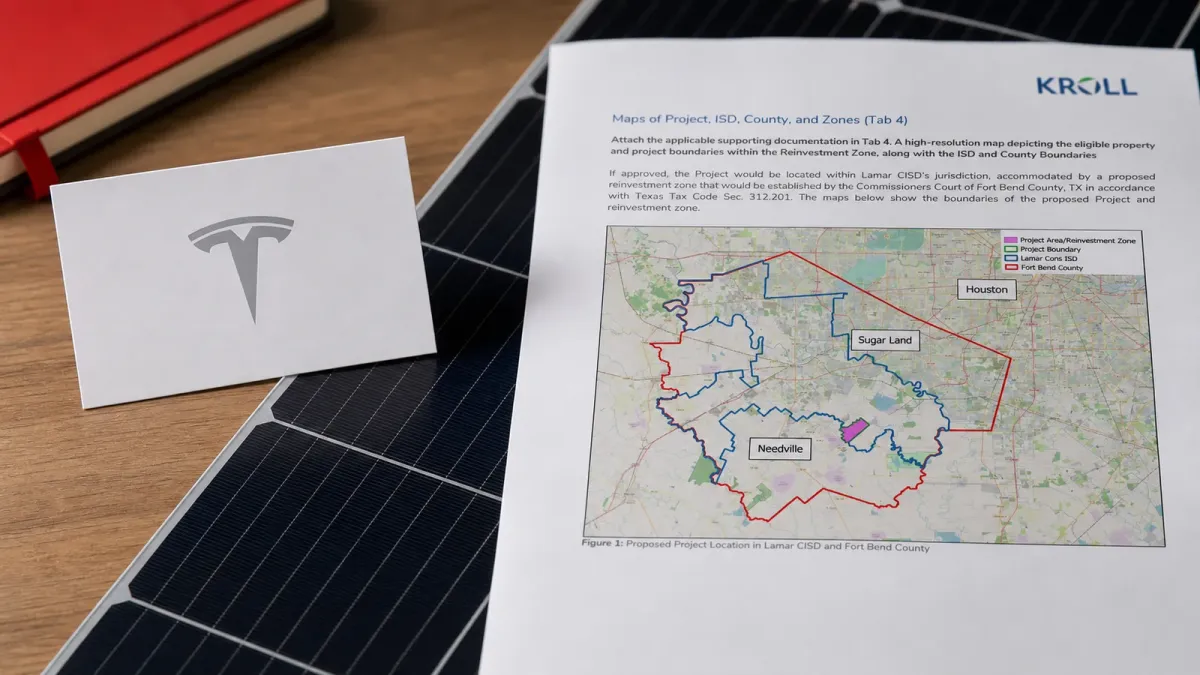
The project, called Project Crystal Sun in a Texas Comptroller application, would be located in Fort Bend County within Lamar Consolidated Independent School District, southwest of Houston. Tesla says the proposed facility would manufacture photovoltaic solar cells and/or assembled solar modules, with commercial operations planned for the first quarter of 2029 if the project moves ahead.
The scale is the reason the filing matters beyond Texas. Tesla lists more than 9,700 permanent full-time jobs, 1,147 temporary construction jobs, and a capital investment of roughly $10.1 billion. Business Insider and Fox Business both reported the filing on Thursday, August 13, 2026, after the public application surfaced through Texas' Jobs, Energy, Technology and Innovation Act process.
The Short Answer
This is a serious manufacturing proposal, not a confirmed factory. The application gives unusually specific figures for jobs, timing, equipment, parcels, and tax exposure, but Tesla also says it is evaluating other U.S. locations and that the Texas site is not economically competitive without incentive support.
That distinction should shape how readers understand the news. The filing shows what Tesla may build if Fort Bend County, Lamar CISD, the Texas Comptroller, and other officials make the numbers attractive enough. It does not prove that construction is guaranteed, that the site has final approval, or that Tesla has disclosed the plant's eventual solar output capacity.
What Tesla Filed
The Texas Comptroller application says Tesla is evaluating a solar cell manufacturing facility on property tied to several Fort Bend County parcels near FM 762 and FM 1994, including an address in Richmond, Texas. The proposed project would sit inside Lamar CISD's jurisdiction and would require a reinvestment zone if approved.
The eligible property list points to a vertically ambitious solar supply chain. Tesla lists wafer manufacturing equipment, ingot manufacturing equipment, coating equipment, metallization and printing lines, cell testing and quality-control equipment, cleanroom support, automation, chemical storage, utility infrastructure, and environmental and safety systems.
That matters because the U.S. has added solar module assembly capacity faster than it has added upstream cell and wafer capacity. A plant that reaches into cells, wafers, and related production steps would be a deeper manufacturing bet than simply assembling imported components into finished panels.
Why the Incentive Request Matters
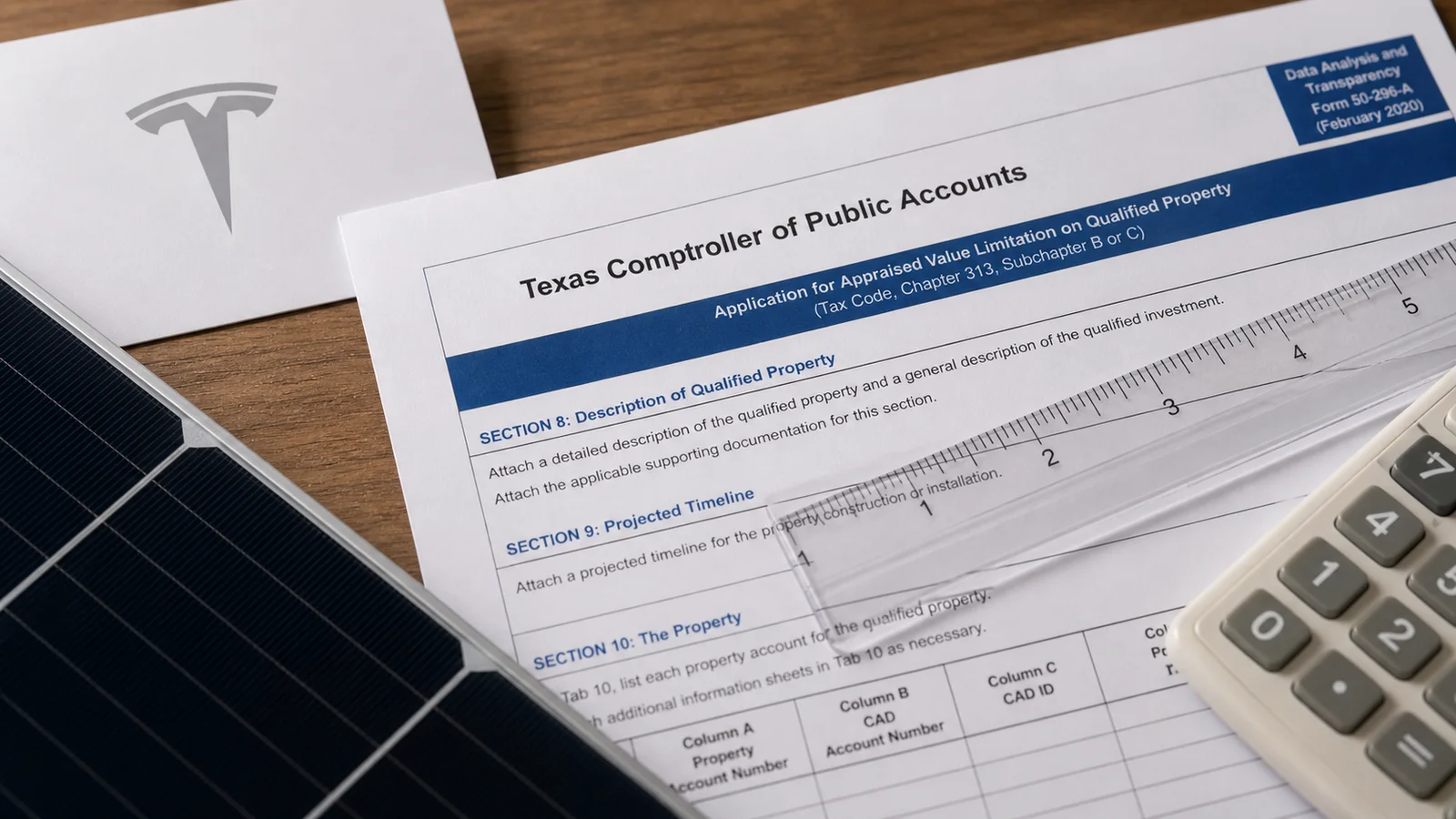
Tesla's application is direct about the leverage point: property taxes. The company says property taxes are among the highest operating costs for large capital-intensive developments in Texas and that the Fort Bend site is expected to be less favorable than a competing out-of-state site without incentives.
Fox Business reported that Tesla estimates the project could owe about $1.1 billion in local property taxes over 37 years without incentives. The company is seeking a 10-year taxable-value limitation under the JETI program, along with support from state and local officials.
For taxpayers, the practical question is not just whether 9,700 jobs sounds large. It is whether the public value of landing the project outweighs the tax revenue that would be limited or delayed, and whether the promised jobs, wages, and investment survive the final agreement.
What Readers Should Watch
The first thing to watch is whether Lamar CISD, Fort Bend County, and state officials advance the incentive package. A school district value limitation would not by itself build the plant, but it would be a key signal that the Texas option remains alive.
The second thing to watch is whether Tesla turns the application into binding construction commitments. The filing points to construction beginning in 2026, completion by 2028, and commercial operations in early 2029, but those dates depend on final site selection, permits, utilities, land work, and equipment procurement.
The third question is capacity. Tesla has not disclosed how many gigawatts of solar manufacturing Project Crystal Sun would add. Business Insider noted that the filing cites Elon Musk's January 2026 comment about Tesla and SpaceX separately working toward 100 gigawatts a year of U.S. solar manufacturing, but the application does not say how much of that ambition would come from this Texas plant.
The Bottom Line
Project Crystal Sun is best read as a high-stakes option: Tesla is telling Texas what it might build, what it wants in return, and why the decision is still competitive. If officials approve incentives and Tesla commits, Fort Bend County could become a major piece of U.S. solar manufacturing. If the economics do not close, the same filing gives Tesla a public record for taking the project somewhere else.


