
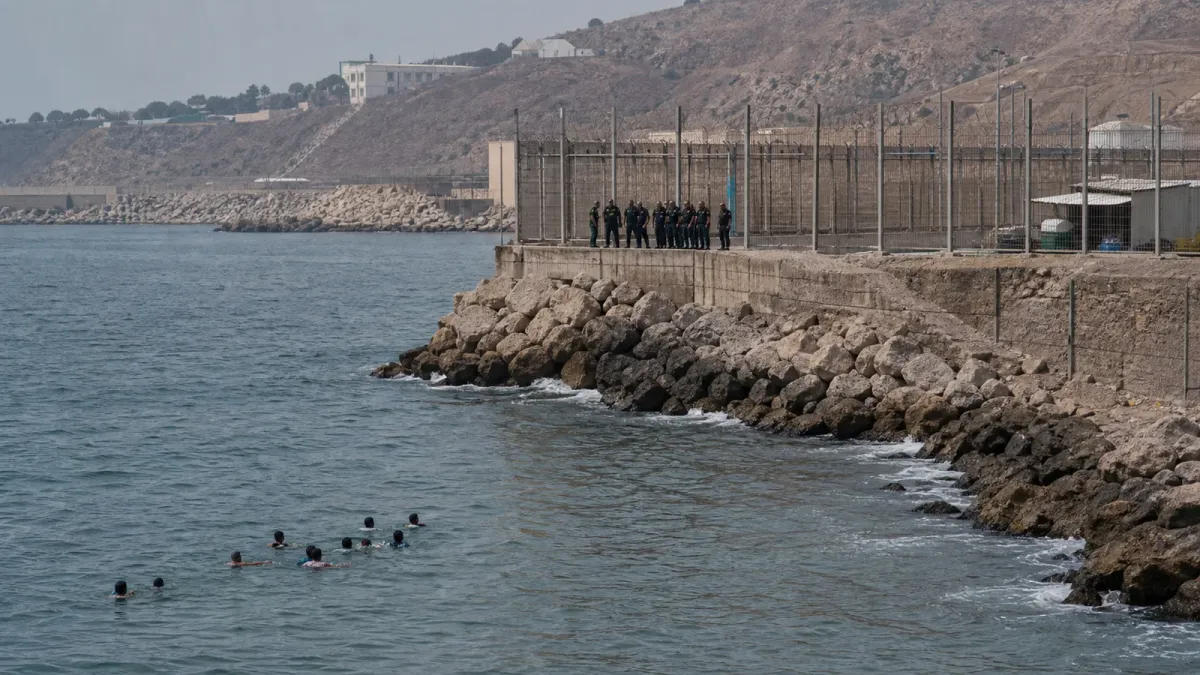
Thousands of people crossed from Morocco into Spain’s North African territory of Ceuta on Thursday, July 30, overwhelming border and reception services as crowds moved around the Tarajal breakwaters and onto local roads. The Associated Press reported that most appeared to be young Moroccan men, though families, women and children were also among those arriving.
The immediate consequence is a humanitarian and administrative strain with no firm public count for Thursday’s crossings. Ceuta President Juan Jesús Vivas asked Spain’s central government to declare a national emergency and deploy the army, while the Interior Ministry said migration flows do not qualify for the protection-civil emergency mechanism he cited.
By Thursday morning, Vivas said more than 1,500 people had reached Ceuta over the previous 10 days. That figure preceded the day’s large-scale crossing. Earlier in the week, the local government and Spain’s delegation in Ceuta said the child-protection system had collapsed and the Temporary Immigrant Reception Center was saturated.
What changed Thursday
Spain and Morocco agreed to reinforce coordination and review measures intended to return, as soon as possible, people who entered Ceuta irregularly, according to an Interior Ministry statement reported by Cadena SER. The ministry thanked Moroccan authorities for stopping thousands of attempted crossings in recent days and said Interior Minister Fernando Grande-Marlaska would travel to Ceuta on Friday, July 31.
The agreement does not mean everyone can be sent back immediately. A recent Spanish Supreme Court ruling held that the country’s special summary-rejection rule for Ceuta and Melilla applies when people cross physical border barriers such as fences, not when they are intercepted at sea while swimming. Those sea arrivals require a formal process with legal safeguards, El País reported.
Why Ceuta sought emergency powers
Vivas described the situation as a humanitarian and social emergency, arguing that the autonomous city needs more national police, reception space and central-government coordination. Madrid said it was adding resources for border control and humanitarian assistance but rejected the requested declaration because Spain’s civil-protection law reserves that mechanism for specified natural, technological and industrial hazards.
The scenes recalled the May 2021 crisis, when more than 8,000 people entered Ceuta over two days. Spanish officials currently describe Morocco as cooperating, and Madrid has rejected suggestions that the surge reflects a new diplomatic confrontation with Rabat.
What remains uncertain
Authorities had not published a verified total for Thursday’s arrivals by early afternoon, and it was not clear how quickly the new return coordination could reduce pressure on Ceuta’s reception system. Grande-Marlaska’s visit on Friday is the next announced decision point, when officials are expected to assess staffing, border operations and humanitarian capacity.


