
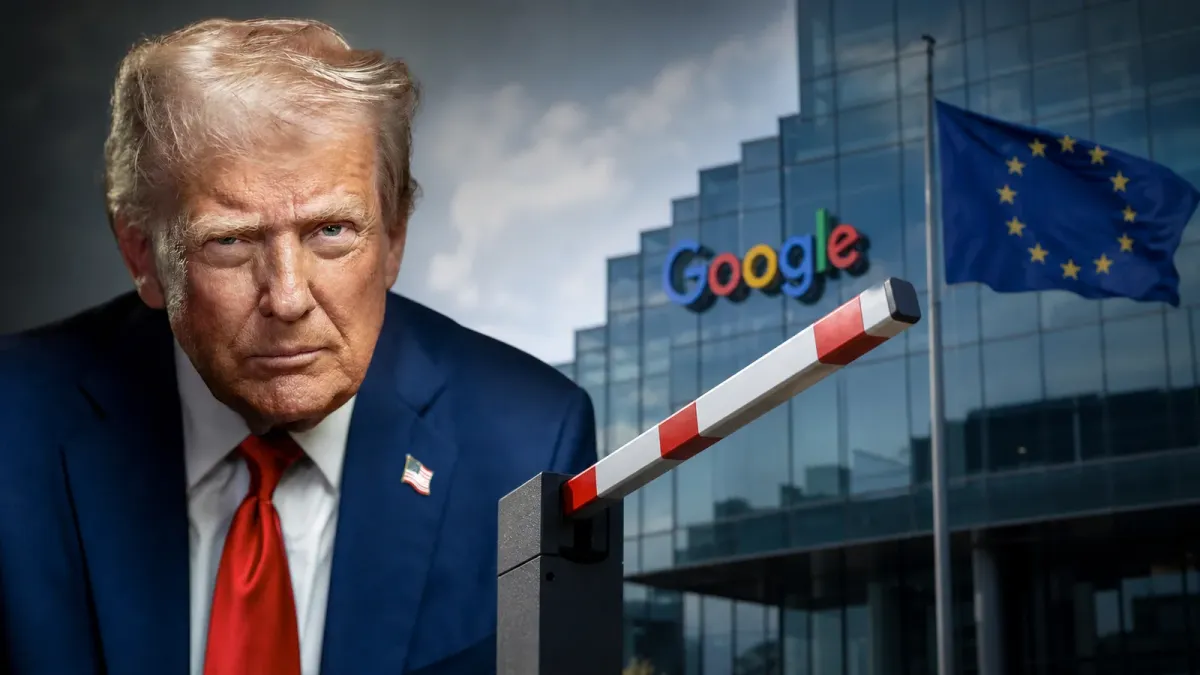
President Donald Trump said on Friday, July 24, that the United States would immediately investigate the European Union’s treatment of American technology companies and threatened a “substantial” tariff on the bloc. The announcement came one day after Brussels fined Google €890 million, or about $1 billion, under the Digital Markets Act.
Trump accused the EU of “robbing” companies including Google, Apple, Meta and Amazon through regulatory penalties. He predicted the fines would be reversed and said a tariff would be imposed “at the earliest possible moment,” according to The Associated Press.
The immediate consequence is a new layer of uncertainty in the world’s largest bilateral trade relationship. As of Friday afternoon, the administration had not specified the tariff rate, which EU products could be covered, when duties might begin or which legal authority it would use.
What changed
The European Commission issued two Google decisions on Thursday. It imposed a €460 million fine after finding that Google favored its own shopping, hotel, transport and sports services in search results. A separate €430 million fine addressed restrictions that the commission said prevented Google Play developers from steering users to alternative, often cheaper, ways to buy.
Google has 60 days to comply. The commission said the company has already begun testing changes and described parts of that work as substantial or good progress. Google’s global affairs president, Kent Walker, said the required changes would degrade products, remove real-time features and weaken Google Play safety protections.
The U.S. pressure campaign began before Trump’s Friday post. Trade Representative Jamieson Greer said Thursday that the EU’s actions created “massive uncertainty” for U.S. exports and threatened stability under the transatlantic trade framework. His statement characterized the Google penalties and other Digital Markets Act enforcement as targeting competitive American companies.
What is not known yet
A trade investigation is not itself a tariff order. Trump’s statement did not identify the agency leading the inquiry or publish the procedural notice, findings and product schedule that normally accompany a trade action. Until those details appear, companies cannot calculate which imports would face higher costs.
The new threat is also separate from tariffs that took effect Friday after a different investigation into forced-labor import enforcement. Under that White House action, the combined tariff on many EU goods is capped at 10%. Trump’s tech-enforcement threat could create additional duties, but the administration has not said how it would interact with the existing rate.
What happens next
The next concrete signal will be a formal notice from the White House or U.S. Trade Representative defining the investigation. Businesses will be watching for a tariff percentage, affected product categories, a comment period and an implementation date.
EU officials will also have to decide whether to seek a negotiated pause, defend the Google decisions through litigation and regulatory channels, or prepare retaliation. The bloc says its trade framework with Washington caps U.S. tariffs on most EU exports at 15% and allows Europe to suspend concessions if the United States does not honor its commitments. That makes the legal shape of any new tariff as important as the headline threat.


