
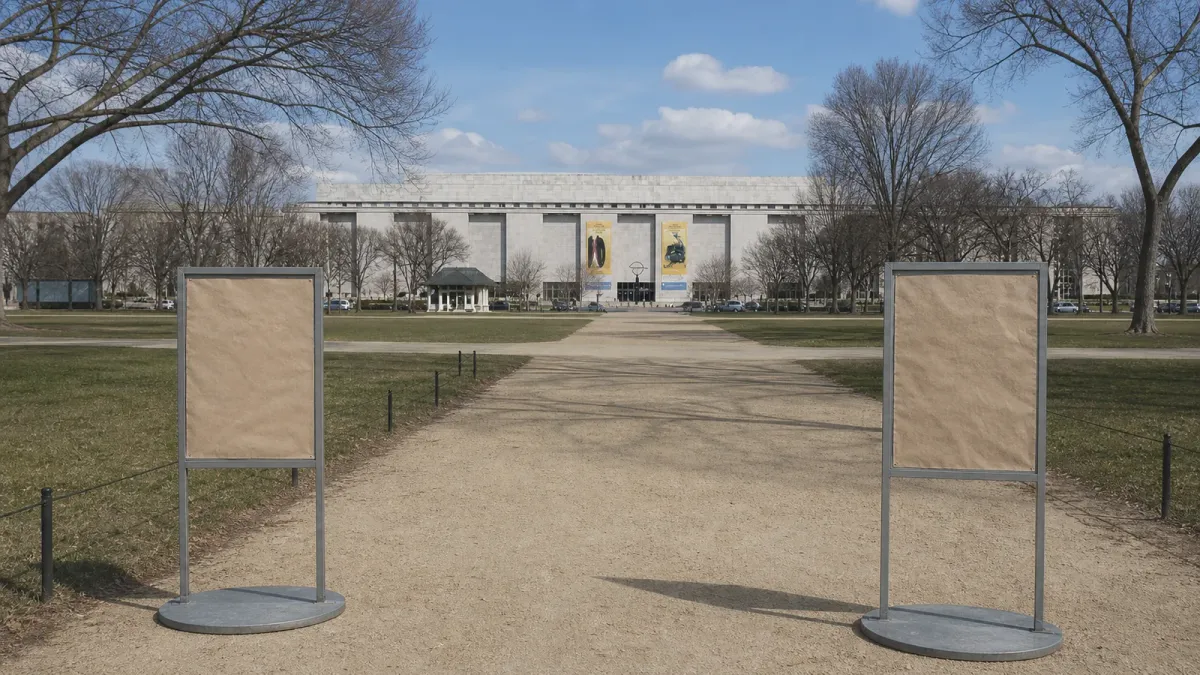
President Donald Trump ordered his administration on July 24, 2026, to put temporary signs outside the Smithsonian's National Museum of American History after a White House review accused the museum of presenting U.S. history in a way the administration says is inaccurate and overly ideological.
The practical effect is narrower than the political fight. The order directs the Interior Department, through the National Park Service, to place signs along NPS-maintained sidewalks, walkways and land used by visitors approaching the museum. It does not, by itself, rewrite exhibit labels inside the Smithsonian or replace the museum's leadership.
That distinction matters because the Smithsonian is not a normal executive-branch agency. It is governed by a Board of Regents, with Congress, the chief justice, the vice president and citizen regents in the governance structure. That gives the White House more leverage over federal funding, public messaging and outside land than direct day-to-day control over curators.
What the order says
The executive order says the administration will take available legal steps to respond to a Domestic Policy Council report called Saving America's Story. It tells Interior Secretary Doug Burgum and the National Park Service to install temporary signs that tell visitors the museum's exhibits should be renovated consistent with the report's findings and point them to what the order calls accurate historical resources.
The order also says the museum has failed to appropriately honor the 56 signers of the Declaration of Independence during the country's 250th anniversary year. It directs temporary exhibits or signage on NPS-maintained sidewalks, walkways and land to address what the White House says is inaccurate information presented in the museum.
What is still uncertain
The order leaves several important questions open: what the signs will say, where exactly they will be placed, how quickly they can be installed, how much the effort will cost and whether Congress, Smithsonian leaders or outside groups will challenge the move. The order says it must be implemented consistent with law and available appropriations, which gives agencies room to interpret timing and scope.
Associated Press and Washington Post reporting framed the order as part of a broader push by Trump to challenge cultural institutions over how they present American history. Earlier this week, National Museum of American History director Anthea Hartig defended the museum's scholarship during congressional scrutiny, while critics of the White House report argued that political officials should not dictate museum interpretation.
Why visitors should care
For museum visitors, the first visible change may be outside the building, before they enter. For historians, teachers and cultural institutions, the larger question is whether the government can use adjacent public space, budget pressure and official messaging to contest the work of an institution that has long presented itself as scholarly and nonpartisan.
The next signals to watch are whether the Park Service publishes a sign plan, whether Smithsonian regents or congressional overseers respond formally, and whether the White House tries to pair sidewalk messaging with funding conditions or additional reviews. Until then, the order is best understood as a high-profile pressure move around the museum, not a completed takeover of the exhibits inside it.


