
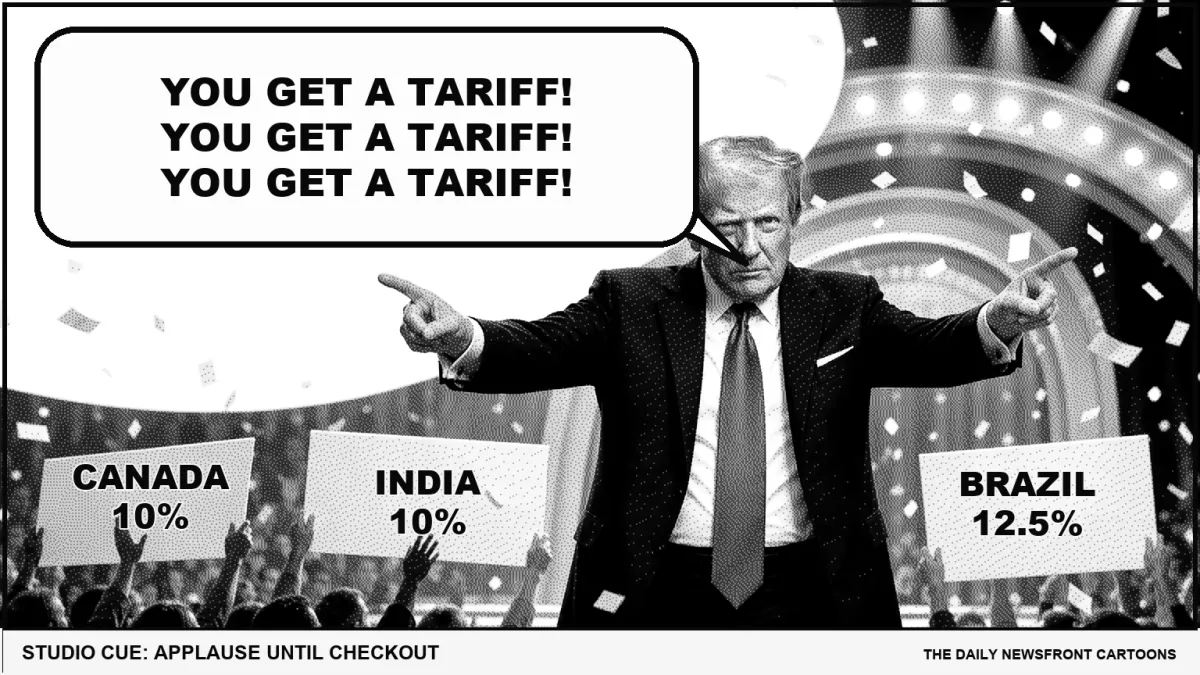
The joke is a giveaway show where the prize is a tariff—and the applause lasts only until the checkout receipt arrives. The Trump administration’s new Section 301 duties took effect at 12:01 a.m. ET on July 24, 2026, replacing a temporary 10% tariff program that had reached its legal time limit.
The Office of the U.S. Trade Representative said the action applies to goods from 60 trading partners. Rates are generally 10% for economies that have adopted or committed to certain forced-labor import restrictions and 12.5% for most others, with separate calculations for some products from the European Union, Taiwan, Japan, South Korea and Switzerland. USTR also listed exemptions for products including certain raw materials and goods whose inclusion could disrupt the wider economy.
What the cartoon exaggerates
Donald Trump did not appear on a television giveaway set, toss receipt-shaped confetti or deliver the dialogue shown in the cartoon. The setting, gestures and words are invented satire. The policy action itself is real, and it was imposed by the administration under Section 301 of the Trade Act of 1974; it was not a tariff bill newly passed by Congress.
Who gets the bill
Tariffs are collected from U.S. companies that import covered goods. Those businesses can absorb the cost, seek concessions from suppliers or pass some of it along through higher prices. That is the cartoon’s reversal: the audience is told it is receiving a prize, while the receipt points back toward the American checkout line.
USTR presents the duties as leverage against countries it says have not effectively blocked goods linked to forced labor. Trading partners and U.S. critics dispute the legal and policy rationale. That disagreement is the factual debate; the game-show spectacle is the joke.
Sources: Office of the U.S. Trade Representative; Associated Press; CBS News.


