
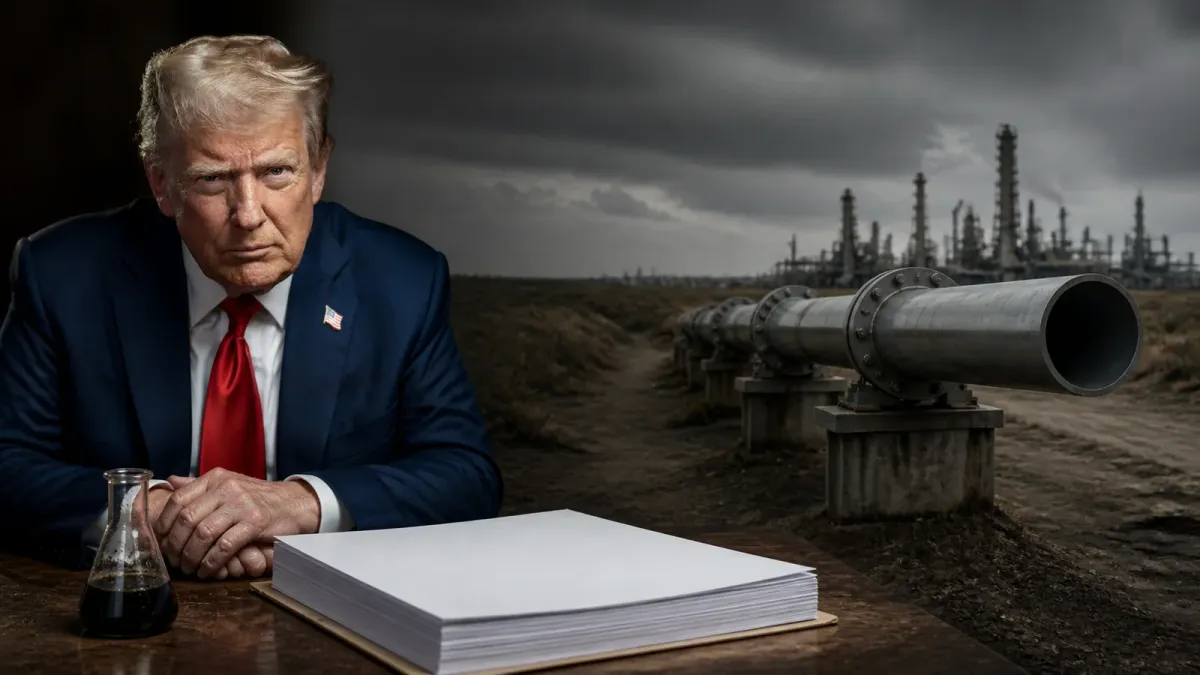
President Donald Trump said Friday, August 28, that the United States and Venezuela had reached an agreement giving the U.S. majority control of more than 65 billion barrels of proven Venezuelan oil reserves. If carried out as described, the arrangement would be an extraordinary transfer of influence over a major share of the world’s largest known crude-oil resource.
The announcement is consequential, but it is not yet a complete deal readers can independently evaluate. The administration had not released a contract, a list of covered fields, the ownership structure, the duration of U.S. control, the companies expected to operate the assets or the allocation of financial and legal risk. Those missing terms will determine whether the agreement changes actual oil supply or remains a political claim about barrels still underground.
Trump said the agreement was negotiated by Secretary of State Marco Rubio, Defense Secretary Pete Hegseth and Venezuela’s interim president, Delcy Rodríguez, working with private business. He said it would cost U.S. taxpayers nothing and would eventually lower gasoline prices. Those cost and price claims cannot yet be verified from public documents.
What was announced
Trump described the agreement as giving the United States majority control of more than 65 billion barrels of proven reserves. Rubio separately said the arrangement could bring nearly $100 billion in private investment and support the reconstruction of Venezuela’s economy. The Associated Press and CBS News reported the announcement, while noting that the administration had not disclosed which fields are included or how production would be managed.
The timing matters. The U.S. has been seeking more secure energy supply while the Iran war and disruption around the Strait of Hormuz have increased pressure on fuel markets. Washington has also loosened selected Venezuela-related contracting restrictions. On August 27, the Treasury Department’s Office of Foreign Assets Control said contracts authorized under several Venezuela general licenses would no longer have to include a choice-of-law clause, citing investment-related reforms since January.
Earlier reporting indicated that negotiations covered a group of productive fields rather than all Venezuelan reserves. That makes the exact contract essential. “Control” could mean ownership, operating rights, long-term production contracts, a revenue share or another structure. Those arrangements carry very different consequences for Venezuela’s sovereignty, U.S. companies and creditors.
Why 65 billion barrels does not mean immediate supply
Venezuela’s oil endowment is enormous. The U.S. Energy Information Administration estimated that the country held about 303 billion barrels of proven crude reserves in 2023, roughly 17% of the global total. Yet Venezuela produced only about 0.8% of the world’s crude that year. Most of its reserves are extra-heavy oil in the Orinoco Belt, which is more difficult and expensive to extract, process and transport than lighter crude.
Years of underinvestment, deteriorated infrastructure, sanctions, debt disputes and the loss of skilled workers have constrained production. A legal right to develop reserves does not repair power systems, pipelines, upgrading facilities, refineries or ports. It also does not guarantee that oil companies will commit capital on the schedule political leaders want.
That distinction is central to Trump’s promise of lower gasoline prices. Oil prices respond to expected production, transport capacity, refinery demand, geopolitics and the global supply balance—not simply to a government’s claim over reserves. Even a large, credible investment program would take time to lift output. The price effect would depend on how much new crude reaches the market, when it arrives and what happens to supply elsewhere.
The legal and political questions
The agreement is likely to face scrutiny over who in Venezuela had authority to grant the rights, how existing PDVSA partnerships and creditor claims are treated, and whether U.S. control can survive future changes of government. Venezuela’s state oil company remains central to the country’s public finances, and decades of nationalization and litigation have left a dense network of claims around energy assets.
The U.S. role is also politically sensitive because it follows the American operation that removed Nicolás Maduro earlier this year. Critics are likely to argue that Washington is converting military and diplomatic power into resource control. Supporters will frame the agreement as an energy-security and reconstruction partnership. A published contract, rather than either political narrative, is needed to test those claims.
What happens next
The most important next step is disclosure. Watch for the signed text, the identities of participating companies, the covered fields, the investment schedule, production targets, tax and royalty terms, environmental obligations and any guarantees offered by either government. Congress may also seek details about legal authority, sanctions policy and taxpayer exposure.
Until those documents appear, the confirmed development is narrower than the headline promise: Trump has announced a major U.S.–Venezuela oil agreement and attached a figure of more than 65 billion barrels to it. Whether that produces new barrels, lower prices or durable reconstruction remains an open question.


