
Britain’s push to expand artificial-intelligence infrastructure has run into a very physical planning question: where will the cooling water come from? Water UK, the trade association for the country’s water industry, told Parliament that official forecasts for England’s future water needs explicitly exclude data centers even as the government aims to triple data-center capacity by 2030.
Water UK estimates that UK data centers currently use about 6.6 million liters of water a day. If capacity triples with the same average water intensity, that figure could reach 19.8 million liters. The pressure is not evenly distributed: more than three-quarters of existing capacity is located in the water-stressed south and east of England, according to the group’s submission.
Where the joke starts
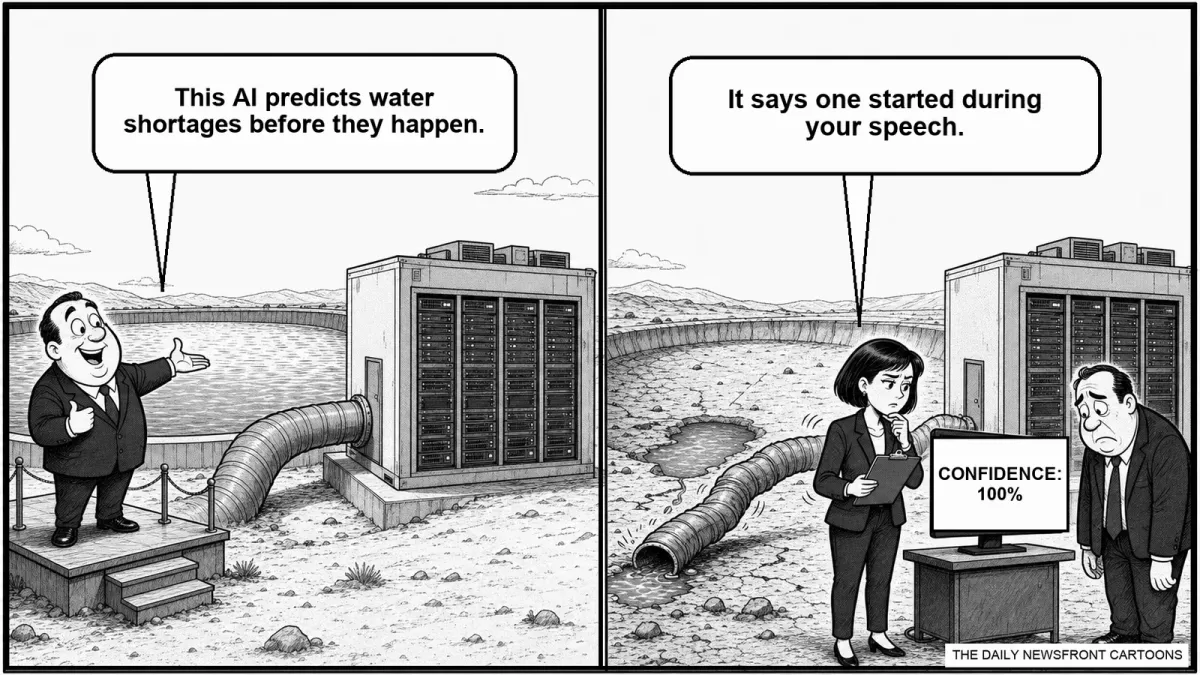
The cartoon compresses that planning contradiction into a two-panel product launch. A confident official promises that a new AI can predict water shortages before they happen. By the second panel, the machine’s own cooling system has supplied the prediction—and the analyst reports that the shortage began during the speech.
The instant reservoir drain, characters and dialogue are fictional satire, not a depiction of a real facility. The underlying water picture also has important nuance. TechUK says 51% of the 73 commercial sites in one voluntary survey used waterless cooling, and it estimates that data centers account for about 0.2% of England’s non-household water market. National averages, however, can obscure local constraints during hot periods.
Both water and technology industry groups have called for earlier planning, clearer disclosure and greater use of non-potable or recycled water. The punchline targets a familiar institutional habit: announcing the intelligence first and checking the plumbing afterward.


