
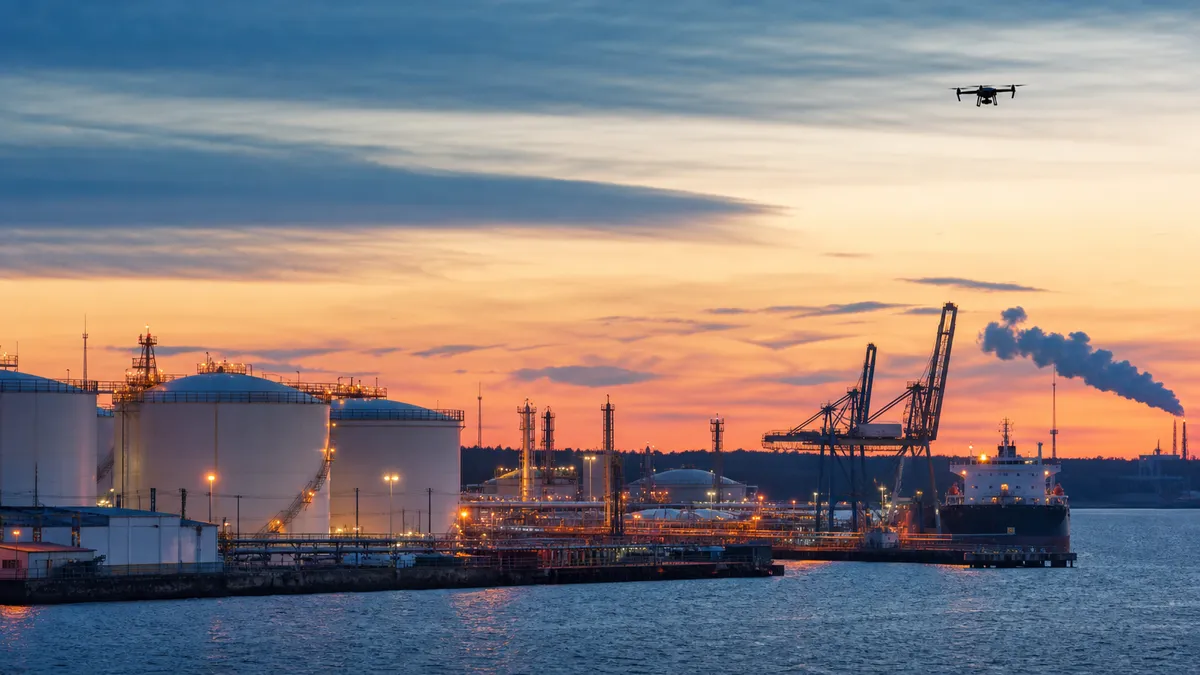
Ukrainian drones struck an oil terminal in St. Petersburg on Saturday, July 4, 2026, Russian officials said, extending Kyiv's long-range campaign against the energy infrastructure that helps finance Moscow's war.
The Associated Press reported that St. Petersburg Gov. Alexander Beglov said the city's Kirovsky district, on the Baltic Sea, was hit. Russian officials said air defenses shot down 72 Ukrainian drones across Russia's second-largest city and the surrounding region, while Ukrainian President Volodymyr Zelenskyy described the operation as part of Ukraine's "long-range sanctions" against Russia.
Zelenskyy also said Ukrainian forces hit a military target on Kronstadt, an island west of St. Petersburg that is tied to Russia's Baltic Fleet. The Guardian reported that regional officials separately described drone activity around port infrastructure in the Leningrad region, underscoring how the strikes are reaching beyond the front line and into Russia's transport and fuel network.
Why this strike matters
St. Petersburg is not just another Russian city. It is President Vladimir Putin's hometown, a major Baltic port and a symbolic center of Russian state power. Strikes there carry military and economic consequences, but they also challenge the Kremlin's effort to keep the war distant from daily life in Russia's largest urban centers.
Ukraine has increasingly targeted refineries, depots and export facilities as a way to pressure Russia without trying to match Moscow missile for missile. Recent Al Jazeera and Reuters reporting has described Ukrainian attacks on Russian oil refineries and terminals as part of a broader effort to strain fuel supplies, disrupt logistics and reduce revenue available for the war.
The July 4 strike fits that pattern. Oil terminals are difficult targets to harden completely because they connect storage tanks, pipelines, rail links, docks and shipping operations. Even limited damage can force inspections, rerouting or temporary slowdowns. Russian officials did not immediately provide a full damage assessment, and early claims from either side in the war often remain incomplete until satellite imagery, local reporting or official updates clarify the extent of the impact.
The wider war picture
The attack came as both countries continue to rely heavily on drones for deep strikes and air defense saturation. Russia has used large drone and missile barrages against Ukrainian cities and infrastructure, while Ukraine has built a long-range drone program aimed at sites far inside Russia. The result is a widening battlefield in which ports, airfields, power assets and fuel facilities can become targets hundreds of miles from the trenches.
For readers, the immediate takeaway is that Ukraine is signaling persistence. By hitting around St. Petersburg again, Kyiv is showing that Russian energy and naval-adjacent infrastructure near the Baltic remains within reach. For Moscow, the challenge is both practical and political: defending a sprawling energy system while explaining why a war framed as remote keeps arriving at high-profile Russian sites.
The strike does not by itself change the war's front lines. It does, however, add pressure to Russia's fuel and export system and shows why long-range drones have become one of the central tools of the conflict in 2026.


