
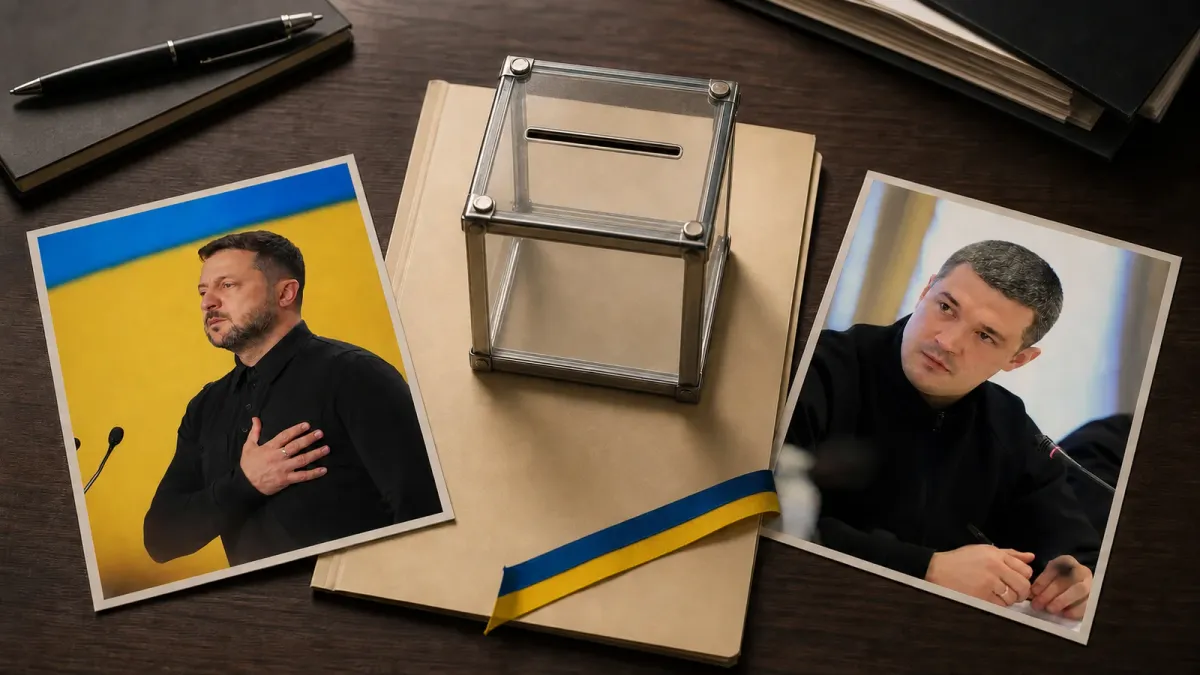
Ukraine’s long-suppressed election debate became a direct political rupture on Sunday, August 23, when President Volodymyr Zelenskyy publicly rejected former Defense Minister Mykhailo Fedorov’s demand for a vote during the war. Fedorov’s August 18 appeal was the first such call from a major Ukrainian political figure since Russia’s full-scale invasion began in February 2022.
The short answer is that Ukraine cannot hold a presidential, parliamentary or local election under its current legal framework. The country’s martial-law statute expressly prohibits those votes while martial law remains in force. A credible election would also require a security and participation plan for troops, frontline communities, citizens living under occupation and millions of Ukrainians abroad.
The dispute matters beyond a contest between two politicians. It tests whether Ukraine can preserve democratic competition without allowing Russian attacks, displacement or disinformation to determine who can campaign and who can vote. It also turns Fedorov, once one of Zelenskyy’s closest allies and a public face of the country’s technology-driven defense reforms, into a potential political challenger.
What changed this week
Fedorov was dismissed in July after reported disputes inside the defense establishment. His removal triggered weeks of demonstrations, but the former minister then went further than many of his supporters expected. In a 10-minute video on August 18, he argued that Ukraine should find a legal, safe and realistic route back to elections even before the war ends. He cited corruption, a governance crisis and public distrust, but did not say whether he would run.
Zelenskyy answered for the first time in remarks released Sunday. He said a wartime campaign would divide the country and argued that no partner had offered a plan that could make voting safe, legitimate and democratic. He left a narrow opening: if Ukraine’s allies could establish specific security conditions and guarantee participation for the military, frontline residents and citizens abroad, he said he would support an election.
The legal barrier comes first
Ukraine’s law on the legal regime of martial law prohibits elections for president, parliament and local government while martial law is in effect. It also bars referendums and constitutional amendments during that period. That means an election cannot simply be scheduled by political agreement; lawmakers would need a lawful mechanism that removes or changes the present bar.
Zelenskyy’s scheduled five-year term reached its end in May 2024, but Article 108 of Ukraine’s Constitution says a president continues to exercise the office until a newly elected president takes over. The legal design avoids a vacancy, but it does not settle the political question of how long democratic competition can be postponed during a prolonged war.
Four practical tests any election plan must pass
- Physical security: polling places, election staff, observers and voters would need protection from missile and drone attacks. A nationwide vote held under uneven threat could produce unequal access.
- Military participation: hundreds of thousands of service members would need a confidential and verifiable way to vote without exposing unit locations or disrupting operations.
- Displaced and occupied voters: millions of citizens are abroad, internally displaced or living in territory occupied by Russia. Registration, ballots and identity checks would have to work across borders without accepting occupation as permanent.
- Campaign fairness: candidates would need meaningful access to media and voters while wartime restrictions, mobilization and Russian influence operations remain active. Observation and dispute procedures would also need time to function.
Why the security argument is not abstract
Zelenskyy’s election comments came in a wider briefing dominated by the war. He said Ukraine expected to receive 264 Patriot interceptor missiles in 2026, down from 675 in 2023, even as Russian ballistic attacks intensified. Ukraine’s Air Force has requested 360 additional interceptors for the coming winter, according to the president.
Those figures do not decide the election debate, but they explain why a promise to secure polling stations cannot be treated as a routine administrative task. Ballistic missiles can reach cities far from the front, and the same air-defense shortage that puts homes and infrastructure at risk would also shape campaign events, voting locations and ballot counting.
What Ukrainians appear to want
Public opinion does not give either side a blank check. A Kyiv International Institute of Sociology poll released August 5 found that 57% of Ukrainians wanted elections only after the fighting ends, according to Reuters. At the same time, frustration over corruption and centralized decision-making has created demand for stronger accountability and new political choices.
That produces a genuine democratic tension. Waiting protects participation from wartime coercion and physical danger, but an open-ended delay can deepen mistrust. Rushing risks an election in which millions cannot vote on equal terms. The useful question is therefore not whether elections are inherently democratic, but whether the process can meet basic tests of law, safety, access and competition.
What happens next
No election date or agreed legal plan exists. Fedorov has put the issue inside Ukraine’s mainstream political debate, while Zelenskyy has set an exceptionally high security threshold for acting on it. Any serious proposal would need legislation, a revised election calendar, operational work by the Central Election Commission and a credible international observation plan.
The immediate political test is whether Fedorov turns his argument into an organized movement or whether voters reject campaigning before a ceasefire. The institutional test is harder: Ukraine must prepare for its first postwar—or potentially wartime—election without letting Russia define the conditions.
Bottom line: Ukraine can restore a national vote only after it changes the present legal barrier and solves the security and participation problems created by the war. This week’s rupture matters because a former insider has forced those requirements into public debate before the country has a workable plan.


