
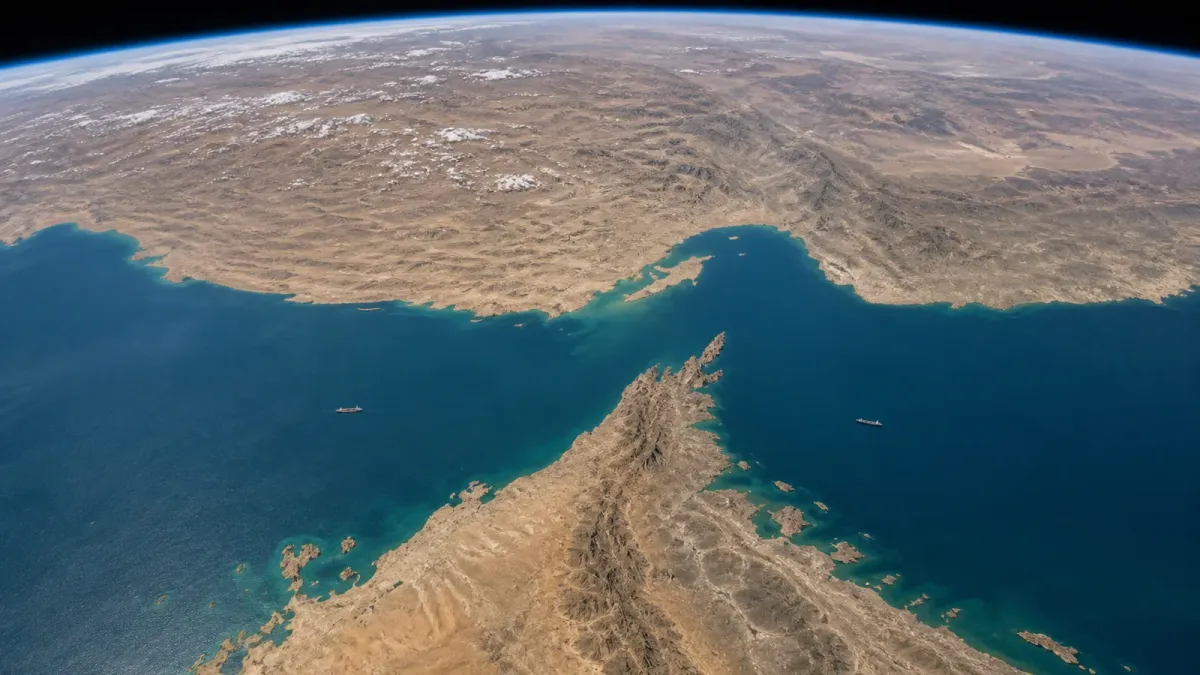
A projectile struck the engine room of an unidentified ship as it left the Strait of Hormuz early Tuesday, causing a crew casualty and adding a fresh hazard at one of the world's most important energy chokepoints.
The ship, its cargo and the source of the projectile have not been identified, and no one has claimed responsibility. The Associated Press reported, citing the United Kingdom Maritime Trade Operations center, that the strike damaged the engine room. It was not immediately clear whether the crew member was killed or wounded. Oman's coast guard was assisting the vessel and investigating, and officials reported no environmental damage.
The incident comes a day after a 60-day U.S.-Iran peace deadline expired without a final agreement. Iran has effectively restricted the strait since February 28, when war began after U.S. and Israeli attacks, while the United States has imposed a blockade on Iranian shipping. The attack does not establish who carried it out, but it raises the stakes as diplomats try to restore predictable commercial passage.
What changed
The new strike turns a prolonged shipping standoff into an immediate safety event for a vessel attempting to leave the waterway. Its location matters: the strait connects the Persian Gulf with the Gulf of Oman and the Arabian Sea, and its narrow shipping lanes have few practical substitutes for regional oil and gas exporters.
Iranian parliamentary speaker Mohammad Bagher Qalibaf said the passage would not reopen unless Washington meets Iranian conditions, including lifting the blockade, releasing frozen assets, ending oil sanctions and halting threats and military operations, according to AP. Iran and Oman are still finalizing a passage arrangement. Egypt's foreign minister said a plan for transit through the strait could help return the United States and Iran to negotiations.
Why it matters
About 20 million barrels of oil per day moved through the Strait of Hormuz in 2024, roughly one-fifth of global petroleum consumption, according to the U.S. Energy Information Administration. The route also carried about one-fifth of global liquefied natural gas trade. A lasting disruption can therefore affect freight costs, insurance, fuel prices and inflation far beyond the Middle East.
Markets were already showing that sensitivity. Brent crude traded at $91.35 a barrel early Tuesday after rising 2.7% Monday, while Asian shares mostly fell, AP reported. A single incident does not determine the oil price, but repeated attacks or continued limits on traffic would increase the chance of a sustained supply shock.
What remains unknown
- The vessel's name, flag, ownership, cargo and destination have not been publicly confirmed.
- Officials have not said what kind of projectile struck the ship or who launched it.
- The condition of the affected crew member remains unclear.
- Iran and Oman have not published final terms or a start date for their proposed passage arrangement.
What happens next
The most important near-term signals will be the Omani investigation, any identification of the ship and the projectile, changes in commercial transit, and formal responses from Tehran and Washington. Diplomatically, attention will focus on whether Oman's passage proposal becomes operational and whether Egypt or other mediators can restart U.S.-Iran talks.
For now, the central fact is narrower than any claim of a new campaign: one unidentified ship was hit, one crew casualty was reported, and responsibility remains unresolved. The broader consequence is clear. Commercial traffic through a route that carries a major share of the world's energy supplies has become more dangerous at the same moment that the political path to reopening it remains unsettled.


