
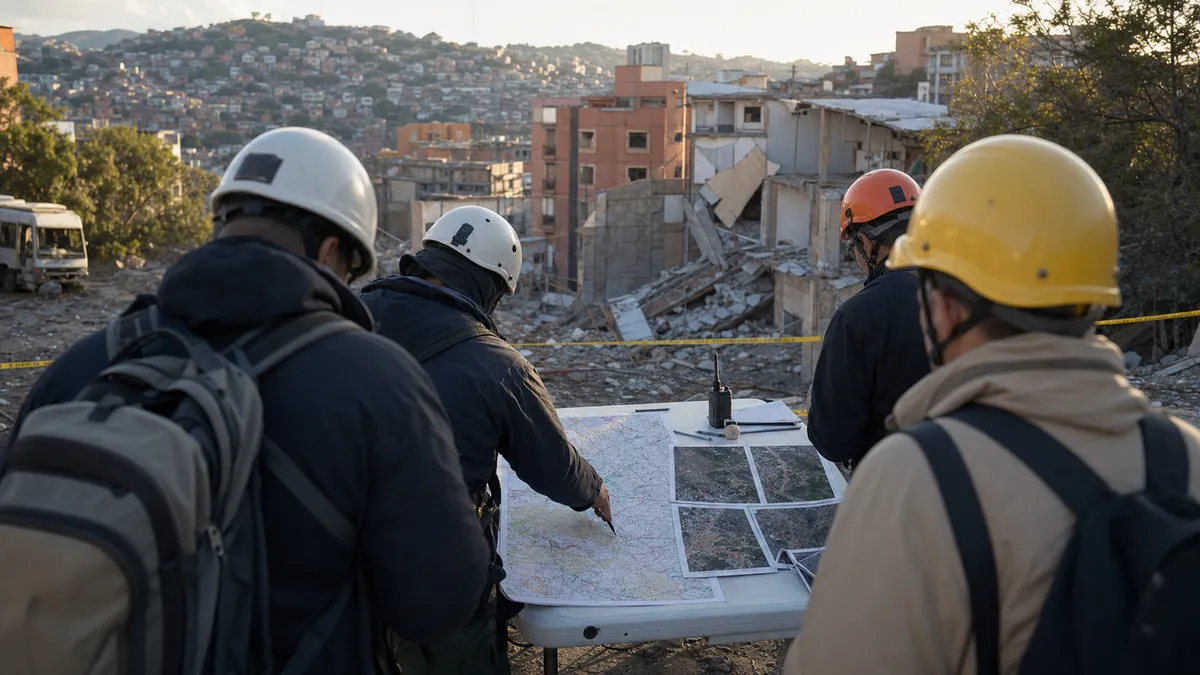
Venezuela's earthquake emergency has moved into a second week with a sharply higher official toll and rescue teams still working through damaged communities, according to the latest situation report circulated by ReliefWeb and the U.N. Office for the Coordination of Humanitarian Affairs.
The report, posted July 4 and current to 7 p.m. on July 3, says authorities have counted 2,645 deaths, 12,666 injuries and 6,462 rescues since the twin earthquakes struck northern Venezuela on June 24 at about 6 p.m. local time. Authorities also reported that about 15,050 people lost their homes.
The same update says at least seven states have been affected, with La Guaira still described as the hardest-hit state. Urban search-and-rescue teams remain deployed in coordination with OCHA, even as the response expands toward transitional camps, medical care, water, sanitation, food and shelter support.
Why the risk is not over
The June 24 disaster was not a single isolated shock. The U.S. Geological Survey describes it as a pair of large earthquakes, measured at magnitude 7.2 and magnitude 7.5, west of Caracas. OCHA's latest report says authorities have now recorded 890 aftershocks.
Aftershocks can slow rescue work, unsettle damaged structures and complicate returns to homes that may no longer be safe. USGS also said its ground-failure modeling indicated that earthquake-triggered landslides were likely to be significant in number or spread, a concern that matters for road access, hillside neighborhoods and aid delivery.
The practical challenge for responders is shifting by the day. In the first hours after a major quake, the priority is finding survivors and stabilizing the injured. More than a week later, crowded shelters, damaged water systems, debris and interrupted medical care can become a second emergency.
Local authorities and aid groups are also trying to keep accurate lists of missing, rescued and displaced people as communications and transport remain uneven.
Associated Press reporting from Caracas this week cited doctors and aid workers warning about untreated injuries, infection risk and poor sanitation among displaced people. Those concerns match the priorities listed in the situation report, which names health, shelter, food, nutrition, water, sanitation and hygiene among the active response areas.
What to watch next
The next official updates will be important for three reasons: whether the death and injury tolls continue to climb, whether aftershocks or landslides block access to more communities, and whether transitional shelters can absorb people whose homes were destroyed or deemed unsafe.
International agencies and partner organizations are working with Venezuelan authorities on a multisector response, according to OCHA. For readers outside Venezuela, the clearest signal of whether the emergency is stabilizing will be less about the headline magnitude and more about access: hospitals able to treat injuries, clean water reaching shelters, roads reopening and search teams gaining safe entry to damaged areas.
Until those conditions improve, the June 24 quakes remain an active humanitarian crisis rather than a completed natural-disaster story. The official numbers already make it one of the deadliest seismic emergencies in the region in years, and the aftershock and landslide risks mean conditions can still change quickly.


