
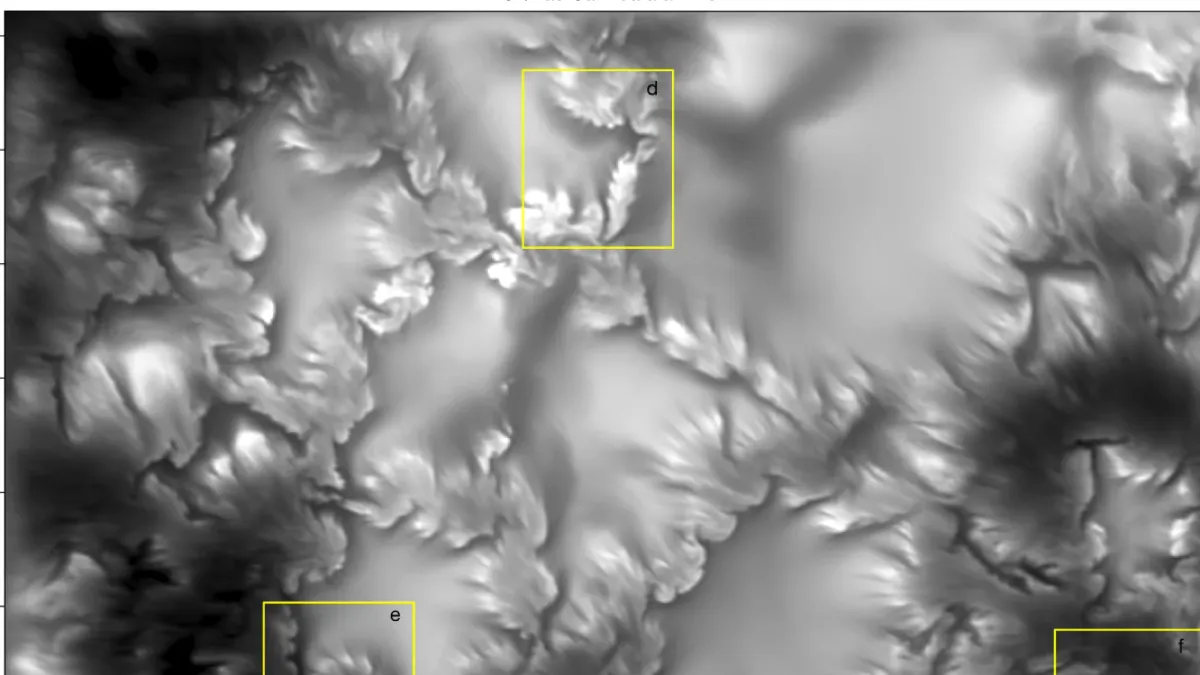
The sharpest new images of the Sun are not just pretty space pictures. They show small, curling disturbances on the Sun's visible surface that scientists say are evidence of Kelvin-Helmholtz instabilities, a fluid-motion process that appears when fast-moving material shears past slower material.
The finding matters because those small surface swirls may help explain how magnetic energy gets mixed, braided and eventually released in the solar atmosphere. That is the chain scientists study when they try to understand flares, coronal mass ejections, GPS disruptions and auroras.
The short answer
Researchers using the NSF Daniel K. Inouye Solar Telescope in Hawaii captured a magnetically active region of the photosphere, the Sun's visible surface, at about 19-kilometer resolution. In the images, boundaries around magnetic features look ragged and vortex-like instead of smooth.
A Nature paper published August 5, 2026 identifies those shapes as Kelvin-Helmholtz instabilities. The same basic physics can appear when wind pushes over water or when moving fluids meet at different speeds, but the new work reports direct, fine-scale evidence on the Sun's photosphere.
How the telescope saw it
The observations came from the NSF Daniel K. Inouye Solar Telescope, the world's first 4-meter-class solar telescope, according to the study. The team observed an active region near a sunspot at a 416-nanometer wavelength and compared the time sequence with high-resolution numerical simulations.
The match between the observations and simulations is the key. The paper reports that the vortices clustered around magnetic flux concentrations, with a characteristic spacing near 65 kilometers in the observed data. The researchers also compared the structures with simulations that produced similar vortex patterns and motion.
Why it matters beyond astronomy
The practical reason to care is space weather. Coronal mass ejections can disturb radio links, satellite operations, GPS signals and power-grid systems when they interact with Earth. The new images do not make solar storms instantly predictable, but they give researchers a closer look at one of the small-scale processes that can feed magnetic complexity.
The discovery also narrows a long-running mystery: how energy moves from the visible solar surface into the outer atmosphere. The Nature authors say the vortices can transport mass, energy, momentum and magnetic flux in magnetized plasma systems. In plain English, they may be one of the mechanisms that churns and transfers energy in places older telescopes could not resolve.
What readers should not overread
The images are a research advance, not a new danger alert. They do not say a specific flare is coming, and they do not change ordinary eclipse or skywatching safety rules. The useful takeaway is narrower: scientists can now inspect a scale of solar motion that was mostly hidden, then test whether that motion is part of the path from surface turbulence to space-weather events.
What to watch next
The next test is whether scientists can connect more of these small surface motions to larger solar events over time. If future Inouye observations repeatedly link vortex behavior with magnetic braiding, heating or eruptions, the images could become more than a record-setting view. They could become a better warning map for the Sun's next move.


