
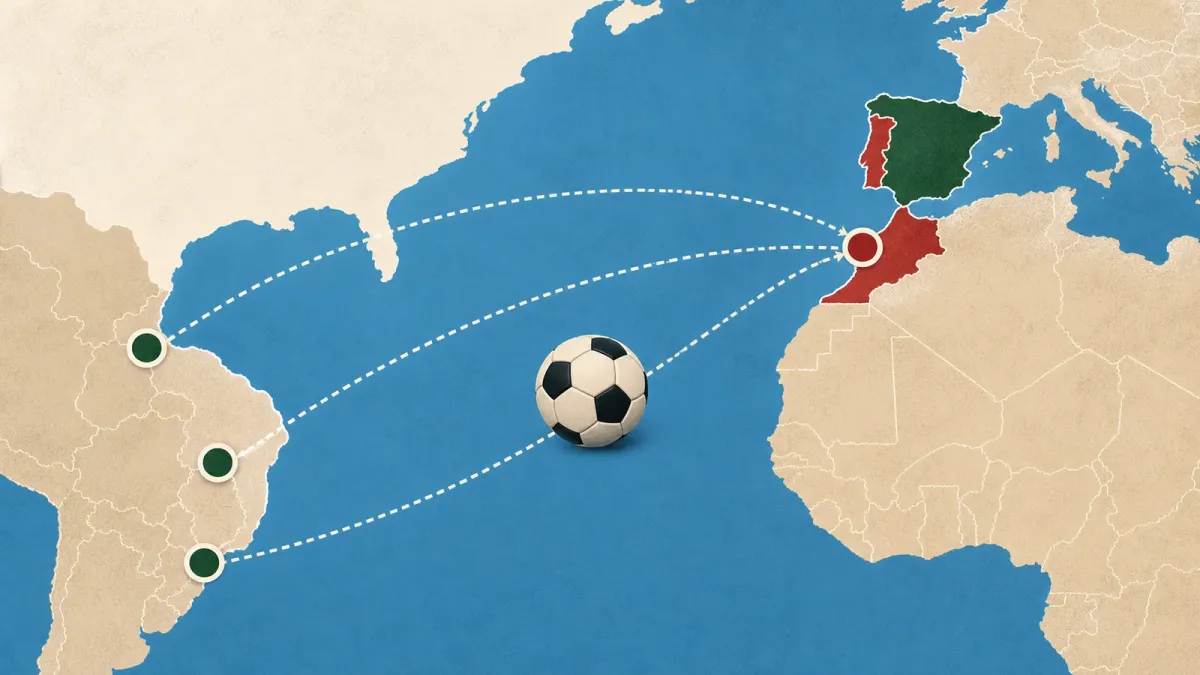
Searches for the next men's World Cup jumped after the July 19, 2026 final, and the answer is more unusual than a normal host handoff. FIFA has appointed Morocco, Portugal and Spain as the main hosts of the 2030 World Cup, with Argentina, Paraguay and Uruguay each staging one centenary celebration match.
That makes 2030 a tournament split across three continents: South America for the anniversary openers, then Africa and Europe for the main event. FIFA says the arrangement marks 100 years since the first World Cup, held in Uruguay in 1930.
The short answer
The main host countries are Morocco, Portugal and Spain. Argentina, Paraguay and Uruguay are not full co-hosts in the same sense, but each is scheduled to host one celebration match connected to the tournament's centenary.
Think of it as a two-part host map. The centenary matches explain the history; the Morocco-Portugal-Spain cluster explains where most fans, teams and media operations should expect the tournament to settle after the opening celebration.
Why South America is involved
The South American matches are symbolic as much as logistical. Uruguay hosted and won the first men's World Cup in 1930, Argentina was the other finalist, and Paraguay is home to CONMEBOL, South America's soccer confederation.
After those celebration matches, the tournament is expected to shift to Morocco, Portugal and Spain for the rest of the competition. That creates a rare planning wrinkle for teams, fans and broadcasters because a small group of early matches will sit far from the main tournament footprint.
It also means the simple question 'where is the next World Cup?' has two answers. The official host appointment is shared, but the practical fan answer depends on whether you are asking about the opening celebration, a group-stage trip, the knockout rounds or the final.
What fans should watch
The big unresolved items are the final venue, the complete city list, the match schedule, ticket windows and travel logistics. FIFA's host appointment is official, but the exact route a fan would take in 2030 will depend on the draw and the final match calendar.
For now, the useful planning takeaway is simple: do not treat 2030 as one-country travel. Fans following a team may need to think in regions, not just cities, and should wait for the official schedule before making expensive bookings.
That is especially true for supporters hoping to follow one national team. A team could open in South America only if the draw and schedule place it there; another could spend its entire tournament path in the main host region. Until FIFA releases the full match calendar, country-by-country travel assumptions are guesses.
It is also worth separating host status from tourism certainty. A country being named in the tournament plan does not mean every city, stadium or date is ready for booking.
The other caveat is format. The 2026 World Cup used the expanded 48-team, 104-match format, and 2030 is being discussed in that context, but any major change still needs a formal FIFA decision. Until then, the host map is clearer than the final bracket details.


