
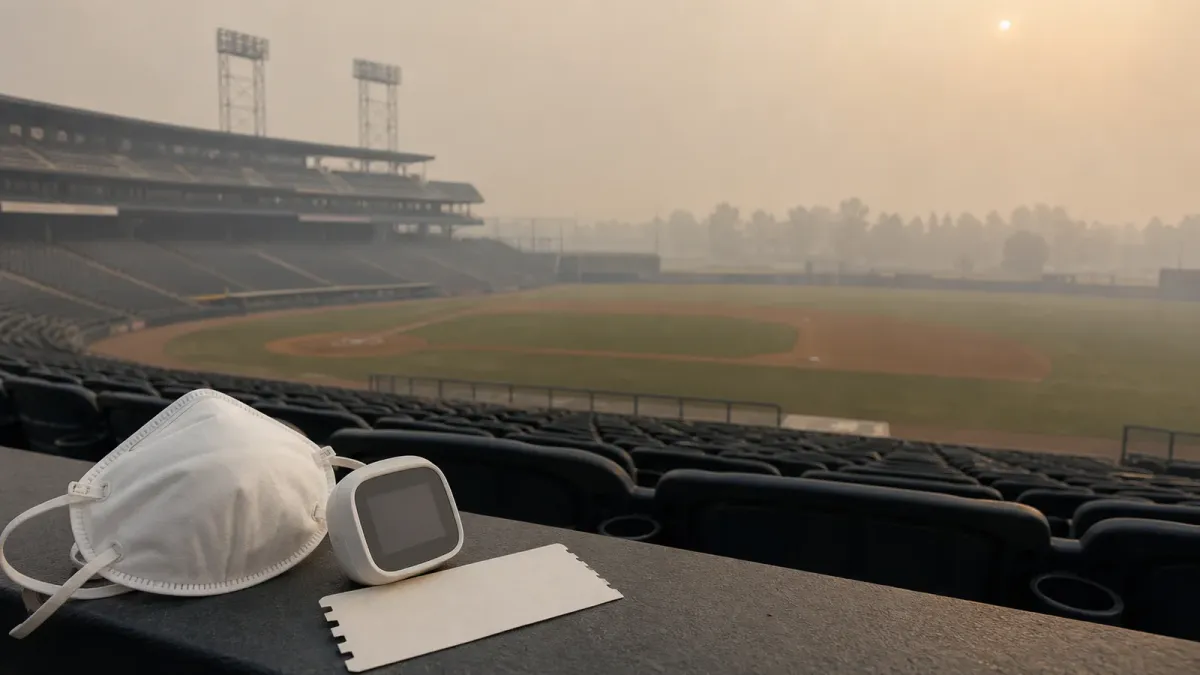
Wildfire smoke forced the Pittsburgh Pirates and Cleveland Guardians to postpone their Friday night game on July 17, turning a regional air-quality warning into a visible disruption for players and fans.
The Associated Press reported that the air quality index in Cleveland was 203 when the game was postponed at 4:45 p.m. EDT, a level considered very unhealthy. The teams are now scheduled to play a split doubleheader on Saturday, July 18, at 1:10 p.m. and 7:10 p.m. EDT.
The postponement came as smoke from Canadian wildfires and fires in northern Minnesota darkened skies from the Great Lakes into parts of the East Coast. The National Weather Service said a lingering high-pressure system was helping trap smoke near the ground, where fine particles can affect breathing even far from the flames.
What changed
The smoke is no longer just a hazy-sky story. It is changing outdoor plans, sports schedules and public-health advice across several states. NOAA's Weather Prediction Center highlighted air-quality alerts from the Upper Midwest through the Great Lakes into the Northeast, alongside dangerous heat and humidity in parts of the northern Plains and Upper Midwest.
In Michigan, an official statewide alert for July 17 and July 18 warned of elevated fine-particle pollution from wildfire smoke. The alert said Friday concentrations could range from very unhealthy in southern areas to hazardous in the north, with conditions on Saturday ranging from unhealthy for sensitive groups to very unhealthy in northern portions of the state.
Those categories matter because wildfire smoke is dominated by fine particle pollution, often listed as PM2.5. The particles are small enough to move deep into the lungs, so a neighborhood that looks merely hazy can still be a poor place for a long run, a youth tournament or several hours of outdoor work.
AirNow, the federal air-quality site, is also pointing readers to its Fire and Smoke Map as smoke affects multiple states. The practical reason to check locally is simple: AQI can shift by neighborhood and by hour as wind, storms and smoke layers move.
What to check before going outside
Start with your local AQI, not just the color of the sky. At unhealthy, very unhealthy or hazardous levels, move workouts, youth sports and heavy yard work indoors when possible. People with asthma, heart or lung disease, older adults, children, pregnant people and outdoor workers should be especially cautious.
If you need to be outside, keep the trip short and consider a well-fitting N95 or similar respirator. Indoors, close windows, run air conditioning on recirculate when available and avoid adding particles from candles, fireplaces, smoking or heavy vacuuming.
Heat complicates the decision. If closing windows makes an apartment dangerously hot, look for a library, cooling center, mall or other clean-air space instead of choosing between heavy smoke and unsafe indoor temperatures.
What happens next
Saturday's baseball schedule now depends on whether smoke and storms improve conditions enough for play. For everyone else, the same rule applies: check official AQI updates before making outdoor plans, because this smoke event is moving faster than a normal weekend forecast.


