
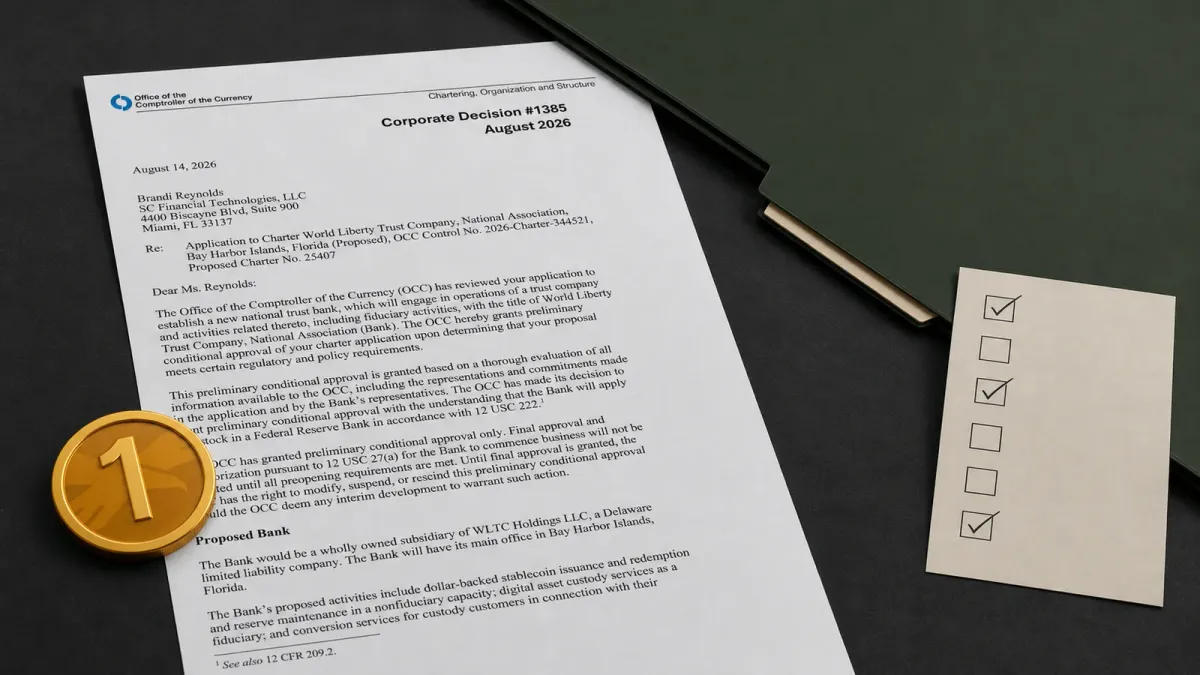
The Office of the Comptroller of the Currency granted preliminary conditional approval on August 14 to World Liberty Trust Company, a proposed national trust bank connected to World Liberty Financial. The decision creates a federal path for the company to bring issuance, redemption and custody of its USD1 stablecoin under one institution.
It does not let the bank open immediately. The OCC's Corporate Decision 1385 says final approval and authorization to begin business will come only after the organizers satisfy preopening requirements and pass an OCC examination. The regulator can modify, suspend or rescind the preliminary approval before then.
The distinction matters because a conditional charter is a regulatory milestone, not a functioning bank. Customers cannot treat the decision as proof that the proposed institution is already operating, and the USD1 stablecoin would not gain federal deposit insurance through this structure.
What the approval would change
If final approval is granted, World Liberty Trust Company plans to replace BitGo as the issuer and custodian of USD1. It would maintain the stablecoin's reserve assets, offer fiduciary digital-asset custody to institutional customers and provide limited conversions from approved stablecoins into USD1 for custody clients.
The bank would operate nationwide from Bay Harbor Islands, Florida, as an uninsured national trust bank. Its January application described institutional customers such as exchanges, market makers and investment firms rather than ordinary checking-account customers. World Liberty's launch announcement said the proposed bank would combine issuance, custody and conversion services that currently depend on separate providers.
The conditions are substantial
The OCC attached enforceable conditions that narrow the approval and set minimum safeguards. Among them:
- The bank must maintain at least $20 million in Tier 1 capital.
- The greater of half that capital or $10 million must remain in eligible liquid assets, and the bank must separately hold 180 days of operating expenses in liquid form.
- Material changes to products, services or risk limits require advance notice and written OCC non-objection during organization and the first three years of operation.
- Stablecoin activities must comply with the GENIUS Act and future implementing rules; the OCC can require the bank to change, stop or divest activities that do not comply.
Before a preopening examination, the organizers also must complete accounting, audit, security, Bank Secrecy Act, anti-money-laundering and sanctions-control work. The OCC must approve key directors and senior officers, including compliance, technology, information-security and trust leadership.
Political ties remain part of the scrutiny
World Liberty Financial says an entity affiliated with President Donald Trump and members of his family owns 38% of the company, according to CNBC's August 14 report. Critics, including Democratic lawmakers, argued that those ties created conflicts in the charter review.
The OCC said career staff handled the application under delegated authority and addressed seven comments from four commenters. Its decision says the proposed bank will not issue, custody or trade the separate WLFI token. The OCC also accepted passivity commitments restricting certain indirect investors from controlling management or bank policy.
What happens next
The organizers now must raise and position capital, finish control systems, hire approved leaders and request a preopening examination. Only after the OCC finds those requirements satisfied can it issue final charter approval and authorize the bank to commence business.
For readers and institutions following USD1, the clean takeaway is narrow: federal regulators have approved the plan in principle, with conditions, but the operating handoff from BitGo has not happened. The next meaningful development is final OCC authorization—not another announcement that repeats this preliminary approval.


